Showing posts with label History. Show all posts

Thursday, May 1, 2025

How the next Pope can heal divisions...

One of the challenges facing the next Pope, regardless as to who it is, will be in healing the cultural divide between the unfortunate wings of the Catholic Church. Cardinal Pietro Parolin, who is seen as a favorite to become the next Pope, has spoken of one of the more unfortunate divides in the Church over the Tridentine Mass. There is gossip about him that he intends to further restrict it, but I am actually not entirely certain about that. He seems to even take a more sympathetic stance toward the French regarding Traditionis Custodes. Although it's hard to tell what Parolin's exact views are in the midst of the gossip and banter, I think the divide among Catholics regarding Old Rites and New Rites is going to continue unless something is done.

Traditionis Custodes, on face value, doesn't ban the Tridentine Mass, though many Bishops maliciously took it that way. Here is where I'll say things that Traditionalists are not going to like, but they need to understand. I do not believe that Traditionis Custodes was ever intended to phase out the Tridentine Mass at all, but was meant to build bridges between those in the Church who refused to attend the Novus Ordo and preferred the Tridentine Mass with those who only looked at the Novus Ordo as the true expression of Vatican II. One thing neglected among Catholics and often difficult to grasp is the hermeneutics of continuity. The hermeneutics of continuity is the Church's official doctrine regarding the interpretation of Vatican II with the continuity of the Church as it existed before Vatican II. If one reads works such as Michael Davies's The Liturgical Revolution or Alcuin Reid's Organic Liturgy, one will find that the reform of the Western liturgy actually predates Vatican II. The only Missal we got from Vatican II was the 1962 Roman Missal, and Eastern Catholics were ordered to return to their traditions.

Far from being an anti-Traditionalist Council, Vatican II encapsulated the pastoral process of prior years leading up to its culmination. Today, you won't see many Catholics fasting from midnight before they receive Holy Communion in the morning, let alone six hours prior to receiving Holy Communion as is a recommended abbreviated Eucharistic fast in the East. You can thank the Ven. Pius XII for shortening the Eucharistic fast, not Vatican II! And that, I don't think, is understood when we talk about Vatican II's liturgical reforms. They predated Vatican II. Far from being a Council that changed the direction of the Western Church, Vatican II further propelled the Western Church on liturgical reform. But some reform is too much. That is where Traditionalists have a point.

The problem in the Church, is not that there are two expressions of the Western Rite. The problem is one group insisting that only one version of that expression was valid. The next Pope is going to have to address this issue with the same hermeneutics of continuity that his predecessors used. Far from phasing out the Tridentine Mass, it must be noted from Traditionis Custodes, that Francis actually wanted the Tridentine Mass continued. But he wanted the Tridentine Mass continued in the spirit of continuity with the Novus Ordo. This was also Pope John Paul II's and Pope Benedict XVI's vision as well. Such position is also maintained by Cardinal Sarah, whom Traditionalists are very enthused with. But many who attend the Tridentine Mass refuse to see the Novus Ordo as valid. Which is why Francis went to great lengths to ensure that those who continued celebrating the Tridentine Mass would also see the Novus Ordo as valid. In order to continue Francis's legacy, the next Pope will have to further help Traditionalists see the Novus Ordo as bearing continuity with the ancient Church.

But how is that to be done? With the general direction the Novus Ordo is going, things have to change in the Novus Ordo. Let's be realistic, Traditionalists are going to continue looking at the Novus Ordo with skepticism if bishops and priests continue to castigate those who receive on the tongue or in the mouth despite the Church's instruction. Traditionalists are never going to see the Novus Ordo as respectful to God if the charismatic dancing continues to be done and EHMCs remain as numerous as they do and the priests continue to appear as if they're just having a conversation with the congregation. Traditionalists would come to accept the Novus Ordo if it included more incense, was done ad orientem, and with much more Gregorian chant as Musicam sacram argues for and commends. Far from being anti-traditional, much of the abuses that we see in the Novus Ordo, the Church already does consider as being in opposition with the spirit of Vatican II that these people claim to follow. And the next Pope will have to further address these deficiencies. In that way, bringing Novus Ordo attendees to respect the ancient customs of the Church and Tridentine Mass attendees to respect the New Mass of St. Paul VI. I don't think any Traditionalists have issues with the Ordinariate, after all.

The next Pope, in bringing together Traditionalists, Novus Ordo attendees, and the Ordinariate, will be fulfilling not only the legacy of Pope Francis, but will also be fulfilling the hermeneutics of continuity of Vatican II, honoring the ancient Traditions of the Church, and building bridges in the Church Universal. Also, he would not be giving cause for anxiety to Eastern Rite Catholics who might be more inclined to wonder that if the Pope can abrogate a Western liturgy, can he then abrogate an Eastern liturgy? Far from being against the reforms of Vatican II, a Novus Ordo, reconstructed and enforced to include more Gregorian chant, incense, and ad orientem posturing of the priests, is both what is encouraged and what is the expectation of Vatican II. Far from being against the reforms of Vatican II, the 1962 Roman Missal was produced by that Council. Far from being against the reforms of Vatican II, the Ordinariate is just the fruitful outcome of a theologically corrected once-Protestant liturgy. Far from being against the reforms of Vatican II, a return to Tradition was called for. The next Pope's biggest task will be in implementing what those reforms actually looked like. Easing Traditionalists into accepting not the Novus Ordo as they have perceived it, but as the Church perceived it. In doing so, Traditionalists would come to accept the Novus Ordo, also allowing for easing of restrictions against the Tridentine Mass and a greater harmony of continuity to exist in the Church. I pray the next Pope can actually do what the Church needs, and not further continue divisions by ignoring the plights of the Traditionalists.

Saturday, June 1, 2024

What would it take? (response to Mr. Roger Olson)

Mr. Roger Olson, an Evangelical historical theologian who, over the past several years, has demonstrated the political intoxication of American Evangelicalism from the "never-Trump side", blogged recently about the reaction to Trump's conviction by a Manhattan jury. My main response to his question is perceived fairness. When Democrats tell you in 2016 that Hillary Clinton shouldn't be prosecuted because that's prosecuting political opponents, then open an investigation in 2017 on their political opponent over "collusion with Russia" which was proven never occurred, then in 2020 complain about Trump attempting to investigate Biden, then start cheerleading over the conviction of a President, any effort to lecture the general populace on democracy, fairness, rule of law, is moot. Now, one could insist that it was a "jury of his peers" to defend said "fairness", but that ignores the fact of how Manhattan voted in 2020 (85-15 pro-Biden). This is a district where you are almost guaranteed to get a jury of your peers that's 10-2 Democrat, with strong Democrat ideologues, where Democrat bullies can bludgeon the other two to render in the desired verdict. Does that seem "fair"?

Mr. Olson also complains that Trump is a bully though. In his efforts to condemn people who still support Trump to Hell after this. Right. Trump is a bully. I've been abused by both people on the right and people on the left for solely being autistic. Now, Mr. Olson can deny my personal experience (which is called gaslighting and a form of bullying), or Mr. Olson can take my personal experience into account for why I find the left more venomous. Because even though I've been abused for my autism by people on both sides of the court, none has abused me more than those who are Biden-voters. While Joe Biden himself may not be a bully, his failure to control and stabilize his voting base is telling. When a significant portion of Biden-voters found on social media tell you things like you're a moron because you're autistic or that you shouldn't vote or be allowed to drive because you're autistic, you definitely have a much different perspective. Trump might be a bully but who he bullies are people who deserve it. I would rather have a President who refers to Biden-voters who abuse people based on their disability as human scum than what we currently have.

Mr. Olson, despite being an Evangelical, apparently has no concern for the Left-wing agenda. No one may sway his opinion on this, but I'm fully aware that Christians, even Evangelicals, are opposed to the Left-wing agenda of tax-funded trans surgeries for minors, tax-funded abortions, tax-funded overseas wars, gay marriage, abortion up to the point of birth, etc. Since Mr. Olson is a Christian and against all of that, I do find it curious he thinks the Left-wing agenda is no threat. Now, he does contradict himself a lot though. For instance, he will unequivocally support Liz Cheney who supports overseas wars but supports Robert F. Kennedy because he does not support overseas wars. To be honest, I've never honestly believed Mr. Olson was anything other than a hypocrite and a false Christian. But that's irrelevant. That the Left-wing agenda is dangerous, is something that I continue to have a lot greater concern about than anything Trump has said or done.

What would it take? What would it take to get me to see that a Trump Presidency should be feared? Okay, here's a good list: Masses of liberals who aren't ghoulishly promoting abortion but at least view it as a tragedy. Masses of liberals who can hold an intellectual conversation with someone who doesn't agree with them on a political issue. Masses of liberals who don't foolishly drift tot the argument that being an orthodox Catholic makes someone a pedophile-supporter. Masses of liberals who have a respectful tolerance for the beliefs of Christians who aren't shouting "HOMOPHOBIA!". Basically, liberals behaving like the opposite of human scum would have me much more inclined to see eye-to-eye with Mr. Olson that a second Trump term would be a very evil thing. Instead, we have just the opposite of that. I'm an independent voter and still undecided. I don't know if I want to vote for Kennedy right now or not. Kennedy has said some good things in the past. Trump had a lot of objectively good policies. What I think America needs more than a President is an exorcism and a mass conversion to orthodox Catholicism.

But I think that Mr. Olson shows overall a significant problem with Evangelicalism today. A lot of Trump's most bitter critics and supporters are among Evangelical Christians and self-described Evangelicals. Evangelicalism, without anything sacred to look toward in the Church, has effectively satiated its lack of the sacred with the sacred within the State. It's a very sad state that Evangelicalism is in. Mr. Olson's posts frequently dunk on the Evangelical Trump-supporters, and safe to say, they aren't listening to him, but he still dunks on them anyway. Never-Trumper Evangelical critics will certainly act like they aren't political but when 9 out of 10 of your posts each week are all about the political state of America and Trump, you don't really give a good impression to an outsider that you are in favor of that. Maybe it's the idea of having a god who responds to Mr. Olson's every call that makes him lose focus on the sacred. That kind of god is being advanced by many Evangelicals nowadays. I don't see much of a future for Evangelicals. For Catholics, apostasies will come and mass conversions will come. With the death of Evangelicalism as it inclines itself more toward replacing the sacred with the political, I think that we might see an objectively good thing for this country in a mass conversion to Catholicism.

Wednesday, May 15, 2024

The Exorcism of Emily Rose: Review

I had been wanting to watch The Exorcism of Emily Rose for a while and last night, it went on sale via the Apple Store and so I didn't hesitate to get it. I was not disappointed. It is partially a supernatural horror and partially a legal drama with a heavy focus on the question of exorcism and the overlap between the possible realm of the spiritual and the naturalist. The movie ends up pitting the spiritual against the naturalist, the Truth against the lie, and the Church against the State. It is a State that is hostile to the Church that must be convinced of the spiritual reality of the Victory of Christ over the demonic, but the State refuses to see itself as subjected to the demonic. Right from the beginning, we see the spiritual battle unfolding.

The movie opens up right after the death of Emily Rose, the titular character, most of her story will be shown in flashback during the court questionings of the witnesses involved in the story. The priest, Fr. Moore, is at the house and a medical examiner comes in to give his conclusion of cause of death to the officer. The officer then charges Fr. Moore with negligent homicide. It now must be determined who shall prosecute. The prosecution calculates the prosecutor must be a Christian, preferably a Catholic, and that he must be seen as Church-going and friendly toward the Faith. While this is a calculative decision, it is remarkable as to how in the real world such Satanic thinking operates. We are often presented with a "devoutly Christian" politician presented to us by the media who happens to have firm agreements with the faithlessness of the World because it is only under such an appearance of light that Satan could ever deceive us. How many times have we heard the drivel that Nancy Pelosi or Tim Kaine or Joe Biden are "devout Catholics" while they openly oppose every single Church doctrine?

It so happens that the prosecuting attorney picked is a regular Church-going Methodist. A Protestant. The defense attorney is an agnostic with doubts about her own past. And it is in that remarkable mixture that we are presented with the conversion power of the Church over a heresy. Throughout the course of the trial, we see the defense attorney come under both spiritual attack and receive spiritual protection in her own time of need as she becomes more and more open to the idea that there are spiritual powers that we come into conflict with. The priest, Fr. Moore, is more focused on presenting the Truth of the story of Emily Rose and he does not fear being portrayed as a madman.

Throughout the trial, we see the materialistic side presented by the prosecution to prove the case of negligent homicide. When I consider my old Protestant views and how much of it favored the idea of syncretism of the materialistic viewpoint with Christian theology even when both were incompatible, I see the manifestations of the Enlightenment mindset which Protestantism has given birth to. The "man of faith" is ultimately seen as the faithless and the skeptic. It is he who is exposed as the unbeliever. Whereas the agnostic is shown to have much more faith than she even realizes throughout the movie. It is something that many people don't recognize among our current world how faithless those they present as faithful are. It is the Satanic nature of today's world to present as faithful those who oppose the very Faith that is claimed to represent in an effort to undermine the very essence of the Faith. And that is where the real spiritual battle in the movie lies.

The priest, we find, does not intend to defend his own self. He only intends to present what he believes is the Truth. That is the very Truth of the Victory of Christ. He wants to make it known to the jury, not that he is a martyr, but that Emily Rose is a saint. He does not fight the battle but he puts the battle into the hands of God and the saints and lets them fight the battle. The movie also contains quite a theodicy in it where Emily Rose relates in a note to the priest a brief encounter she experiences with the Virgin Mary prior to her death and how it is in that which she ultimately chose to accept her continued sufferings so that others may come to belief.

The movie is based on the real life exorcism of a German girl named Annelise Michel. Annelise Michel was a college student who went through the exact same struggles as Emily Rose. It was presumed by the Church and the clergy that she was possessed and needed exorcism. The overlap between the spiritual and the material was forgotten and she was ultimately left malnourished and died. The priests involved, and her parents, were convicted of negligent homicide by German authorities. But today, the grave site of Annelise Michel is a place of pilgrimage among many German Catholics who even ask for her intercession as a saint. Through the sufferings of Annelise Michel, many have been brought to Faith. I won't reveal the ending of the trial of Fr. Moore in the movie as that would be a spoiler, but I would strongly recommend it. There are scenes that can be frightening so I would not recommend children see it, the theological message is very important.

Friday, April 12, 2024

Why modern day modalist doctrine rejects God's oneness


Divine Simplicity is a doctrine often times brought up to challenge the orthodox doctrine of the Trinity which is believed by all Christians and denied by non-Christians. I go so far to say that because, simply put, without the Trinity, there is no salvation. Not that invincible ignorance might lead to damnation. I cannot make judgments on that as I am not God, but that unless God is Triune, the doctrine of salvation as taught by the Church is incoherent. Christ's Mission on Earth was to defeat Death and Hell and He did exactly that. To those denying that He is Divine in and of Himself, they would posit that a mere mortal could do such. And to those confounding the Persons of the Trinity, well...

A large problem is there is ample literature on Trinitarian doctrine and Trinitarian apologetics and the Church's classical doctrine and teaching are often times buried in the philosophical mumbo-jumbo that modern day anti-Trinitarians accuse Trinitarians of holding. The philosophical mumbo-jumbo about the Trinity in modern day Trinitarian apologetics is rarely seen or observed in classical orthodox dogmatics. That is because that mumbo-jumbo never even occurred to the Church. I see a lot of anti-Trinitarians using the word "Godhead" to refer to the Trinity as if "Godhead" is the same as God or even the famed "Trinity Delusion" website. They mostly respond to the anti-cult hunters and the Trinitarian apologists who are divorced from classical Christian doctrine.

The Trinity Delusion website is a class example. In the article I linked, it enforces modern understanding of the terminology upheld at Nicaea to arrive at the conclusion that the "nature" cannot be a "Who" but a "What". This is echoed strongly among Trinitarian apologists and lends itself to the greatest anti-Trinitarian strawman attack ever. I used to be an anti-Trinitarian and that was the dogma I attacked. But it was not the doctrine taught in historical Christian theology. In fact, in order to understand what Trinitarians mean by "ousia" and "persons" and "beings", a knowledge of the historical controversies has to be gathered. In Cardinal Joseph Ratzinger's Introduction to Christianity, he has an entire chapter dedicated to proving the point that the Trinitarian doctrine is built on a graveyard of heresies. It was Sabellians who first used terms such as "ousia" and "persons" and "beings" and this was why the Church was reluctant at first to adopt Nicene orthodoxy.

And that brings us to Sabellians of the modern day who are mostly found among a group called "Oneness Pentecostals". When contending with an upholder of this modern day Oneness philosophy, a variant of modalism which insists that Jesus is the Father, the Son, and the Holy Spirit, much appeal is made to the hypostatic union doctrine. Of course, it is not. Sabellians will say that their doctrine is consistent with Divine Simplicity because they misunderstand the proper Trinitarian theology regarding the Father, the Son, and the Holy Spirit. The Trinity is not a "group" deity nor is the Trinity a conglomeration of "parts" and the Father, the Son, and the Holy Spirit are not parts of God either. Rather the Father is wholly God, the Son is wholly God, and the Holy Spirit is wholly God. If God was divided into parts, this would violate Divine Simplicity. But God's Oneness is found in His infinitude. Infinity is the only thing which cannot be divided into parts. God is infinite in nature, indivisible in nature, hence, the three persons of the Trinity can never be acknowledged as divided or in parts.

But when confronted, what you will notice with "Oneness theologians" is that they frequently separate the Son from the Father. How else will they get two witnesses (John 8)? How else do they explain the baptism of Christ or the Transfiguration? Either the Son and the Father are two persons or the Son and the Father are two entities which are not united as one together. The Son would have to be a projection created by the Father. This exceeds the hypostatic union doctrine of Chalcedon. While the hypostatic union differentiated between a human nature and divine nature had by Christ, it never denied that Christ was wholly talking as God. There are many places in Scriptures where Christ conceals His deity, but He never denies it. Matthew 24:36 is often times brought up by anti-Trinitarians on both sides and the Church has never accepted the interpretation that it marks Christ as "ingorant". There are many senses of "knowing". In knowing the day and hour, Christ does, but it is not to the benefit of His Mission. He is fully aware of the events that shall lead up to that hour and so He does know the hour. What is not of His earthly Mission is to judge the world. St. Augustine writes: "That He says that the “Father knoweth,” implies that in the Father the Son also knows." (Serm. 97, 1)

Further, St. Hilary of Poitiers elaborates on the text by indicating that "in all cases, in which God declares Himself ignorant, He is not under the power of ignorance, but either it is not a fit time for speaking, or it is an economy of not acting." (On the Trinity, IX) Therefore, we see that it is in the humanity, of being contained in finitude and time, that the Son is not here eternally acting, and therefore confesses not knowing. For is in such that He is not at act that He states His ignorance in figurative language. For both the Arians and the Modalists, the omniscience of the Son is denied outright by this text. And the Modalists have such a perverse view that they will proceed to differentiate the man Jesus Christ from God. But if Jesus Christ is the Father in their theology, then Who was incarnated? And that is where the Modalist position collapses. In essence, in denying that the Son is the Father and yet insisting that Jesus is the Father and the Son, the modern day Modalist or Oneness position gives itself over to philosophical reasonings in a desperate attempt to preserve it's anti-Scriptural theology. And it splits God into two - a man and a god. Oneness doctrine therefore cannot uphold in any matter the doctrine of Divine Simplicity. For their "Oneness" of God is a Jesus that is split into the Son and the Father who are both Jesus but not each other, meaning Jesus has a conversation with Himself, declares Himself His own God, prays to Himself, declares Himself to be His own Son, etc.

Triune Oneness posits the infinitude of God which cannot be divided. The Trinity is not merely a "Godhead". The Trinity is God. And the Father is God. The Son is God. The Holy Spirit is God. The Father is the only true God. The Son is the only true God. The Holy Spirit is the only true God. The Trinity is the only true God. Those statements cannot all be true unless they are wholly, uniquely, God, in and of themselves, and are indivisible. The "Oneness" deity is divided against himself.

Tuesday, October 24, 2023

Why dispensationalism is not Scriptural

I've been noticing on social media lately, a lot of Christians, particularly Protestant Christians, trying to defend the claims of the State of Israel unconditionally on the grounds of the theology of dispensationalism. Dispensationalism is a philosophy rooted in the more extremes of Protestantism. It is an attempt to take literally all the texts of Scripture that refer to Israel and apply them literally to the "people of Israel". It has gained more ground since the founding of the modern State of Israel. And herein lies the fundamental distinction and the most significant flaw of dispensationalism. Even from a literalist reading of Scriptures, it does not compute. This is why Catholic and Orthodox theologians have never held to such a theological position and why the Reformed Christians in Anglicanism and Lutheranism have also refused to accept the position.

Dispensationalists caricature the historic orthodox position of the Church as "replacement" or "supercessionist" theology, but as one looks through Scriptures, it's actually neither. In fact, it's a theology of the fulfilment of the covenant. The Scriptures are divided into two parts: the Old Testament and the New Testament. But the word "Testament" is generally criticized as a bad translation. The more accurate translation, and what is more revealing, is "Covenant". In Genesis, God made a covenant with Abraham (Gen. 15-17). At the Last Supper, Jesus declared that what His Apostles were drinking was "the Blood of the New Covenant" (Matt. 26:28). Everything in Scripture about God's relationship with humanity centers around the idea of covenants. God makes multiple covenants in Genesis with Noah and with Abraham, and then He becomes a man and makes a New Covenant with the shedding of His own Blood. The Covenant establishes His bond with His people.

When He makes a covenant with Abraham, He promises that Abram will be a father of many descendants and describes the boundaries of their lands, that his descendants will number the stars of the Heavens, and that they will be held in captivity for four hundred years (Gen. 15:4-21). Then, God changes the name of Abram to Abraham and declares that Abraham will be the father of many nations (Gen. 17:7). Abraham is not to be the father of one nation only, but of multiple nations. We can see that there are many peoples throughout the world who confess the name of Christ. God foreshadows an everlasting covenant to be made with the descendants of Abraham. This is not just referring to one nation of Israel or one specific group of people. God's intentions, from the beginning, with Abraham, was to use the descendants of Abraham according to the flesh, to be a light for the whole world.

There are multiple instances where "Israel" is referred to in Scriptures. It is referred to in Scriptures as Jacob the Righteous, the son of Isaac. It is referred to in Scriptures as the Kingdom of Israel. It is referred to in Scriptures as the people of Israel, the people of the Kingdom of Israel. Even dispensationalists have to acknowledge that the modern State of Israel is not a Kingdom but a democratic parliamentary republic. But there are already is a King of Israel according to Scriptures! In the Davidic line of descent, the Messiah is born to the Virgin Mary and becomes King of Israel! Moreover, it is revealed in the fulfilment, that this King was to come, not just to the Hebrews but to all nations. Such was the mission work of Christ. He clarifies that He has come for the Hebrews first, but with full intention to incorporate the Gentiles. This became an early question for the Church (Acts 15:3-21). In this controversy over the question of the circumcision of the Gentiles, the Holy Prophet Amos is referenced, "I will raise up the tabernacle of David, which has fallen down ... [a]nd all the Gentiles who are called by name" (Am. 9:11-12).

So even in the Old Covenant, it is explained that Gentiles were to be included in the promises of Israel! As St. Paul declares, "Now to Abraham and his Seed [Christ] were the promises made" (Gal. 3:16). Those who are included in the promise are of Israel, the Seed of Israel, because Christ is the firstfruits of Resurrection (1 Cor. 15:20). Christ has established Himself as firstborn of a brotherhood and this includes those who find Faith in Christ. Christ establishes Himself as King over all nations in the glory of His Resurrection and the splendor of His Godhood. The Kingdom of Israel, therefore, must be the Church. But St. Paul also recognizes that there is a remnant of Israel according to the flesh.

In Romans 9-11, where many dispensationalists come away with the understanding that their opponents' theology is somehow a "replacement" theology, they miss on key concepts that St. Paul speaks of the remnant of Israel (Rom. 9:27-28). The point is to show that Abraham has descendants according to the flesh, but that the flesh will account for nothing in the judgment from God. Much the same, even Jesus makes note of this in His dispute with the Pharisees where He declares that they are not the children of Abraham but of the Devil (Jn. 8:44). St. Paul is much aware of the statements made by Christ and is making an argument showing that the Gentiles are indeed apart of the Covenant, but how the Covenant is not superceded at all. Ironic that fulfilment theology is often termed "supercessionist" because it is anything but!

When I went to a non-denominational church when I was younger, the pastor once informed us that Paul was a "Jew" and emphasized in his lecture the Jewishness of Paul. I was both disturbed and perplexed. This is because the distinguishing of Judaism and Christianity as a religion nor the ethnic distinction was actually applied. But if we look at Scriptures, we do come across the statements made by St. John that there are Jews who say they are Jews but are of the Synagogue of Satan (Rev. 2:9, 3:9). It is not the replacement of Israel that we are looking at in Scriptures, but the fulfilment of Israel. The writers of the Catholic epistles want us to come away with the understanding that we are indeed correctly called Israel, have the promises of Israel, and are included in that. They cite the Old Testament's references that include the Gentiles in that Covenant and show the intent to incorporate the Gentiles into that Covenant. The Gentiles are restored with the tabernacle of David. That is the Church. Anything that contradicts is actually supercessionist and replacement. Was St. Paul a "Jew"? He was a Jew who was a Jew in reality. But that is because the true Jewish religion is not that of Rabbinic Judaism, but that of the Messianic following of Christ in the Sacrament of the Blessed Eucharist. Both "Christian" and "Jew" is appropriate for Christians are Jews of the New Covenant. Those tied to the Old Covenant stand in rejection of Christ. They deny that Christ came in the flesh and are Antichrist (1 Jn. 2:22, 4:3; 2 Jn. 1:7). Thus, St. John distinguishes between Jews who are of the Synagogue of Satan and practitioners of the true Faith (called Christians).

The word "Christian" was first applied to those who followed Christ as the Messiah by the opponents of Christianity and not by Christians themselves. The first Christians more than likely would have viewed themselves as a sect of Judaism at the time. When we sort through the anachronisms, and understand the texts according to the way the early Christians saw it, we see that they viewed Jewishness far differently than it is understood nowadays, Israel is a Kingdom of which the Church (Ekklesia - gathering) is the standing army, and the Eucharist is the sacrifice. Because many Protestants have rejected that the Eucharist is sacrifice and that Jesus's pouring Himself out on the Cross once and for all is infinitely offered on the Holy Altars, they miss out on this. That's how dispensationalism is arrived at. Because Lutherans and Anglicans haven't dismissed that theology of the Eucharist, they have retained the same views as historic Christianity. Dispensationalism is, effectively, replacement theology because it throws the Gentiles out of the Covenant and replaces the Kingdom of Israel with the modern State of Israel. Dispensationalism, therefore, is heretical.

Wednesday, September 27, 2023

My view on Fratelli Tutti revisited...

A couple of years ago, I wrote a post about the Pope's encyclical Fratelli Tutti. I think it's healthy to reflect on how one's mind develops over the years toward the search for Truth and whether or not I still actually affirm that there are heresies in it. Overall, the Catholic dogma can be vast and is established and is firmly rooted in its historical tradition. This is what separates Catholicism from Protestantism. Whereas Protestantism undergoes self-criticism through Biblical reflection, Catholic doctrine is guided by historic tradition which roots out novelties of Scriptural interpretation, ever discerning how the Holy Spirit is being listened to. Re-reading my comments on Fratelli Tutti as of today, I can state with confidence that the document is a largely problematic document, but each Papal Encyclical is written to a specific audience, for a specific purpose, at a specific point in time. So I think I should re-look at Fratelli Tutti and reassess the analysis I made on it. Consider the Epistles of the New Testament. Whether written by St. Paul, or St. Peter, or St. John the Evangelist, each one of these are episcopal encyclicals, and the two by St. Peter are Papal Encyclicals! They are dealing with different circumstances in the Church and different contexts. With that said, a proper reassessment of some of Fratelli Tutti's statements can be further explained.

Private Property
On private property, the statement of Fratelli Tutti when compared to other areas of Catholic dogma don't really appear well. I compared Fratelli Tutti's assessment of private property to Rerum Novarum's assessment of private property. This was wrong of me to do so. When read side-by-side, Rerum Novarum seems to contradict Fratelli Tutti. However, Fratelli Tutti never undermines the doctrine of private property and its management in Rerum Novarum. In today's world, where capitalism is often idolized, we tend to also become very much attached to our own private property. While capitalism was a dominant philosophy when Rerum Novarum was written, there was a budding philosophy that many were beginning to take seriously - communism. Communism undermined the value of the human individual and attacked the private property rights' of the given stewards. The fact of the matter is that all property we are given is actually a direct gift of God Who has made us stewards of that private property. This should be understood first when we discuss the question of private property. When reading Fratelli Tutti in full, we should take into account that the importance of Pope Francis's comments on private property is not to undermine the value of private property, but to remind us of the important usage of private property in direction to the common good of men. That's not heretical at all.

Just War
I still maintain that his position on war has always seemed contradictory. But I think there is an important point to consider is that when the Pope is speaking as an advisor on stately matters, he is not infallible. On this matter, when he is advising nations not to seek war, he is certainly speaking on the position of a stately advisor. Even though this is an encyclical, there are aspects that he seems to address toward the world and to his actual sheep. And I think this is a problem with Pope Francis overall. He strikes me as a much more worldly Pope who gets too much caught up in media attention rather than the focus of his flock. In his writings on Just War, this is a prime example. That said, his position that takes on a much more pacifistic approach is a more healthy way for the lay Christian to engage. Reading some of St. Basil's ethics, one finds that there is considerable question as to whether a soldier would be guilty of murder should he kill another Christian in combat. And I think this also requires historical combat. What extent should Christians be involved in wars between countries when we know that we might be killing our own brethren? On a practical matter, as Fratelli Tutti indicates, no war is a far superior position.

Death Penalty
This one is far more shakier. The past few Popes, from John Paul II to Benedict XVI to Francis, have all been hotly against the death penalty. And though past posts in the past have had me unequivocally defend capital punishment, I think St. Mark the Ascetic's position should be taken. When lay Christians bring others to be punished before the state tribunals, those Christians sin. When Christian rulers carry out punishments against criminals, there is no sin committed. According to Romans 13, the state has been given full right by God to wield the sword of judgment. There is a distinction then that should be made. Unfortunately, it's not a distinction that is made by today's moralists. We don't see any effort to make a distinction, but instead, we presume that the call for Christians to seek the end of the death penalty is an inherently unequivocal call for even Christian rulers to cede their God-given authority. That's where things become more ambiguous and more confusing. Because the historical doctrine is that the death penalty can be used by the legitimate authorities without sin, but the current mode of thought is that all Christians are to be against it. And yet, Fratelli Tutti isn't directed at state officials, but to lay Christians. The intended audience of Fratelli Tutti needs to be taken into account. This is not a political advisory statement to officials, even if it was, such political advisory would not be considered infallible. I think the difficulty is that the position is based on philosophical prowess rather than theological prowess.

Equality
While the question of equality really ought to be defined based on what is meant by equality, I think we should look to earlier theological positions of Pope Francis to determine what is meant before making a conclusion. In Evangelii Gaudium, Pope Francis upholds the traditional hierarchical nature of the Church. What he means by equality then cannot, in any way, be a contradiction to what he has maintained in the past. So we should take a view on equality that is far less absolute. Are we all equal as brothers in Christ through our baptism? Yes. Again, the audience of Fratelli Tutti is not those who are outside of the Church. Therefore, we can conclude that equality is not a heresy.

In full retrospect, I think I may have been too hasty with my statements on Fratelli Tutti in the past and I apologize for those positions. Although I will leave that post up to show what my mindset was back in 2020, I'll leave a link at the bottom to this post so that people can have an idea of how my view on the document has changed. Please don't judge me for any errors in the past. I was deeply affected by Traditionalist circles at the time Fratelli Tutti was written and I think that affected my overall reading of it too.

Wednesday, September 13, 2023

The identification of the True Cross

When the Empress Helen discovered the sacred relic of the True Cross, it was not known as to which one the one in which Christ was crucified on was. Helen led the excavation team which found the three crosses. One was the True Cross and the other two were the ones that the thieves alongside Christ had been crucified on. During the crucifixion, at the earthquake, the footbeam on the True Cross had been twisted to reveal the judgment of the two thieves. One to Heaven and the other to Hell. The True Cross had been made with three types of wood, fashioned like that together in order to reveal the Holy Trinity. Having established with Faith that the Cross was the one with the plaque indicating that Jesus was the King of the Jews, St. Helen wanted to confirm this before all.


As a funeral procession was meandering by, the Empress proclaimed the finding of the Cross to the Holy Bishop. The Bishop wanted to test this great finding. For years, the Pagans had attempted to cover up the Cross with shrines and temples dedicated to their gods hoping that when Christians would pay homage to Christ, they would actually be rendering homage to the deities of the ancient Romans. But such was a laughing case. When homage is paid to God, it is done to Him, even in the presence of the wicked. The Bishop now saw that the temples of these demons had been desecrated. Could this really be the True Cross? Indeed, he called for the funeral to be paused and the crosses to be brought forward.

One by one, the crosses touched the dead man. The first cross touched him and nothing happened. The second cross touched him and nothing happened. The True Cross, the one proclaimed to be the True Cross by the Empress, touched him and the dead man came alive. The True Cross, which grants resurrection and life to all for Life itself was hanged upon the wood of that Cross, brought the dead man back to life as it does for all of us who are dead to sin. This was a joyous moment and the Jew who had helped Helen find the Cross declared that he was now in allegiance with Christ and accepted baptism. He would eventually become a bishop of the Church too during the reign of the Apostate Emperor Julian.

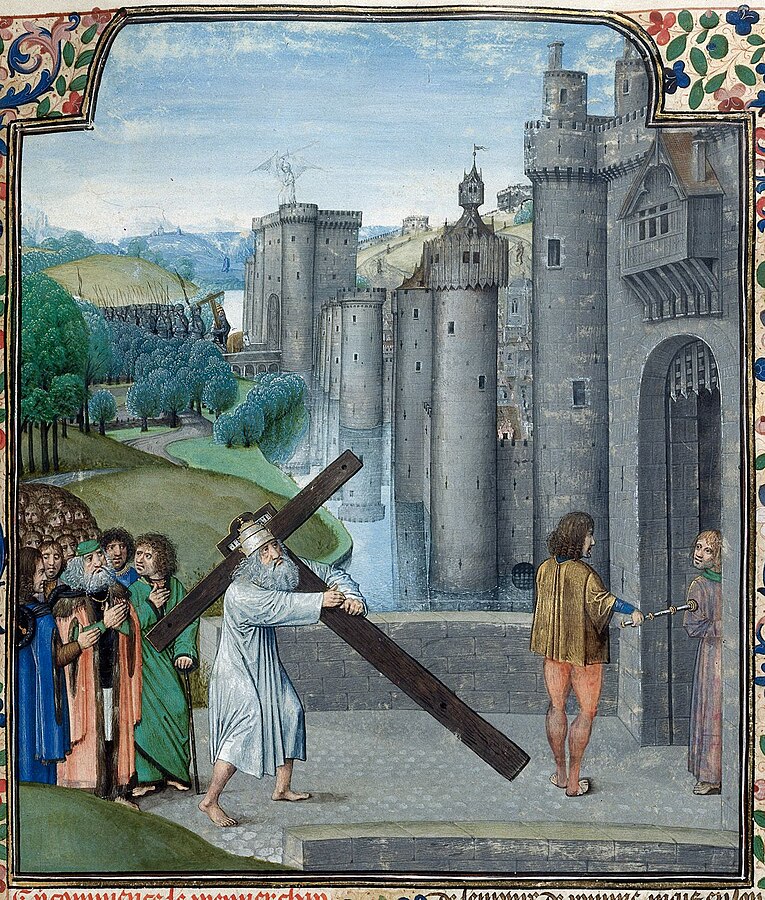
The Cross remained in the possession of the Christians for many years until it was seized by the Persians hoping to demoralize the Christians. This did nothing to demoralize the armies of the Romans. For the Emperor Herakleios would lead his men to reclaim the property that was rightly of the Christian Faith. Marching into Persia, the Emperor reclaimed the Cross for the glory of the Lord and took it back to the Empire. But it was not to remain there, for it was better that the Cross be returned to Jerusalem where Our Lord was crucified. The Emperor would carry it.

But in Jerusalem, on that path of blessed suffering which the Lord marched on, the Emperor felt a heavy weight upon him. He was strong enough himself to carry the Cross. There was no issue with his physique. But an angel had pinned him down, preventing him from carrying the Cross. The Bishop would discern what was happening and told the Emperor that unless he humbled himself as Christ had humbled himself, he would not be able to enter into the Holy City where the Lord was crucified. Tossing away his imperial garb, the Emperor put on rags like a beggar and carried triumphantly the Cross of Christ, back to its original place where it would stand.

So let us humble ourselves and attach ourselves to that Cross which grants us life. Let us walk with humility, a living sacrifice to God. And let us glorify the Holy Trinity forever!

Saturday, September 9, 2023

I haven't been here in a while

I have not been posting here in a while. I took a break from blogging here, because, truthfully, I wanted to try things out as a different person. That did not go well at all. I wanted to hide myself away from past mistakes. But that does not work at all. I cannot hide from that past or from that filth. I can only pray that people love me and will forgive me for whatever sins and failures I have committed. You may have heard of someone called "Autistic Catholic". That was me. That was my moniker. That is who I am now. I am no longer "newenglandsun". But "Autistic Catholic" has the same exact character flaws as "newenglandsun" did. Only that "Autistic Catholic" was able to get the things that "newenglandsun" didn't get. And getting those things that "newenglandsun" didn't get turned "Autistic Catholic" into a monster.

I have found more emotional abuse in the past year and a half getting the things that "newenglandsun" didn't get than emotionally worthwhile friends. That might be only partially true. I found some very decent friends as Autistic Catholic and made friends that I might not have had if I wasn't. And I think I have found very good and decent friends as Autistic Catholic that I could have also found as newenglandsun if I had genuinely wanted to. And the people who didn't want to be friends with newenglandsun to begin with were probably the ones who eventually turned on Autistic Catholic anyway. It was an interesting experiment for about one and a half years actually allowing myself to admit that I was autistic.

I found that Catholics on social media really like the idea of an autistic person speaking on behalf of the Faith. What they don't like is when that person begins to show more and more character traits associated with autism. I learned a lot of Catholics on social media claim to be empathetic toward autistic people, but turn their backs when character traits associated with autism become more obvious. There is a mixture of welcome and a mixture of hostility toward the autistic community. Spiritual warfare is not seen as a cause by some of these people as a source of problems for autistic people online, but only the exclusively autistic problems. If an autistic person is attacked for being autistic, many of these Catholics will attempt to instruct an autistic person defending that person's dignity as being "Woke" or "playing victim".

I think a lot of this has to do with the failure of Catholic culture on social media in general. I've encountered hostility on Facebook, Instagram, X, etc. Catholic culture on social media should not be seen as representative of the Church. There is a statement made by St. John Henry Cardinal Newman about how the Barque of St. Peter is a truly magnificent ship if you refrain from entering into the boiler room. Too many online Catholics want to step into the boiler room. One of the most recurrent problems in Catholic culture today is a mass of bishops who want to lead their sheep directly into the boiler room. Whether they are disobedient liberals who reject Church Teaching or are the "Rad-Trad" pastors who are relentlessly lamenting about how the Church is persecuting them.

I've been called a hypocrite by Catholics on social media many a times. I've been called a hypocrite once by a woman who claimed she would promote each of my blog posts (she never did because she was a liar). I might very well be a hypocrite. I have to get the plank out of my own eye before getting the speck of sawdust out of my neighbor's eye. The thing is that many sins I've committed have been done directly in my interactions on social media and my brethren there have never given me a chance to display my fruits. I have complained about the double-standards. If I were to block someone on X, I'd be accused by Catholics of "holding a grudge". A person who blocks me is "defining boundaries". Of course, I've felt constantly held to the position of being the one who figures out what those boundaries actually are, rather than them clearly being defined. That was my latest negative interaction on X.

It's always the same scenario. I was once told I was being bullied by a woman by another woman who said that she would block the woman who was bullying me. That woman never did that. She went on continuing being mutuals with the other woman until I finally challenged her trustworthiness and brought up that statement. I was blocked. The woman currently has a backup account and where she mutually follows the woman she said she would block and who was "not a good person". She claims what she did to me was "merciful". It was anything but. It's an expected demand that I be a mind-reader in social interactions. That woman knew and understood autism but apparently did not understand that if definable boundaries are not set, I'm not going to have a clue if I'm expected to be a mind-reader.

There were too many interactions like that. I quit. My mental health improved. Honestly, I don't think I will ever go back. One of my dear friends on X though is @fifth_wife (Katherine Howard). She has been a faithful friend almost since the beginning of my tenure on X, even when she thought I was a girl. I have never seen anything from her that has not been unwholesome. I have told her that if she ever converts to Catholicism, I want her to be my goddaughter. I'm referring to people who are exclusively on X though. Not people who I still communicate with via another media form.

I've been looking at my stats here and I might try and blog here more often seeing as people are apparently still viewing this website, even in my absence. I don't recall ever getting that much traffic while...not blogging!

Thursday, February 10, 2022

The Holy Empress Theodora

The Holy Empress Theodora's life parallels that of the Empress Irene's in the Church's struggle for orthodoxy over the heresy of iconoclasm. Like Irene of Athens, Theodora was brought before the Emperor as part of a bride show. The Emperor Theophilos, like the Emperor Leo IV, was an iconoclast and Theodora was an iconophile. She had been raised an iconophile by her mother Theoktiste and her mother taught her daughters, in secret, the proper veneration of icons. The Emperor Theophilos, who would severely punish, banish, and even branded two monks with iconoclastic texts on their foreheads. Both the Emperor's stepmother who had arranged the bride show, and the Empress's mother, were iconophiles and they recognized the risks, but the orthodoxy had to prevail somehow. The Emperor's stepmother, Euphrosyne, was herself, a descendant of the Holy Empress Irene, a daughter of the Emperor Constantine VI, who was killed for his treacheries against his mother and his heresies of iconoclasm.

The Empress Theodora bore five daughters and two sons to the Emperor Theophilos. One son died in infancy and one daughter died at a young age as well. She would see five children live into adulthood. Michael III would succeed his father on the throne. The marriage was carried out some time around the year 830. Theophilos would discover his wife and their daughters venerating the icons at some point and she fiercely denied that they were icons but insisted instead that they were "dolls". The Emperor is furious about this iconodulist incident occurring in his courts and he orders that the practice cease. Theodora continued the practice of continuing to see her mother and her mother-in-law in private with her children, continuing to raise her children in the orthodoxy of the Second Council of Nicaea. Theophilos would be infected with dysyntery around the age of 29. Much like the Emperor Leo IV was covered in tumors and perished from disease, so God brings disease to call men to repentance. Unlike Leo IV, Theophilos would repent of his sins. Theodora recorded his repentance and presented it to the church seeking a pardon for his iconoclasm. Indeed, as the Patriarch Methodios recorded the names of the iconoclasts and presented them on the altar of Hagia Sophia, the Emperor Theophilos's name would disappear from the list. In Theophilos's case, his dysyntery would bring his mortal body to an end but it called his soul to repentance that it may soon be filled with eternal life.

Theodora ordered a council held which re-established the faith of the Second Council of Nicaea. This council was held on the First Sunday of the Great Lent that year. Because of this, Greek Catholics and Eastern Orthodox Christians always celebrate the Feast of the Holy Sunday of Orthodoxy to mark the beginning of Lent. This is not the only imperially established Feast Day on the Church's calendar either. As part of this celebration, the Empress Theodora removed the remains of the iconoclast Emperor Constantine V, the father-in-law of Empress Irene, and had the remains burned. In turn, the remains of the Empress Irene were brought back from Prinkipio and restored to the imperial burial place (Women in Purple, 213). This act further showed the triumph of the iconophiles as the Empress Irene was the one who convened the Second Council of Nicaea, keeping her iconodulist faith hidden from her husband during his briefly lived reign, much as Theodora had to keep her iconodulist faith hidden from her husband as she taught her children to venerate icons.

The Empress was also strong in her leadership.
"She also stood up to the caliphs, according to one historian Bar Hebraeus, who reports that the Arabs thought they could take advantage of a widowed Empress and her young son. 'Seeing that it was a woman who ruled the country, the Arabs regarded Roman homage with contempt and broke the peace. Then Theodora the Queen sent an army against Cicilia in AD 861 and enslaved all the country of the Anazarbos.' There follows the account of an Arab ambassador, a eunuch named Nashif, when the queen offered to make peace but demanded 20,000 Christian prisoners of war in exchange for the 20,000 captured Arabs. When Nashif tried to take them anyway, 'Theodora killed them.'" (235-236)
She also did not hesitate to prosecute the Paulician heresy that was running rampant in the Eastern Empire, persecuting approximately 10,000 of the adherents of this heresy.

Sadly, she did not spend too much time in dedication to her son's education and he was known as "Michael the Drunkard" during his reign. Much like Irene, whose son Constantine VI was a poorly educated and stupid soul, so too was Michael III. Unlike Constantine VI, Michael III would not embrace the iconoclast heresy. But due to his poor ruling, he would ultimately be assassinated by Basil I. Theodora would witness the beginning of the reign of her son's assassination. Having lost the regal authority of being the Dowager Empress, she would not be buried with her husband. Instead, she makes indication to her daughters to be buried beside her mother in Gastria, where her mother lived as a monastic (234). The life of this saint is one of elevation from nothingness to preservation of the faith, to the loftiest of worldly elevations, and then a return back to her own lowly position. But worldly elevations are meaningless for a saint. The glory of an imperial burial might not have been for her but she had in the stead a saintly and holy burial, reaching the end of her life February 11, 867. Though some sources are conflicted and state that her death was in 856 (Thornton, Pious Kings and Right-Believing Queens). This is perhaps why Otto of Freising is also confused as to when to date the assassination of Michael III. It is presumable that the latter date seems most accurate. St. Theodora, Empress Regent and Dowager Empress of the Roman Empire who restored the veneration of icons to Christendom, pray for us!

See also:
Dictionary of Saintly Women, Agnes B.C. Dunbar
Women in Purple: Rulers of Medieval Byzantium, Judith Herrin

Saturday, December 18, 2021

Christ in the Book of the Holy Prophet Daniel

The Christian looks at the Old Testament with the constant anticipation of Christ that was experienced by the Jewish world as they awaited their Messiah. As we approach the Nativity on our Festal Calendar season, we also take a moment to remember the Holy Prophet Daniel and more specifically the Three Children. On December 11, we commemorated St. Daniel the Stylite who not only was named after the Holy Prophet Daniel, he was also buried on top of the remains of the Three Children, Radshach, Meshach, and Abednego. The Book of the Prophet Daniel is filled with foreshadowings of the Messiah's impending coming. Not just His second coming which is often times considered when looking at the apocalyptic narratives, but also the first coming too. Scripture is a multi-layered cake and different parts of Scriptures often times have multiple meanings. We can see the multitude of meanings in the apocalyptic literature of the Holy Prophet Daniel especially.

We start in Daniel 2. Many people see this as a foreshadowing of the world empires before the second coming of Christ. While this is certainly one way of reading it and also one of the more traditional ways of reading it, we must remember the multitude of meaning that Scriptures have and remember there might be another meaning. In Daniel 2, there is a statue with a gold head, silver chest, bronze waist, iron legs, and iron and clay feet. A stone is thrown at the statue's feet shattering it to pieces. Nebuchadnezzar is troubled by the statue's image in his dream and seeks out to find someone who can interpret the dream. None of the astrologers of the Emperor can give an adequate interpretation until the Holy Prophet Daniel, with discernment given to him by the Only Wise God, is able to decipher the dream's meaning. The statue shows the successive Empires that shall dominate the world, one after the other. Tradition understands them as Babylon, Medo-Persia, Greece, and Rome. The rock that is thrown at the statue will bring an abrupt end to the current era, dismantling the present kingdoms, establishing an everlasting kingdom. Most see Rome as the end of history and so look for some kind of antichrist from this passage. While the apocalyptic narrative definitely foretells the antichrist, this is a narrative of the Messiah. It was in a period in which Rome was being divided up into a Triumvirate, the Republic was dissolving after the Julius Caesar's dictatorship and his son Octavius Augustus was reigning upon the newly erected throne of the Roman Empire when an infant was born. Octavius was proclaiming himself to be the son of a god but the one that was born was the Son of God. Octavius proclaimed the Pax Romana but the Son of God proclaimed the Pax Christi. Indeed, a new kingdom, the Church, was established from the rubble of the Roman civil wars which savaged the world. The clay and iron couldn't withhold and Christ came down and established His own kingdom. It was a kingdom not of this world. It was a rock thrown from Heaven.

In the very next chapter of the Holy Prophet Daniel, we see the Three Children refuse to bow down before the false idol of the Emperor's. As a punishment, the Three Children are thrown into a fiery furnace with flames so hot that the men who threw them into the fire all died the moment the flames came near to them. Assuredly, Nebuchadnezzar had presumed the Three Children would be incinerated but he was in for a surprise. When Nebuchadnezzar looked into the furnace, he saw a fourth man in the furnace. The Hebrew text does not possess a definitive article so it is very possible he presumed it to be one of his own gods, but he recognized in the fourth figure and proclaimed that it was "one like a son of god!" Christians understand that this divine being who appeared in the furnace was Christ Himself. The Angel of God in the Old Testament is commonly held to be a Christophany or an appearance of Christ. And this is identified later in the text as an Angel of the God of the Three Children. While Nebuchadnezzar may not have understood who the being was, later generations have given new meaning to his words which shows that the Three Children very clearly understood that this being was not only a son of god but the Son of God who had come to save them from the fires of the furnace.

Once more, we see in Daniel 7 another prophecy of the things to come and the end of the world. There are four successive beasts. The beasts are identified in tradition as Babylon, Medo-Persia, Greece, and Rome. From the Roman beast, there stem ten kings and from there, a little horn comes out with great blasphemies, speaking these until fire is reigned down upon the beast from Heaven and the eternal kingdom of the saints is established. One like the Son of Man is then seen ascending upward to the Ancient of Days. While this is typically interpreted in the Cosmic Battle between Christ and Antichrist, there is an additional foreshadowing of this battle which is found in the incarnation of Christ. Christ comes into a divided Roman world that is wrested in its factionalism. From the chaos of the civil wars comes the Roman monarchy and the claims that the Emperor is the son of a god. But Christ comes in a very unique and unexpected way. He ushers in the true Peace while Rome claims a time of peace for itself. He is the Son of God but Rome can only claim such. While this is indeed is a very prophetic text about the coming antichrist, it is also a text which prophecies the initial conquering of Christ on the Cross and His establishment of His earthly Kingdom, not of this world.

Daniel 11:36-45 has baffled many scholars and eschatologists for years because there is failure to understand the often times dual fulfillment of prophecy. While there is grounds that this is a prophecy for the coming antichrist, it is also a Messianic prophecy of the first coming of Christ too. This is missed when people get fixated on the futuristic interpretations of Scriptures and fail to see that the Lord's Day has been here for quite some time. This is why He invites us into His Church now. Because the Church is the Kingdom of God. It is very easy to see how Herod fulfills the description of the one described in Daniel 11:36-39. He was thought of as a Jew being an Idumean but proclaimed the gods of the Romans and the Greeks. He thought of himself above all the priests and above all in the land of Judea. He sought the blood of all the infants throughout the land of Judea going against the natural maternal inclinations of women. He spoke great blasphemies against the Most High God and sought the death of the One Who was God in the flesh. Herod then supported Mark Antony in his war against Octavius as the King of the South attacked the King of the North and the news of the Messiah's coming brought great trouble to Herod. This was brought to him by the three kings of Orient. Herod would eventually succumb to madness, killing his own son and then dying of an illness. In Daniel 12:1, we finally see Michael the Archangel taking the stand for the Israelites, just as was done in Revelation 12. Revelation 12 is also given a double-meaning in its reference not only to battle of Christ and Antichrist but also the Virgin Mary's fleeing to the wilderness to give birth to the Messiah.

All throughout the writing of the Holy Prophet Daniel we see the presence of the Coming of Christ foreshadowed in not only the first but also in the second coming. It is revealed for Christians that there is a cosmic battle between Christ and Antichrist and the enemies of Christianity and the followers of the Kingdom that is established not of human hands. But we are given the hope that our side is victorious. We see in the coming of Christ in His incarnation that He has already proclaimed victory. He set up and established a Kingdom already. The prophecies of Daniel are fulfilled in the Nativity which is why the Holy Prophet Daniel's celebration falls just before the Nativity and not afterward. It is a poetic way to end the narrative of the Holy Scriptures that point to and foreshadow Christ. Christ is all throughout Scriptures and Christians are given this revelation because they have been entered into the Kingdom of Heaven on Earth, the Church. The Church is the eschatological fulfillment of these pages and the Church is what the infant Christ established. The Church is what was brought to life when Christ stormed the gates of Hades. The Church is what proclaims the victory of Christ! Glory be to the Father, and to the Son, and to the Holy Spirit! Unto ages and ages, Amen!

Wednesday, December 15, 2021

Adelaide, Empress by Divine Grace

St. Adelaide's story is one of true romance and damsels in distress. She was the daughter of Rudolph II of Burgundy who had been involved in a conflict with Hugh of Provence for the throne of Italy. In a peace treaty between the two, it was concurred that Rudolph II's daughter would be pledged in marriage to Hugh's son Lothar II. Adelaide was a young girl at this point so the marriage would not occur until much later. In the meantime, Adelaide's father died and her mother Bertha married Hugh. Adelaide was soon married to Lothar as had been promised but at this time, an Italian nobleman from Ivrea, Berengar, forced her father-in-law into abdication. Berengar wasn't satisfied with that. After Lothar succeeded his father, Berengar had Lothar poisoned and, wishing to strengthen his position, sought to marry his son to Adelaide. Adelaide insisted that "if she ever married again it should be should be a man who could avenge her husband's death" (Dunbar, Dictionary of Saintly Women). Adelaide refused, wanting nothing to do with her husband's murderer, and was imprisoned in the Castle of Garda but was led to the woods by a priest named Martin who fed her fish. Not much is known about this Martin and it is possible it was none other than St. Martin of Tours.

Adelaide sent aid for Otto who was well-regarded for the expansion of Christendom and whose many battles liberated many Christians from Muhammadan rule. He was also quelling many rebellions throughout the Holy Roman Empire and had been declared successor to the imperial throne by his father Henry I. He was preparing to take Italy also. The Bishop Otto of Freising writes of this,
"At this time Italy was being oppressed in many different ways by the tyrant Berengar, by whom also Adelaide the widow of the emperor Lothar (Otto's predecessor) was then held in captivity. Therefore the king entered Italy and, having freed the queen from captivity, took her to wife." (The Two Cities, Bk. 6.19)
The wedding between the two was blessed by John XII in the year of 951. Adelaide was given Pavia as a dowry in her wedding to Lothar which was taken away by Berengar. After Otto had rescued her, she was restored Pavia as her rightful dowry. Through Adelaide and Otto, missionaries were sent to convert the people of what is now the regions of Prussia and Poland, a people known as the Sclavonians. They had the Pope set up bishops in that area.

Adelaide always returned good for every act of evil she received and when the wife of Berengar was sent to her in chains, she remonstrated on the crimes that were committed. The wife of Berengar said that the only crime she committed was that she did not kill the saint when she had her in her power. Upon this, the Empress had the woman unbounded and sent back to her husband in safety. When Adalbert, the son of Berengar, was forced to have his property confiscated, Adelaide adopted his two daughters. Otto and Adelaide were final coronated as Emperor and Empress respectively on February 2, 962. John XII was an incredibly debauched Pope and Otto would have him deposed of and replaced with his own personal secretary, a layman with no clerical experience, who would be known as Leo VIII. Otto died in 973 and was buried next to his first wife Edith. His son Otto II would reign in his place and Theophano, the wife of Otto II, would quarrel with her mother-in-law. Upon the advice of the Empress consort, Adelaide was banished back to her homeland. But the Empire didn't prosper without Adelaide and the people wanted Adelaide back in the royal courts.

In 983, her son died leaving her daughter-in-law Theophano as regent for her grandson. Though the two quarreled, mostly on part of Theophano, one thing they both agreed was that Otto III was to have the best quality education. He was educated by Gerbert d'Aurillac who would eventually become an Archbishop and later Pope Sylvester II. Theophano threatened her mother-in-law that if she herself lived another year, Adelaide would have nothing left in her possessions. Adelaide, in spite of the opposition from her daughter-in-law, retained in the royal courts out of love for her grandson. Theophano would die in 991, within a month after making this foolish declaration to her mother-in-law. Adelaide was known as the "Mother of the Kings" as her grandsons Otto III and Louis V ruled the Holy Roman Empire and France respectively as the sovereign monarchs.

When her grandson came of age, she retired to a cloistered life but was called out one last time to assist her nephew Rudolph III in making peace with his subjects. She reposed on her way there. Blessed are the peacemakers, St. Adelaide returned to Heavenly Glory on December 16, 999. She lived to the ripe age of 69 and had outlived many of her children including the Blessed Matilda of Quedlinburg. Her daughter Emma, by Lothar, had also died sometime in the mid to late 980s. She saw the death of her son Otto II. She saw the death of her grandson Louis V. In all her life and hardships, she refused to return evil for evil, but chose the rugged path of forgiveness of one's enemies and repaid evil with good, leading all to virtue. She sent a gift to the tomb of St. Martin of Tours, recalling that priest who led her safety, of a mantle worn by her son, Otto II. A letter sent with it read:
"Bishop of God, receive these humble presents of Adelaide, servant of the servants of God, sinner by nature, Empress by Divine Grace. Receive also the cloak of Otto, her only son. And pray for him, thou who hadst the glory of covering with thine own cloak Our Lord, in the person of a beggar." (in Thornton, Pious Kings and Right-Believing Queens, 15)
See also:
Thornton: Pious Kings and Right-Believing Queens
Dunbar: Dictionary of Saintly Women

St. Theophano Martinakia


St. Theophano was the first wife of the Emperor Leo VI, called "the Wise" as people suspected that he was engaged in astrology. Leo VI was also a contributor of much laws and legal theory in the Eastern Roman Empire. His deep devotion to his wife Theophano was a contributing factor in the establishment of the Eastern Feast Day for All Saints. In the West, this Feast Day falls on November 1, but for the East, this Feast Day falls the First Sunday after Pentecost. The Emperor Leo would also build a church for her after her death.

Theophano was born of eminent parents, Constantine and Anna. Much like Anna, the Mother of Samuel, and Anna, the Mother of Mary, Constantine and Anna were devoid of offspring. So they prayed to the Theotokos to bless them with a child and they were given a daughter, Theophano. She held a Christian spirit from childhood and surpassed all of her companions in virtue. She would enter into marriage with Leo, the son of the Emperor Basil, and endured many hardships with her husband. Leo had been falsely accused of carrying a knife around with him in order to kill his father Basil with and the Emperor locked both Leo and Theophano in prison.

But on the Feast Day of the Prophet Elias, a parrot squawked, "Alas, alas, my Lord Leo!" Frightened, the imperial noblemen begged the Emperor to release his son and daughter-in-law from prison. After Basil's death, Leo ascended to the throne. But Theophano did not consider her imperial status anything of gain and she would distribute to the poor and to the Church. She cared only about her soul and she fasted and prayed, and restored many churches and monasteries by her almsgivings. Leo always considered her a saint during her lifetime. The two had one child together, Eudokia, who died in infancy.

After Theophano's death, the Emperor Leo VI desired to have a church built in her name. But the patriarch forbade him for the veneration of Theophano had not been formally approved. So he built a church to All Saints in the belief that should Theophano's canonical status as a saint ever be approved, she would be reckoned as one among the saints. This is why he also instituted the Feast of All Saints, in the belief that should All Saints be venerated, Theophano would certainly be venerated among them. Theophano is now venerated on December 16.

See also:
Prologue of Ochrid

Saturday, December 11, 2021

The Righteous Ruth and Her Mother-in-law Naomi

The book of Ruth was probably the most frequently analyzed book in my undergraduate years studying Biblical Hebrew and Ancient Hebrew literature. It is also a moving story of a woman who places her ultimate trust in an unknown God and clings to her kinswoman in a most tragic and difficult circumstance, finally being rooted and ingrained into the everlasting kingdom of saints as an ancestor of the Heavenly Messiah. The story starts with famine, destitution, and death. It starts with a fleeing from God. But then it ends with a return to God. This return is spurned on by a former Pagan woman who desires the God of her mother-in-law, the God who her mother-in-law at first left behind.

Naomi and her husband Elimelech lived during the time of the Judges of Israel. As Israelites, they were children of the Promise. They were the Chosen race of God and their sacred duty was to place trust in God and shine the light for the world. There was more than just a famine of food in Israel. There was a famine of Holiness. Naomi fled Israel with her husband Elimelech as a reminder to her that her king was God. The name Elimelech, translated from Hebrew, means "my King is God". Names have meaning. For secularists, this is nothing more than a literary device. But for Christians, this is Divine Providence. Fleeing from Israel with the constant reminder that her God was her king, Naomi, her husband, and her two sons, Mahlon and Chilion, would end up in Moab. Moab was an enemy of Israel and once again, her sons names give an ominous foreshadowing as to what is to come. Mahlon mean "sickness" and Chilion means "wasting". Fleeing from Israel, the Church as it was in the Old Testament, Naomi sees her family wasting away even if they may now have food. For her venture into Moab, Naomi sees her husband Elimelech die. Signifying also her soon attachment to the Moabite tradition. Her sons marry two Moabite women, Ruth and Orpah. Ruth is wed to Mahlon and Orpah is wed to Chilion. It is not long after her sons cling to Moabite Pagan women that they also perish.

It is in this that Naomi renames herself "Mara" meaning "bitterness" as she acknowledges the bitter hand that God has sent her. Widowed and with no children, she sadly sends her daughters-in-law to depart from her and find new men to marry. Naomi cannot bear them sons of her own to marry for even if she could still give birth, her daughters-in-law would have to wait for them to grow old enough to marry. Orpah leaves. In the New Testament, St. Paul spends time talking about the care of widows and what qualifies a widow. He permits widows to remarry but refuses to have younger widows put on the list of widows to be honored "for when their sensual desires alienate them from Christ, they want to marry" (1 Tim. 5:11). He would rather "have younger widows marry, bear children, and manage their households, so as to give the adversary no occasion to revile us" (1 Tim. 5:14) and any believing woman is to care for a relative of hers who is truly a widow (1 Tim. 5:16). We see in Orpah the first category of younger widow. One who is given over to her sensual desires, who runs off from her widowed mother-in-law refusing to care for her. In Naomi, we see a widow who is truly a widow. One who is to be honored for she has no sons to care for her and has reached an older age. In Ruth, we see the second class of younger widow who is managing her house, caring for her mother-in-law. For when Naomi sends her daughters-in-law away, Ruth clings to her and exclaims, "Thy people shall be my people and thy God shall be my God!" (Ruth 1:16-17) Ruth is exemplary of a younger widow, which is not to say all younger widows are required to marry, but they are required to manage their households and give the adversary no occasion to revile Christians.

Naomi, a name in Hebrew which translates to "pleasant" or "beautiful" is now left "Mara" or "bitter" after witnessing both the death of her husband and the death of her sons. When famine began in Israel, she fled with her husband Elimelech, "my God is King", to the land of Moab. Clinging to the Pagan falsities from Moab, Elimelech dies, which signifies Naomi's apostasy. Mahlon and Chilion signify God's further chastisements, for God chastises His faithful in order to bring them back into the flock. Seeing their deaths, she accepts the chastisements from God, and although bitter, returns once again to Israel, the Church. She is joined by her daughter-in-law Ruth who exhorts Naomi in her penitence. Naomi's story is one of repentance while Ruth's story is one of conversion. Orpah's story is of one who prefers the darkness to the light. Ruth, desiring the light, having observed Naomi's repentance, now desires also the God of Naomi.

When Ruth and Naomi return to Israel, Ruth seeks to glean in the fields. She does not realize it at the time, but she ends up by Divine Providence, gleaning in the field of Boaz who is a kinsman of Elimelech. By Israelite law, the next nearest kinsman would be required to provide his deceased kinsman an heir through his kinsman's widow. Boaz sees Ruth gleaning in the field and inquires about her. Understanding that she is gleaning on behalf of her mother-in-law to provide care for her, Boaz extols her. "All that you have done for your mother-in-law since the death of your husband has been fully told me, and how you left your father and mother and your native land and came to a people that you did not know before." (Ruth 2:11) Ruth is the archetype of what a believing woman is to do for any relative of hers who is truly a widow. By bringing back the grain she has gleaned for her mother-in-law, Ruth is showing that she is also managing her own household. Ruth earns the favor of Boaz and is invited to drink wine (Ruth 2:14). She is provided with superabundant care by Boaz. When she reports back to Naomi it is revealed to Ruth that Boaz is a kinsman of her mother-in-law. Naomi instructs her daughter-in-law to go out with Boaz's women in his field and to stay close to Boaz (Ruth 2:22). Honoring her mother-in-law and committing herself to her household duties, she obeys the instruction given to her.

Naomi instructs Ruth to put on her best clothes, find Boaz on the threshing floor, and to wait for him to lie down after which, she is to uncover his feet and wait for his instruction (Ruth 3:3-4). Ruth does what her mother-in-law says. It is easy for someone to make the mistake in assuming that Naomi has a higher authority than Ruth, however, Ruth's subjection to her mother-in-law and her willingness to do as her mother-in-law says is an entire act of voluntary faith on the part of Ruth. Ruth was given the option to go her own way early on but chose to remain with her mother-in-law. Ruth is willing to do what her mother-in-law says because she recognizes the dire need of her mother-in-law. Ruth is a provider for her mother-in-law. She is the youthful one who will be able to carry on the familial line and Ruth is doing her duty in managing her own household and taking care of her widowed mother-in-law. She does exactly as her mother-in-law has told her to do and Boaz blesses her for not pursuing a younger man. He then informs her of a relative closer to her and that it is not to be found that Ruth entered upon the threshing floor for there might be a scandal should an adulterous relationship be found suspected (Ruth 3:13-14). Boaz, understanding that Ruth is a provider for her mother-in-law, gives her six measures of barley to take back to Naomi (Ruth 3:16-17).

Boaz presented Elimelech's land to the next-of-kin, but on hearing that he would inherit Ruth, the widow of Mahlon, the next-of-kin refused the land and gave it to Boaz (Ruth 4:1-6). This also meant that Boaz would acquire Ruth, the Moabitess (Ruth 4:10). The people gathered and blessed Boaz that this woman be like Rachel and Leah and that his house may be like "the house of Perez, whom Tamar bore to Judah" (Ruth 4:12). The comparison to Tamar is interesting as Tamar was under a similar circumstance as Ruth. Tamar had married Judah's son Er. But Er was found wicked in the Lord's sight and was struck dead. Judah sent his son Onan to provide the heir for his brother, but upon realizing the children would not be his, Onan spilled his semen before he had relations with Tamar. The Lord found this wicked and struck him down with that. Judah refused his third son Shelah to Tamar, telling her to remain a widow until he grew up. Tamar, hoping to claim what was hers properly, removed her widow's garments and set about as an harlot, seducing her father-in-law. Through her father-in-law, she bore the twins Perez and Zarah. Zarah had stuck his hand out of the womb first and a cord was tied around his hand to distinguish him as the firstborn but then he withdrew it and Perez was born to Tamar first (Gen. 38).

Ruth conceived as soon as she came together with Boaz and the women prophecy to Naomi. Then the women said to Naomi,
“Blessed be the Lord, who has not left you this day without next-of-kin; and may his name be renowned in Israel! He shall be to you a restorer of life and a nourisher of your old age; for your daughter-in-law who loves you, who is more to you than seven sons, has borne him.” (Ruth 4:14-15)
Thus, Ruth is to Naomi more than seven sons. Not just a maidservant as one could reasonably assume from the text, but rather the caretaker of her mother-in-law. She is not a subject of her mother-in-law but has presumed a role greater than Naomi. Through Ruth comes Naomi's redemption. For Ruth is to give birth to Obed, the father of Jesse who is the father of King David. In the genealogy of Matthew 1, Ruth is one of three women mentioned by name along with Tamar, Rahab, and Bathsheba is mentioned as a fourth as the wife of Uriah. Thus showing us that the universality of the Church. Israel was not meant to be a nation of one race, offering salvation based on one's blood inheritance. Israel was meant to graft the foreigners into the community as well. Israel stood as a light. Ruth was grafted into the Church of the Old Testament as also Christ grafted the Gentiles into the Church in the New Testament. Ruth gave birth to the genealogical line of King David (Ruth 4:17). As mentioned, Naomi's husband Elimelech died when she abandoned Israel. Elimelech, meaning "My God is King", in a way symbolized Naomi's apostasy. Mahlon and Chilion, meaning "sickness" and "wasting" married Pagan women and died. But Naomi, having returned to the Church, and bringing back with her a convert daughter-in-law, now finds herself taking God as her King once again. Her daughter-in-law is who conceives the Davidic Royal line of Israel. This is the Royal line that the Messiah is to be born unto. The incarnate God thus finds His way back into Naomi's life as she returns from her own spiritual apostasy. Ruth the Righteous, pray for us!