Showing posts with label European History. Show all posts

Wednesday, December 15, 2021

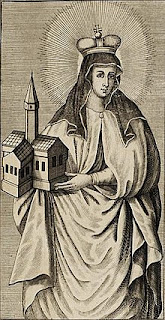
Adelaide, Empress by Divine Grace

St. Adelaide's story is one of true romance and damsels in distress. She was the daughter of Rudolph II of Burgundy who had been involved in a conflict with Hugh of Provence for the throne of Italy. In a peace treaty between the two, it was concurred that Rudolph II's daughter would be pledged in marriage to Hugh's son Lothar II. Adelaide was a young girl at this point so the marriage would not occur until much later. In the meantime, Adelaide's father died and her mother Bertha married Hugh. Adelaide was soon married to Lothar as had been promised but at this time, an Italian nobleman from Ivrea, Berengar, forced her father-in-law into abdication. Berengar wasn't satisfied with that. After Lothar succeeded his father, Berengar had Lothar poisoned and, wishing to strengthen his position, sought to marry his son to Adelaide. Adelaide insisted that "if she ever married again it should be should be a man who could avenge her husband's death" (Dunbar, Dictionary of Saintly Women). Adelaide refused, wanting nothing to do with her husband's murderer, and was imprisoned in the Castle of Garda but was led to the woods by a priest named Martin who fed her fish. Not much is known about this Martin and it is possible it was none other than St. Martin of Tours.

Adelaide sent aid for Otto who was well-regarded for the expansion of Christendom and whose many battles liberated many Christians from Muhammadan rule. He was also quelling many rebellions throughout the Holy Roman Empire and had been declared successor to the imperial throne by his father Henry I. He was preparing to take Italy also. The Bishop Otto of Freising writes of this,
"At this time Italy was being oppressed in many different ways by the tyrant Berengar, by whom also Adelaide the widow of the emperor Lothar (Otto's predecessor) was then held in captivity. Therefore the king entered Italy and, having freed the queen from captivity, took her to wife." (The Two Cities, Bk. 6.19)
The wedding between the two was blessed by John XII in the year of 951. Adelaide was given Pavia as a dowry in her wedding to Lothar which was taken away by Berengar. After Otto had rescued her, she was restored Pavia as her rightful dowry. Through Adelaide and Otto, missionaries were sent to convert the people of what is now the regions of Prussia and Poland, a people known as the Sclavonians. They had the Pope set up bishops in that area.

Adelaide always returned good for every act of evil she received and when the wife of Berengar was sent to her in chains, she remonstrated on the crimes that were committed. The wife of Berengar said that the only crime she committed was that she did not kill the saint when she had her in her power. Upon this, the Empress had the woman unbounded and sent back to her husband in safety. When Adalbert, the son of Berengar, was forced to have his property confiscated, Adelaide adopted his two daughters. Otto and Adelaide were final coronated as Emperor and Empress respectively on February 2, 962. John XII was an incredibly debauched Pope and Otto would have him deposed of and replaced with his own personal secretary, a layman with no clerical experience, who would be known as Leo VIII. Otto died in 973 and was buried next to his first wife Edith. His son Otto II would reign in his place and Theophano, the wife of Otto II, would quarrel with her mother-in-law. Upon the advice of the Empress consort, Adelaide was banished back to her homeland. But the Empire didn't prosper without Adelaide and the people wanted Adelaide back in the royal courts.

In 983, her son died leaving her daughter-in-law Theophano as regent for her grandson. Though the two quarreled, mostly on part of Theophano, one thing they both agreed was that Otto III was to have the best quality education. He was educated by Gerbert d'Aurillac who would eventually become an Archbishop and later Pope Sylvester II. Theophano threatened her mother-in-law that if she herself lived another year, Adelaide would have nothing left in her possessions. Adelaide, in spite of the opposition from her daughter-in-law, retained in the royal courts out of love for her grandson. Theophano would die in 991, within a month after making this foolish declaration to her mother-in-law. Adelaide was known as the "Mother of the Kings" as her grandsons Otto III and Louis V ruled the Holy Roman Empire and France respectively as the sovereign monarchs.

When her grandson came of age, she retired to a cloistered life but was called out one last time to assist her nephew Rudolph III in making peace with his subjects. She reposed on her way there. Blessed are the peacemakers, St. Adelaide returned to Heavenly Glory on December 16, 999. She lived to the ripe age of 69 and had outlived many of her children including the Blessed Matilda of Quedlinburg. Her daughter Emma, by Lothar, had also died sometime in the mid to late 980s. She saw the death of her son Otto II. She saw the death of her grandson Louis V. In all her life and hardships, she refused to return evil for evil, but chose the rugged path of forgiveness of one's enemies and repaid evil with good, leading all to virtue. She sent a gift to the tomb of St. Martin of Tours, recalling that priest who led her safety, of a mantle worn by her son, Otto II. A letter sent with it read:
"Bishop of God, receive these humble presents of Adelaide, servant of the servants of God, sinner by nature, Empress by Divine Grace. Receive also the cloak of Otto, her only son. And pray for him, thou who hadst the glory of covering with thine own cloak Our Lord, in the person of a beggar." (in Thornton, Pious Kings and Right-Believing Queens, 15)
See also:
Thornton: Pious Kings and Right-Believing Queens
Dunbar: Dictionary of Saintly Women

Thursday, November 18, 2021

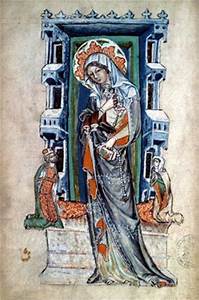
St. Elizabeth, Landgravine of Hungary

St. Elizabeth, the Landgravine of Hungary, is an exceptionally holy and pious example of Christian charity in the Church that the Middle Ages has produced. She also possessed a holy and childlike faith and devotion in all her life to Our Lord Jesus Christ. She was born to the pious King Andrew II who was renowned as King of Hungary for fighting back infidels, and his wife Queen Gertrude, the sister of the High Duchess St. Hedwig of Silesia, another charitable influence on the life of the young Landgravine. Herman, the Landgrave of Thuringia and Hesse at the time, was promised by the king that his son Lewis would be given in marriage to the daughter of the king. This promise was fulfilled, and from a very young age, she would be sent to live with the Landgrave, until she was old enough to marry.

She was always devoted to God and had her heart set on attaining the holiness of Our Lord and nothing else. She was devoted to her guardian angel and to St. John the Evangelist especially. At one point, she took the coronet off her head as she entered into the House of God. The Landgravine Sophia and her daughter Agnes inquired of the Princess why she did such an act, to which the young Elizabeth replied that she could not bear the weight of such jewels on her head while she beheld her Lord with a Crown of Thorns on His own head. Her acts of devotion earned her the ill-treatment of the Landgravine and Agnes who became her primary caretakers not long after she was given over the Landgrave Hermann. For Hermann had reposed when Elizabeth was just nine years of age and the widowed Landgravine became regent for her younger son Lewis, whom Elizabeth would soon marry. The courtiers would also bear hostility toward the young Elizabeth. It was through these trials that the saint would learn the rejection of worldly love and affairs and see that the only thing that mattered was her Lord. She would regularly pray,
O sovereign spouse of my soul, never suffer me to love any thing but in Thee, or for Thee. May every thing which tends not to Thee, be bitter and painful, and Thy will alone sweet. May Thy will be always mine: as in heaven Thy will is punctually performed, so may it be done on earth by all creatures, particularly in me and by me. And as love requires a union, and entire resignation of all things into the hands of the beloved, I give up my whole self to thee without reserve. In my heart I renounce all riches and pomp: if I had many worlds I would leave them all to adhere to Thee alone in poverty and nakedness of spirit, as Thou madest Thyself poor for me. O Spouse of my heart, so great is the love I bear Thee, and holy poverty for thy sake, that with joy I leave all that I am, that I may be transformed into Thee and that abandoned state so amiable to Thee.
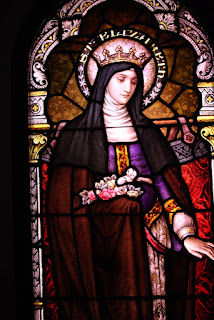
Once, when Elizabeth went out in public, richly adorned and crowned, met a crowd of poor people. Having already given to them all her silver, a poor man walked up to her. She gave to him her embroidered glove. A young cavalier who was following the crowd bought the glove from the beggar and attached it to his helmet for Divine protection. He never ceased to go into battle without the glove. He would be triumphant in all battles and tournaments he faced and he fought in the Crusades. He attributed his victories to the saint. And it was not only in gifts of money that the saint would bestow. She would also serve them in holy acts. Once, when serving a group of impoverished people, she went out to gather meat, bread, and eggs. When her husband came out to meet her, he asked what it was she was carrying. She opened her arms to reveal a bundle of flowers and roses. He was about to caress her when he saw a cross appear above her head. He took one of the flowers from her, which he kept throughout his life and went on his way. When she returned to her friends, the flowers had gone back to the form of meat, bread, and eggs. Once, when she found a poor boy who was suffering from leprosy, she washed him and brought him back to her home. The Landgravine Sophia, who had detested Elizabeth for her charitable acts, exclaimed to Lewis, "See what she has done now! ... She has put one in your bed and you will catch the leprosy!" But when Lewis pulled back the curtain, it was revealed that in the bed was the Savior, and he never allowed Elizabeth to be opposed in her acts of charity ever again.

When she turned fourteen, the young Lewis would return from his education and though he would not think of her much, when the question was put in regards to marrying her, the one thing he considered most of value was her virtue. He expressed much displeasure to the way the saint was treated and more than honored, but also promoted her virtuous acts. He also was inspired to much virtue by the saint himself. As a gift, he sent her a glass garnished with precious stones of incredible value, on one side an image of the Crucified Christ, and the other a looking glass. The wedding was performed with utmost pomp and extraordinary public rejoicings by a holy man, Conrad of Marpurg. This Conrad became the saint's confessor and encouraged her in her acts of virtue. Conrad was further approved by Lewis and he submitted to Conrad as his confessor too. Both Lewis and Elizabeth joined themselves together in their charitable acts of giving. If she wasn't praying or reading, she was performing acts of charity, spinning, or cording wool, of which she would distribute to the poor. She strove to make prayer a continual act. And she never ate but what came out of her own kitchen.

In 1221, the Order of St. Francis was founded in Germany and the young Landgravine gave them utmost support. In 1222, Lewis and Elizabeth paid her father a visit and attended his second marriage to Yolande de Courtenay, daughter of the Emperor of Constantinople. In 1223, Elizabeth gave birth to her first child, Hermann. Elizabeth bore Lewis three children. Hermann, Sophia, and Gertrude. In 1225, a severe famine broke out in Germany while Lewis was visiting with the Emperor Frederick II. Elizabeth had exhausted the entire treasury to assist the poor and hungry during this time and the nobles were sharply critical of what she had done. They brought their accusations of her to her husband. But once more, he supported her, acknowledging that God would enrich them with divine blessings for the charity that they had done for the poor. But soon after this event, Lewis would be called out of his piety to fight in the Crusades for the Emperor Frederick II. The separation was a great trial for the two lovers but they bore all things in holiness. On his way to fight in the Crusades however, the Landgrave became ill with a fever and he died in Otranto. Elizabeth had just given birth to her youngest daughter Gertrude when the news of his repose reached her. She put on the dress of a widow and declared, "If my husband be dead, I promise to die henceforth to myself, and to the world with all its vanities."

And God would grant this request to her through the suffering which would soon befall her. For the Landgrave's brother treated his widowed sister-in-law with bitter contempt. It was said she squandered the public revenue to the poor and that her son Hermann was unfit for the government of the state. Elizabeth was forced out of the palace and made to stay in an inn with her maidens. But she nevertheless rejoiced in this newfound poverty that she had acquired. She would attend the Matins of the Franciscan friars the next day, and finding no one to take her in afterwards, stayed at the Church. She eventually was reunited with her children while there. And yet, reduced to poverty, she cried out in worship:
Ah. my Lord and my God, may Thou be all mine, and I all Thine. What is this, my God and my love? Thou all mine and I all Thine. Let me love Thee, my God, above all things, and let me not love myself but for Thee, and all other things in Thee Let me love Thee, with all my soul, with all my memory.
This bitter poverty the princess found herself in at only the age of 20 would not last long. For the nobility and her family were incensed at the outrage that had taken place and demanded justice for the widow and her children. Her aunt Matilda, the Abbess of the Kitzingen Monastery, invited her in. And the Bishop of Bamberg provided her a house near his palace. The Emperor Frederick II, seeing how young she was and having lost his own wife, proposed marriage to her. But the maiden desired to fulfill the rest of her days in chastity. The remains of her husband were brought back to Bamberg for a funeral procession where she thanked God for having received him into His eternal tabernacles. The remains were then brought back to Thuringia and laid to rest. The chief barons demanded that Henry restore her dower and all the rights of her widowhood. Though she chose to renounce the government, allowing Henry to serve as regent for her son while she took the habit of a Third Order Franciscan. Henry gave to her the land Marpurg begrudgingly asserting that if she held all of Germany, it would be given to the poor. She stayed the remainder of her days with her confessor Conrad who forbade her to give up the remaining disposal of her revenues. She converted the remainder of her dower to the use of the poor.

She was now separated from her children. Hermann was the Landgrave of Hungary, his uncle Henry the regent. Her daughter Sophia was pledged in marriage to the Duke of Brabant. Her daughter Gertrude would be the Abbess of the Aldemburg monastery. Her father attempted to encourage her to reclaim her royal titles, but she refused, preferring the state of voluntary poverty to the riches of the world. Conrad began to treat her harshly so that she would not be inclined to think of her past life and always be in remembrance of the new vows she had taken up. He ordered her not to give so much to the poor and not to provide so much for the sick and when she would disobey, he treated her with blows. He further took away her maids Ysentrude and Guda, lest her conversation with them remind them of her past life and replaced them with ill-tempered women. This was to teach Elizabeth the importance of obedience to her new spiritual director and confessor.

One day, a boy, both deaf and dumb, came to the saint. She inquired of him what ailed him. He did not answer. Not knowing why, she presumed an evil spirit had possessed him and said, "In the name of the Lord Jesus, I command you to answer me." At this point, the boy was able to speak. Hearing of this miracle, many brought their sick to the saintly woman for healing. She beheld a vision not long before her death which she would relate to Conrad. A voice had proclaimed to her, "Come, Elizabeth, come with me into the tabernacle I have prepared for thee from all eternity." On the fourth day, she fell ill with a violent fever which last for several days. Though Conrad had also been battling a recent illness, he was able to recover just enough to visit her one last time. The saint gave her last confession and gave up her soul on November 19, 1231. She was brought to the Church of St. Francis where she had often visited. She was laid to rest in Marpurg.

Her confessor Conrad and her brother-in-law Duke Conrad begged Pope Gregory IX to canonize her. The Pope did so on May 26, 1235. On May 1, 1236, people from all over came to do homage to the saint and two altars were erected to her. Frederick II took up the first stone of her grave and placed upon it a rich crown of gold. Her daughters Sophia and Gertrude took part in these ceremonies. Her son Hermann desired to be buried next to his mother. The Landgrave Henry, fearing the miracles that Elizabeth had performed, was afraid that the proximity to her body would raise her son back to life if he was laid next to her. He sought to have Hermann buried next to his father Lewis in Reinhartsbrunn. The Landgravine's widowed daughter Sophia, the Landgravine of Brabant, sought to claim the inheritance of Hermann for her son, and she succeeded in gaining him Hesse. Portions of her relics are kept in the Church of the Carmelites at Brussels; another portion at the Church of La Roche-Guyon upon the Seine; and a significant portion in the electoral treasury of Hanover.

Sources:
Agnes B.C. Dunbar, A Dictionary of Saintly Women

St. Elizabeth of Hungary, pray for me, and may you send your guardian angel to assist my own angel!

Sunday, November 14, 2021

Emperor Justinian

The Holy Emperor Justinian the Great was a military commander for his uncle Justin I before his elevation to the throne. It was toward the end of Justin I's reign that the two began a co-reign as uncle and nephew for the former's health was beginning to deteriorate. Justinian would begin this co-regnancy with his uncle in the year 527 A.D. and later that year, his uncle would repose. Justinian would become the sole monarch of the entire Roman Empire. The Roman Empire was beginning to deteriorate. The barbarians had overrun the West and all that was left was in the East. Yet that was about to change. According to the historian Otto of Freising,
"In the five hundred and twenty-seventh year from the incarnation of the Lord, Justinian, the fifty-first in line from Augustus, obtained the imperial power while the sons of Clovis were still  reigning in Francia. This most zealous and Christian monarch resurrected his domain, as it were, from the dead. The state, which had been in large part overthrown, he reestablished and among other brave and valiant deeds triumphed gloriously, through Patrician Belisarius, over the Persians who had invaded the Roman territories. The laws published before his time had been put together in loose fashion with semblance of order. Justinian made a compendium of all these laws. This he reduced to order and published in a single volume, a volume which to this day is called after Justinian the Leges Justinianae. He adorned the Church of God also with many beautiful basilicas throughout the length and breadth of his domain: among others was one in the Royal City, a basilica preeminent for its material workmanship, in honor of wisdom divine, called by the Greeks Sophia. He also caused the king of the Heruli, Grates by name, who came to him at Constantinople, to be baptized at the festival of the Epiphany of the Lord. At that time also Garda, king of the Huns, and a certain widow woman of the Huns with a hundred thousand of their race are said to have accepted the faith and to have received the sacrament of baptism." (The Two Cities, Bk. 5.4)
Justinian was a Serb by birth according to St. Nikolai Velimirovic. There was much work to do for the Roman Empire when Justinian took charge. He began to complete the bathhouses throughout the Empire and he also contributed significantly to the construction and architecture. His most notable contribution to the architecture of the Roman Empire was Hagia Sophia Cathedral. Hagia Sophia, initially built as a Cathedral, flipped allegiances after the first millennium different times before finally falling into the hands of the Turks. It had been a Cathedral for the Greeks who had opposed communion with the Roman Bishop, it had been a Cathedral for the first Uniates, and back and forth. According to Met. Kallistos Ware, the last joint-service between the Latin Crusaders and the Greek Church occurred in Hagia Sophia before the Turks captured Constantinople in 1453 A.D. and turned it into a mosque. Hagia Sophia was a museum up until 2020 when it was converted back into a mosque. There is a tradition in the Hagiography of St. Demetrios that Justinian wanted to have relics of the Great Martyr brought back to Hagia Sophia. So he sent soldiers to the tomb of the saint, yet when they started digging, they were halted by a fire. The saint appeared, condemning the soldiers for their actions but allowed them to take some of the dirt back to Constantinople for the Emperor. The Emperor was told this story and placed the dirt from the tomb of St. Demetrios in the Hagia Sophia Cathedral.

The Emperor would also marry out of love his consort Theodora. Theodora was an actress, which in Roman culture, and in Christian culture, was one of the lowest of the professions. It certainly was not economically successful and was a largely frowned upon profession. Yet Justinian's love for his consort was genuine and the two would marry. Justinian was greatly influenced by her and her role in the Nica Revolts would save him the throne. She has been falsely tarnished as a Monophysite heretic, especially regarding her role in the Council of Constantinople. Though the Empress would not live to see the Council, she would be involved deeply with Justinian's arguments regarding the Three Chapters with Pope Vigilius. The West for some time disregarded the Council of Constantinople though its fruits are now evident in the entire Christian world. The Council would denounce the Nestorian leanings of Ibas of Edessa, Theodoret, and Theodore of Mopsuestia. When Theodora would repose in 548, presumably of cancer, the Emperor would regularly light a candle in remembrance of her.

The Emperor also began liberation campaigns in various regions of Africa and Western Europe for Christians who were persecuted by the Arian heretics. Seeking peace first, the Emperor had actually converted many Huns to Christianity from their Arian heresies, he would eventually be forced to exercise war. These former regions once held by a Christian Empire under Constantine could not tolerate being given up to Pagans and Heretics once again. He launched a military campaign in Africa against the Vandals through his Patrician Belisarius and then went into Spain and Italy seizing more land from the Goths and the Vandals. He would form an alliance with the Frankish Kings Childebert, Lothar, and Theudebert. Though Theudebert wanted sole control of Italy so he appointed his general Buccelin to combat Belisarius. Buccelin would achieve many victories against the formidable Patrician forcing Justinian to demote his Patrician and appoint Narses in his place. Narses at first was driven back but when Buccelin was killed in battle, Narses would be able to regain full control of Italy for the Emperor. This control began in 555 A.D. and would last until 565 A.D. when the Emperor reposed.
"The same emperor also built within the city of Constantinople to Christ our Lord, who is the wisdom of God the Father, a church which he called by the Greek name 'Hagia Sophia,' that is, 'Divine Wisdom.' The workmanship of this so far excels that of all other buildings that in all the regions of the earth its like cannot be found. This emperor in fact was Catholic in his faith, upright in his deeds, just in his judgments, and therefore, to him all things came together for good. In his time Cassiodorus was renowned in the city of Rome for knowledge both human and divine. Among other things which he nobly wrote, he expounded particularly in a most powerful way the obscure parts of the Psalms. He was in the first place a consul, then a senator, and at last a monk." (Paul the Deacon, History of the Langobards, Bk. 1.XXV)
The Justianianic Code, which establishes the principles of equality under the law and the presumption of innocence, forms the basis of many of the legal codes today. It had tremendous influence on Napoleon Bonaparte who included many of its principles in his own Napoleonic Code. The legal legacy of Justinian the Great is so tremendous that if one walks into the Halls of U.S. Congress, they will see, in the House of Representatives, images of the great influencers and legal thinkers of American law. Among these are Pope Innocent III, Louis IX, and Justinian the Great. Justinian is considered the founder of Roman law though what he really did was right Roman law down into written format, giving it a more explicitly Christian emphasis.

Justinian practiced this law and governed as was due. During the Nika riots, of which the Blue faction of the chariot fanatics would often persecute relentlessly other factions, burning their homes down, murdering, and looting. Justinian did not lean himself in the governance to be in favor of one faction over another despite whatever perceived leanings he had toward the chariot factions. He ministered due justice, putting to death whoever caused harm, even if it was the Blue faction that he may have been sympathetic toward (Evagrius Scholasticus, Ecclesiastical History, Bk. 4, ch. XXXII). According to John Malalas, Justinian would cut the genitals off of clerics who practiced pederasty causing the deaths of many priests caught in pederasty (Chronicle, Bk. 18.18) and he ended the Gothic wood and oil taxes (Bk. 18.20). The Empress Theodora, his consort, also punished severely brothel keepers (Bk. 18.24).

In addition to his theological contributions at the Council of Constantinople which led to the further decimation of the Nestorian heresy, he also combated the Monophysite heresy in Byzantium and contributed to the Divine Liturgy by writing the Hymn "Only Begotten". He also established as Patriarch of Constantinople, St. Eutychius and his successor St. Menas. Toward the end of his life, Justinian was taken over by an evil spirit, much like the Pious King David, and began to oppose the Patriarch he had appointed, teaching the error of Theopassianism which asserted that the Divine Nature experienced suffering and died. This error was rebuked at the Council of Chalcedon. Justinian would be rebuked for this error but before he could do further damage to the Church, he came to repentance and reposed.

Justinian was always accessible to his people and would allow them to visit his courts frequently. He was a great rebuilder of the Roman Empire and was known as "the Emperor who never sleeps". In his final moments, the light of the Imperial Palace in Constantinople was still on. He is forever immortalized in Western Culture, but even more importantly, he is immortalized in the Church as a Pious Emperor who died in the Holy Faith of Orthodox Catholicism. He entered into eternity in the year 565, having reigned for 38 years as Emperor of the Romans. St. Justinian the Great, pray for us sinners!

Sunday, October 31, 2021

The Ven. Met. Andrei Sheptytsky

Andrei Sheptytsky was born July 29, 1865 in Prylbychi Yavoriv County, Galicia and died November 1, 1944 in Lviv. He lived through two world wars and experienced totalitarianism under two different socialist regimes of the Bolsheviks and the Nazis. He was actually baptized as a Roman Catholic but petitioned the Pope for a change of rites which was granted. He would soon become one of the foremost leaders in the Ukrainian-Greek Catholic Church. He was both political and theological and in all things focused on the service of the Church and the Gospel of Christ in Ukraine. He would go on to study at the Jesuit university in Cracow, Poland and would very quickly ascend within the ranks of the Greek Catholic clergy. A fierce traditionalist, he would be deemed with suspicion by his fellow Ukrainians at first who believed he wanted to Latinize the Greek rites, but instead, he went the other direction. He became one of the strongest supporters, if not the strongest supporter, of the Eastern Catholic rites. He was a Uniate and always defended unification with Rome, but he would support the full expression of the Eastern rites in the Catholic faith.

He was known for both his political and his theological activities. In 1914, he would be arrested by the Tsarist government for his activities with the Austro-Hungarian government during World War I. After his release in 1917, he would speak in defense of an independent Ukrainian national state and would support the establishment of the Western Ukrainian National Republic. He would be confined to Lviv for his support of the Ukrainian National Rada by the Polish government. In 1931, he established the Ukrainian Catholic Union in order to further the Church's social teaching and enhance its standing in Ukraine. He would be denounced by pro-Soviet Ukrainians for his criticism of the Ukrainian famine of 1932-1933 and his condemnation of the Communist government.

When the Nazis invaded the Soviet Union, Sheptytsky encouraged obedience to the new occupying state. However, when he realized their persecution of the Jews, he was at the forefront of the Church leaders to defend them. His mistake was one that was made by the Russian Liberation Army, for those familiar with The Gulag Archipelago by Aleksandr Solzhenitsyn. Many believed the Nazi government would promise more freedom than the Soviets had, for when one only lives under a totalitarian regime, it is easy to fail to distinguish or discriminate the fact that no totalitarianism is better than another.

Sheptytsky was a learned man, well-regarded for his pastoral and theological discipline. He was an intellectual, a politician, and a Churchman. He aided Pope Pius X in the establishment of the Russian-Greek Catholic Church. The move met with little success as very few became adherents to the new church and it was heavily opposed by the Ukrainian Orthodox, yet Sheptytsky's vision for an Uniate Church in Russia would not be dissuaded so easily. He met many learned philosophers, theologians, and Catholics when he visited the Russian Empire in the late 19th century, including Vladimir Soloviev. His title of Bishop of Komianets-Podilskyi, though an inactive eparchy, gave him full responsibility of all the Eastern Rite Catholics throughout the Russian Empire. It was the Petersburg Synod of Eastern Catholics in 1917-1918 that reversed much of the damage of the Synod of Zamość. The Petersburg Synod also approved the veneration of canonized Orthodox saints in the Eastern Catholic Church. Of course, certain saints who had died in schismatic churches were already venerated such as St. John the Almsgiver, St. Elesbaan, the King of Ethiopia, and St. Isaac of Nineveh.

Sheptytsky wanted to unite all of Ukraine under a united Ukrainian Church. His vision was to establish a Ukrainian Church under the authority of the Pope of Rome. He was heavily Eastern and sought the restoration of Eastern traditions, but he was always a fierce Papist. The Ukrainian Orthodox hated this idea for they would never want an autocephalous church underneath the authority of the Pope of Rome. Sheptytsky was an Hebraist and was well-studied in the Hebrew language. This helped him gain Jewish allies when the Nazi persecutions began. He kept Jews in hiding in the monasteries and instructed his flock to do the same. His brilliance and resilience under persecution earned the respect of the Church and when the Soviets took the Ukraine again, the persecutions of the Church would remain moderate. He stayed in Lviv until his death in 1944.

Many of his works have been published posthumously. The Sheptytsky Institute under the University of St. Michael's College in the University of Toronto is named after him. He had visited Canada in 1912. His disciple, Met. Josyf Slipyj, he consecrated, and was made a Cardinal by Pope Paul VI. Some of his works were published in volumes such as The Works of the Servant of God Metropolitan Andrei Sheptytsky: Pastoral Letters and The Church and Church Unity: Documents and Materials. He wrote much on topics such as ecumenism, theology, spirituality, history, and philosophy. His vision for an Uniate Church under the full authority of the Pope of Rome would be betrayed at Vatican II when the hierarchy broke for a false ecumenism favoring the Eastern Orthodox Church's role as opposed to the Traditionalist Catholic position, and the Catholic position, of the Church's jurisdictional authority being fully placed under the Pope of Rome. Sheptytsky was nevertheless influential for Eastern Rite Catholics and Ukrainian-Greek Catholics in recovering much of the Eastern Tradition that had been lost and forming us once again back to the Catholic theology of the one Mother Church. We are not Orthodox in Union with Rome. We are Greek Catholics and our theology is Catholic. Met. Andrei Sheptytsky is venerated on November 1 in the Ukrainian Catholic calendar.

Sources:
Confessor Between East and West, Jaroslav Pelikan

Monday, October 25, 2021

St. Alfred, the Great King of England

Alfred was the youngest of five children and not expected to become the King of England. Because of this, his education was not largely focused on. He was not expected to become a King. He even desired to become a monastic and sought after a monastic life from an early age because his succession to the throne seemed unlikely. Yet at the age of five, Alfred was sent to the Pope of Rome where he was received with royal dignity and given the vestment of the Roman consulate. Alfred, living after the time of Charlemagne, would have been considered a resident of the Western Roman Empire through England's alliance with the Franks. It was not until he was twelve that he taught himself to read. His mother presented a book of English poetry to her sons and promised to give it to the first person who could learn to read it. Alfred was attracted to the beauty of the book so much that he began studying its contents and, learning from his teacher, began to learn to read. When one considers how intellectually influential the King became in England, this detail of his life, that he was unable to read for so long a period, seems almost remarkable. Especially given his overall resume of works that he translated!

Alfred was born to King Aethelwulf and his wife Queen Judith. In the year 855 A.D., his older brother Aethelbald seized the throne of England as Absalom once did the throne of Israel from his father David. Though the people would have been more than happy to see Aethelwulf restored to the throne when he had finally returned from visiting Rome, it was not the wish of Aethelwulf to see his son punished so. Aethelwulf allowed the King Aethelbald to continue ruling though the people would never refer to Judith as the Queen for the scandalous nature in which Aethelbald had proclaimed his own mother as his wife. Instead, the people referred to her as the "King's wife". Aethelwulf would repose two years after his return from Rome and Aethelbald would repose in 860 A.D., in the twelfth year of Alfred's life. Aethelbehrt succeeded his brother and it was then that England would experience numerous raids from Viking armies. These raids would end up changing the course of the young Alfred's life forever.

Aethelbehrt would crush the Viking forces, causing them to flee. But after five years, Aethelbehrt would go the way of all flesh. Alfred's brother Aethelstan had reposed some time in between. Aethelred would assume the Kingdom and Alfred would find himself second in line for the throne as more Vikings would raid England. He would fight alongside his brother, Aethelred, pushing the Vikings back, sometimes losing battles. But Alfred's life was now fully occupied by military campaigns against the Vikings as they ravaged the various parts of England. It was in 871, after Easter, that Aethelred would repose and Alfred would assume full reign over the English government. Alfred pushed the Vikings back but the fighting with the Danish Pagans would resume in 875. In 878, the Danish King Gunthram amassed a large assault upon Wessex. Alfred and his men were cornered. It was at this time, before the Great Battle of Edington, that St. Neot would appear in a dream to St. Alfred promising him victory. So likewise, a strange figure showed up at the fortress of St. Alfred. A beggar, asking for rations, St. Alfred retained full generosity not knowing who the beggar was. He gave the last supply of rations to this beggar. The next day, the rations were restored. The beggar, being none other than St. Cuthbert himself. The Battle of Edington was a decisive victory for the Anglo-Saxons and Gunthram embraced Christianity, being baptized with St. Alfred as his godfather.

From this point on, the Danish occupation of England was broken and Danish military forces would begin to be slowly driven out from England. St. Alfred would unify all of England through their common Christian creed and he would begin to set up institutions of education throughout all of England. Alfred, having regretted his lack of education growing up, sought to build up the university system in England and founded the University of Oxford. He also compiled different translations of the Psalms, he translated Boethius's Consolation of Philosophy, different parts of Pope Gregory I's Book of Pastoral Care and Dialogues, and St. Augustine's Solioquies. In a compilation of religious and classical works that the saint made known as Blooms, he wrote:
"Therefore he seems to me a very foolish man, and very wretched, who will not increase his understanding while he is in the world, and ever wish and long to reach that endless life, where all shall be made clear."
He commissioned the writing of The Anglo-Saxon Chronicle and The Anglo-Saxon Martyrology. He also wrote many numerous laws for his country, much like St. Justinian was a lawgiver for the Romans, St. Alfred was a lawgiver for the English.

St. Alfred was a pious, righteous, and devout King. One area of his life that he struggled with was his burning sexual passion. In order to fight these carnal desires, he would get up early from his sleep and visit the sites of churches, relics, and would venerate the holy icons of numerous saints and martyrs, until these desires finally would cease. Though on his wedding day, he would be inflicted with yet another illness of the flesh. St. Alfred would continue to be inflicted with illnesses throughout his life, but he bore all with humility and penitence. He built England up from ruin, uniting all under one ruler, drove out the Vikings, converted Pagans, and established learning in England. St. Alfred is the only English King to have been given the epithet, "the Great", and he truly was a great King.

His concluding prayer of his translation of Boethius's Consolation of Philosophy, is the appropriate place to end.
"Lord God Almighty, maker and ruler of all creatures, I beseech You on behalf of Your mighty mercy, and through the sign of the Holy Cross, and through St. Mary's maidenhood, and through St. Michael's obedience, and through the love and merits of all Your saints, that You guide me better than I have done towards You; and direct me according to Your will and my soul's need better than I myself am able; and strengthen my mind to Your will and to my soul's need, and confirm me against the devil's temptations; and keep far from me foul lust and all iniquity; and protect me from my enemies visible and invisible; and teach me to perform Your will, that I may inwardly love You before all things with pure thought and clean body, for You are my Creator and Redeemer, my sustenance, my consolation, my trust and my hope. Praise and Glory be to You now and forever, world without end. Amen."
Alfred reposed October 26, 899, entering into eternal glory.

See also:
James Thornton, Pious Kings and Right-Believing Queens
Asser, Life of King Alfred

Saturday, October 16, 2021

St. Hedwig, Duchess of Silesia

St. Hedwig,
Duchess and widow
Hedwig was born to Bertold III and his wife Agnes. These were the grandparents of St. Elizabeth of Hungary. Hedwig was therefore the Aunt of St. Elizabeth of Hungary. She had three sisters and four brothers. Her sister Agnes was married to Philip Augustus, King of France; her sister Gertrude was married to Andrew, King of Hungary, and her third sister was the Abbess of Lutzingen in Franconia. Her brothers Bertold and Elebert were bishops of Aquileia and Bamberg respectively, and her brothers Henry and Otho divided up their father's principalities and became renowned generals. Hedwig was placed in the monastery of Lutzingen at a very young age where she would begin her studies. At age 12, she would be married to Henry, Duke of Silesia. Hedwig bore him six children: sons Henry, Conrad, and Boleslas, and daughters Agnes, Sophia, and Gertrude.

In 1233, the nobility of Poland expelled their Duke Ladislas, and conferred upon Henry the principalities. Always bearing in humility, Hedwig pleaded to her husband not to accept the offer, but it was to no avail and Henry gathered an army and took possession of the lands. From that point on, he was known as the Duke of Poland. He desired to leave his dominions to his second son, Conrad, but Hedwig supported that the oldest should hold the inheritance. This unfortunate disagreement between the Duchess and her husband led to the two sons clashing in military combat. Henry would prevail and Conrad would perish. This became one of the crosses that the Duchess would have to bear throughout her life.

She and her husband founded numerous monasteries including the Augustinian nunnery of Naumberg on the Bober which was later transferred to Sagan, the Cistercian monastery of Heinrichau, the priory of the Augustinian Canons at Kamenz, the Dominicans were brought to Bunzlau and Breslau, the Franciscans to Goldberg and later to Krossen, and the Templars would establish a house at Klein-Oels. In addition, she and her husband founded the monastery of the Cistercian nuns at Trebnitz where she spent most of her time doing many penances. The Hospital of the Holy Ghost at Breslau was founded by her husband and she would spend much time serving the leper women in the hospital in Neumarkt.

Her daughters Agnes and Sophia would die in infancy. Her son Boleslas would also die at an early age as well. She would carry the burden of child loss for most of her life but in all things, she looked to God and she desired to fulfill what was pleasing to God. Even in her marriage, she only carried out her penances to the extent that her husband would allow as she believed that the marital life was what God had called her to and wives are to honor their husbands. Seeing his wife so pious and devout, Henry would be more than willing to allow her to carry out her penances, and he too would find himself attired as a monastic within his royal courts. The two would make a pledge of virginity after their sixth child, and after being tonsured, Henry never once shaved his beard. For this, he was known as Henry the Bearded.

She would fast regularly throughout the year, only breaking such fasts on Sundays and Holy Days. She would kneel in Church on the stone floor without any mat between her knees and the ground. She would wear a hair cloth underneath her dress and would wear simple clothes. She taught her husband and her maids many prayers. She would even walk barefoot in the Winter to the Church, her feet bleeding on the way, yet the saint seemed unaffected by the cold while her maids, who were dressed more fittingly for the weather, would suffer greatly from the harsh weather as they made their way to Mass.

She would serve the poor and needy, and made the monastery of Trebnitz a place for orphans and young girls to receive their dowries. She had with her 13 impoverished people who would symbolize Christ and His Apostles for her. She would make certain they were fed with all sorts of meats and foods before she even gave herself her own refection. She did all of this out of her pure love for God and nothing falling short. She even showed sympathy for prisoners asking their sentences to be commuted. When the Lesko the White had died, he would be succeeded by his infant son, Boleslas V with his mother Grzymislawa as regent. Boleslas V would later marry St. Cunegund but he and his mother and his sister Salome would be taken into captivity by Conrad, Duke of Masovia, and brother of the late King. Henry wished to settle this with Conrad but Conrad took him captive. Hedwig expressed her desire to Conrad to see her husband in good health again. Conrad refused. And as her son Henry was about to assemble an army, Hedwig took matters into her own hands and traversed all the way to see the Duke. The Duke, upon seeing her, relented immediately and gave up her husband. In 1233, the people of Cracow and Sadomir would revolt against the tyranny of the Duke and Grzymislawa and her son entrusted themselves to the care of the Duke and Duchess of Silesia.

In 1238, Henry fell ill and died. All of the people mourned the Duke's repose but the widow remained the only one with a dry eye. Hedwig proclaimed, "Would you oppose the will of God? Our lives are his. We ought to find our comfort in whatever he is pleased to ordain, whether as to our own death, or as to that of our friends." All of her life, she always sought the will of God. Whether in marriage or in the loss of her children, or now in widowhood. She embraced all things as being wholly intended by the will of God and gave herself up to where God had placed her. She would now take the habit at the Cistercian Abbey of Trebnitz which she herself had built and live the remainder of her days in subjection to her daughter.

Anne of Bohemia,
widow of Henry II
She would witness the death of her son, Henry II, not long after. The Tartars were on the move through Russia and Bulgaria, and were now coming into Hungary and Poland. They had destroyed the city of Cracow, leaving only the Church of St. Andrew standing. They laid siege on Silesia which was protected by its walls and the prayers of St. Ceslas. The Duke raised an army and pushed them back but he was killed in the battle. His corpse was carried back to be interred in the convent of the Franciscans in Legnitz. His wife Anne and had retired with her mother-in-law at the fortress of Chrosne. Hedwig, seeing her daughter-in-law distraught, counseled her to accept the will of God.
“God hath disposed of my son as it hath pleased him. We ought to have no other will than his.” Then, lifting up her eyes to heaven, she prayed as follows: “I thank you, my God, for having given me such a son, who always loved and honored me, and never gave me the least occasion of displeasure. To see him alive was my great joy; yet I feel a still greater pleasure in seeing him, by such a death, deserve to be forever united to you in the kingdom of your glory. Oh, my God, with my whole heart, I commend to you his dear soul.” (St. Hedwiges, or Avoice, Duchess of Poland, W.)
Hedwig would teach her daughter-in-law much in the areas of humility and Anne would learn from her mother-in-law's sufferings to accept and grow in the will of God, putting all things into the hands of the Lord. God honored Hedwig with the gift of miracles and she would even cure a blind nun of Trebnitz. Her daughter-in-law was venerated as a saint in Poland too but never formally canonized. St. Hedwig's Feast Day is October 17.*

See also,
A.B.C. Dunbar, Dictionary of Saintly Women

*I rarely write about Western Saints after the first millennium because I am canonically Melkite but if I see an interesting royal saint or even just an interesting Western Saint, I'll definitely try to write about them.

The Law of Emperor Justinian

The Justianianic Code, which establishes the principles of equality under the law and the presumption of innocence, forms the basis of many of the legal codes today. It had tremendous influence on Napoleon Bonaparte who included many of its principles in his own Napoleonic Code. The legal legacy of Justinian the Great is so tremendous that if one walks into the Halls of U.S. Congress, they will see, in the House of Representatives, images of the great influencers and legal thinkers of American law. Among these are Pope Innocent III, Louis IX, and Justinian the Great. Justinian is considered the founder of Roman law though what he really did was right Roman law down into written format, giving it a more explicitly Christian emphasis.

Justinian practiced this law and governed as was due. During the Nika riots, of which the Blue faction of the chariot fanatics would often persecute relentlessly other factions, burning their homes down, murdering, and looting. Justinian did not lean himself in the governance to be in favor of one faction over another despite whatever perceived leanings he had toward the chariot factions. He ministered due justice, putting to death whoever caused harm, even if it was the Blue faction that he may have been sympathetic toward (Evagrius Scholasticus, Ecclesiastical History, Bk. 4, ch. XXXII). According to John Malalas, Justinian would cut the genitals off of clerics who practiced pederasty causing the deaths of many priests caught in pederasty (Chronicle, Bk. 18.18) and he ended the Gothic wood and oil taxes (Bk. 18.20). The Empress Theodora, his consort, also punished severely brothel keepers (Bk. 18.24).

Justinian was a proponent of federalism, as explained by Paul the Deacon. He divided up his laws into different rubrics, reducing the amount of laws to fifty for special magistrates or judges in a work called  "Digests", and one book he called "The Institutes" in which he further explained and expounded on his own laws (History of the Langobards, Bk. 1, XXV). These laws were further reduced to one volume called the "New Code". Despite his more despotic leanings and sub-Christian thought, the philosopher Thomas Hobbes can be cited here as an exponent of the legal code of the Holy Emperor. He elaborates on the essential seven characteristics of the civil code of Justinian the Great. Justinian the Great had seven sorts of Civil Laws.

1. Those that were edicts, constitutions, and epistles of the Emperor himself.
2. The decrees of the whole people of Rome when put to question by the Senate.
3. The decrees of the common people, excluding the Senate.
4. The orders of the Senate.
5. The edicts of the Praetors, which were comparable to the Chief Justices in England.
6. The sentences and opinions of lawyers to whom the Emperor gave authority to interpret the Law.
7. The unwritten customs, which by the tacit consent of the Emperor, were not contrary to the Law of Nature and were very Laws. (Leviathan, ch. XXVI)

One reading this will recognize a very common theme between our current system of presidential parliamentary republics and constitutional monarchies. These systems of government, in general, respect the two-fold aspect of Catholic social doctrine regarding the subsidiarian and the solidaritarian nature of relationship. Federalism is respected. The individual is respected. Yet all are in solidarity with each other through the common rule and governance of one Emperor. The concept of full equality under the law also has its roots in Galatians 3 where St. Paul declares that there is no Jew or Greek, slave or free, male or female, for all have been baptized into Christ. Under the law of Christ, all will have the same hearing at Judgment Day, so also in the civil government, all shall have a fair and equal hearing under the law, regardless of political ideology or political alignment with the civil authorities. The Blue Faction may have been favored by the Emperor, but the rioters were still rioters and they were put to death as a consequence for their actions. A rioter is still a rioter regardless of their political views and if one rioter is locked away in jail but another rioter is let out back onto the streets because of the "cause" they fought for, then the law has no equal application: it is tyranny.

Justinian also recognized the concept of symphony, and acknowledged the harmony between the Church and State. He accepted that the two needed cooperation together. In the Preamble to the Edict of April 17, 535, he writes:
"The greatest gifts which God in His heavenly clemency bestows upon men are the priesthood and the Imperial authority. The former ministers to Divine things, the later presides and watches over human affairs; both proceed from one and the same source and together they are the ornaments of human life. Therefore nothing is so close to the hearts of Emperors as the moral wellbeing of the priesthood since priests have the task of perpetual prayer to God on behalf of Emperors themselves. For if the priesthood is in all matters free from vice and filled with faith in God, and if the Imperial authority with justice and efficiency sets in order the commonwealth committed to its charge, there shall be an ideal harmony to provide whatever is useful for the human race. We therefore have the greatest anxiety for the true doctrines of God and for the moral wellbeing of the priesthood by which, if it is preserved, we believe that the greatest gifts will be given to us by God and we shall preserve undisturbed those things which we have and in addition acquire benefits which are at present lacking to us. But all things are done rightly and efficiently if a beginning is made which is fitting and agreeable to God. We believe that this will come about if there is due care for the observance of the holy canons, which the justly praised Apostles and venerated eyewitnesses and servants of the word of God handed down and which the holy Fathers preserved and interpreted." (in Thornton, Pious Kings and Right-Believing Queens, 255)
The Codes of Justinian became foundational in Roman law and legal theory. It was Roman law that led to the birth of the Medieval system of feudalism, especially in the Frankish law. Roman law influenced the great Pope Innocent III and the philosopher Thomas Hobbes also recognizes the impact of Roman law in the English common law. Roman law was also a strong component and inspiration of the Napoleonic Code which forms the basis of all modern day presidential parliamentary republics and constitutional monarchies. As mentioned, Justinian does not go unrecognized in the United States of America. In the House of Representatives, an icon of the Holy Emperor is raised up among the chief influencers of the legal system of the United States. If only we could commit ourselves to following the influence of this Holy Emperor once again. St. Justinian, pray for our nation!

Sunday, October 3, 2021

Saint Helena-Elizabeth and Saint Stephen Štiljanović

St. Stephen Štiljanović, the Prince of Serbia, ruled Serbia during a most difficult time Serbia was ravaged by famine and their people were in struggle against both the Turks and the Latins. During the famine caused by the war against the Turks, he opened his barns and distributed corn freely to the people. He was even captured by the Turks who released him on account of his bravery and nobility. He is also credited with the founding of the monastery of Kuvedžin. He reposed in 1543 and was buried atop a mountain in called "Djuntir". The Turks, seeing his grave surrounded by a heavenly light, thought there might be a treasure hidden there and opened up the grave. Indeed, they found the Saint's body incorrupt and giving off a sweet fragrance.

The Turkish commander allowed Orthodox monks to retrieve the holy relics and they were translated to the monastery of Šišatovac, which his wife, Helena-Elizabeth, had founded. Helena-Elizabeth, viewed the relics and said to her deceased husband: "Do thou remember me who would speak with thee in time past of holy things, that I too may receive some portion of that which thou hast in the Lord." Soon thereafter, she was tonsured a nun and gave herself to a life of asceticism. They are honored together on October 4. His relics remained at the monastery of Šišatovac until the breakout of World War II.

Friday, October 1, 2021

St. Anna of Kashin

Saint Anna of Kashin, Duchess of Kver and Princess of Russia was born to Dmitry Borisovich of Rostov. She was educated under Saint Ignatii, the Bishop of Rostov. This education in the faith would prepare her for the earthly losses that would befall her later in life. In 1294, she married the Grand Prince St. Michael of Tver and bore five children to him. Then in 1295, a fire destroyed the city of Tver. Not long afterward, her infant daughter Theodora died. Then in 1296, their palace was burned to the ground and the family barely escaped with their lives.

Her husband contended with Yuri Danilovich of Moscow over the Principality of Vladimir. Michael of Tver refused to fight for fear of bloodshed and he relinquished the title of Grand Prince to Yuri. But Yuri continued to threaten Tver and Saint Michael went to war with him. It was during this conflict that the Princess Agatha, the wife of Yuri, was captured by Michael. She died accidentally in captivity and Yuri accused Michael of having poisoned her. Though the charge was false, the slander gained Yuri victory over his enemy. The Saint would either have to face an attack against Tver brought on by the overwhelming forces of the Horde or be brought before the Khan and be judged by him. Choosing to protect his people, Michael appeared before the Khan. The Khan ruled against him and Michael would be executed on November 22, 1318.

Anna, having already lost an infant daughter to illness, now saw her husband slandered and murdered for a crime he had not committed. She also witnessed two of her sons, Dmitry and Alexander, killed by the Horde. After her husband's death, she entered into a convent and took the name Evrosinya. She would die of old age on October 2, 1368.

Her grave passed into complete oblivion, having lied in the Dormition Cathedral for over 200 years. In 1611, she appeared in a dream to the sacristan George and promised him healing. But she said to him, "You do not regard my tomb as anything and consider it to be ordinary and me you despise. People place their hats on my tomb, they sit on it, and no one forbids them. I am uncared for and insulted by you. Surely among you there is an intelligent man, and, until now, none of you understands this. And how far will you trample me underfoot? Perhaps you do not understand that I pray to the all-merciful God and the Theotokos that your city not be handed over into the hands of your enemies and that I preserve you from misfortunes?!" She ordered the clergy to keep her tomb honorably and to light a candle before the icon Made Not By Hands. This dream led to the discovery of St. Anna's incorrupt remains. Her Feast Day is kept October 2.

Additional Sources:
Pious Kings and Right-Believing Queens, Protopresbyter James Thornton

Monday, September 27, 2021

St. Wenceslaus


Wenceslaus, known commonly as "The Good King Wenceslaus" for that wonderful Christmas carol about his compassion toward a poor man and beggar, showing that one ought to share their wealth with those needful of it, was the grandson of the Holy Martyr Ludmilla. Ludmilla and her husband Borivoi were converted to the faith by St. Methodius, the Apostle to the Slavs. The Bohemians resisted the Christian faith and would exile the King and Queen but later called for Borivoi and Ludmilla back. After Borivoi's death, Ludmilla's oldest son, Spitihnew would hold the throne. But his reign was short and after his death, his brother Wratislaus would hold the throne for Spitihnew had no heir. Wratislaus had two sons by his wife Drahomira, Wenceslaus and Boleslaus. Wratislaus had left in his will Ludmilla as the regent, not Drahomira. So when he died, leaving Wenceslaus a king at the very young age of eight, it was left to the regency to serve as guardian until Wenceslaus was no longer a minor. Ludmilla took over the charge of the education of the young Wenceslaus.

The Bohemians as a whole were still resistant to Christianity and Drahomira was sympathetic to the cause of the Pagans. It may have been that she was a Christian but preferred the survival of Paganism nonetheless. She despised Ludmilla's instruction of her own son and sought to regain control over the young king. There was definitely envy over the fact that Ludmilla was effectively serving as regent for the boy which Drahomira believed to be in her rightful possession. Though there was definitely a religious nature to the political struggle, one cannot ignore that it was a political struggle. Drahomira ordered Ludmilla to be assassinated. Ludmilla, sensing the danger to her life, made one last confession and communion, and on that night, she was strangled to death by the assassins who used her own veil to strangle her.

Wenceslaus though, was still deeply influenced by his grandmother's Christianity and when he became of age, he would further advance the cause of Christianity in Bohemia. One of the means he took to ensure this was his purchasing of Pagan children who were sold as slaves and he baptizing them as Christians. He translated the Gospel of John and translated the relics of St. Vitus and St. Ludmilla to Prague.

Wenceslaus was a practitioner both of strict Christian asceticism and Christian charity. During the day, he would devote himself to the duties of the State, and at night he would pray. He would bake prosphora for himself, especially when he desired Holy Communion. As the Christmas carol testifies, he would always give generously to strangers for any of them could be an angel in disguise. Because of his faithful commitment to the poor and needy, many churches were built in which daily services to God were rendered. He was also a lover of peace. When Radislav threatened the Good King to take away the entire Czech territories, Wenceslaus asked him why he was waging war. Radislav replied that it was to seize the throne of Bohemia and take the land of the Czechs. Both men met each other with an army of their own, but the Good King, seeing the bloodshed that was about to occur due to a dispute between him and Radislav, offered instead to duel the potential usurper. Radislav agreed and upon defeat, fell to his knees and begged forgiveness for which the Good King granted (Prologue of Ochrid, September 17).

Wenceslaus, as testified by both St. Alphonsus de Liguori and St. Nikolai of Ochrid, faithfully attended the liturgy. Here is where the two divert. St. Nikolai, an Orthodox hagiographer, makes the martyrdom about the Latin Mass over the Vernacular Byzantine Liturgy. St. Alphonsus does not make mention of this. Boleslav was doing the bidding of his mother. His mother was sympathetic to Paganism. The martyrdom of Wenceslaus should not be used for reasons of ecclesiastical triumphalism. Faithfully on his way to Liturgy one day, his brother Boleslav had the Good King assassinated. Wenceslaus suffered in the year 935 and his relics repose in Prague. After the assassination, Boleslav turned to Christianity. He brought in German priests who celebrated the Latin liturgy to complete the missionary work started by Wenceslaus. As to when the Czechs in Bohemia adopted as a whole the Latin liturgy over the Byzantine liturgy is difficult to determine. Although the assassination of Wenceslaus should not be used for triumphalist purposes, the bringing in of Latin bishops is important to note for the historic development of the Latin Mass in the Slavic world. Wenceslaus and his grandmother Ludmilla are both ranked among the patron saints of Bohemia.

Thursday, August 26, 2021

Medical Ethics and Vaccine Mandates

Vaccine mandates are nothing new. In fact, they have a very recent history tracing all the way back to the Enlightenment period. This was also the period when vaccinations first arrived as a science. In the history of Russia, the first ever to be vaccinated is believed to be Catherine the Great, who was inoculated against small pox in 1768[1]. The science of vaccination was new at the time and the process was highly dangerous, one had a stronger chance of dying from the inoculation process than one does now. But small pox outbreaks were also terrible. And the Empress Catherine had seen Countess Sheremeteva, whose fiancé, Count Nikita Panin, was her son's mentor. Because of this, Catherine had a great fear of small pox and was willing to do anything. She brought Thomas Dimsdale into her courts whose inoculation procedures were new at the time and had him administer the inoculation to her. She developed a small pox illness which was claimed to have been reduced significantly by the new vaccination method. Loving the new science, she declared as blockheads and wicked in a private letter to her friend Voltaire, any one who refused the treatment[2]. It is unclear if she ever mandated vaccinations though.

At a similar time period, small pox was infecting the Holy Roman Empire at its highest levels of authority. The Empress Maria Theresa became infected with small pox and small pox also claimed the lives of both the wives of the Emperor Joseph II, Isabella of Parma and Maria Josefa. Maria Theresa's daughter Josefa also died from small pox. Voltaire had warned that sixty our of one hundred people were infected with small pox in 1734. Fearing small pox, Maria Theresa began to implement the new biotechnology throughout the Empire, however, people lacked trust in the bureaucratic institutions of the Health Fund. How do you convince people to receive a new medicine when they cannot trust the authorities implementing the medicine? Maria Theresa, much like the Empress Catherine, criticized the peasants who preferred, out of the goodness of their heart, to listen to the wise counsel of God. In her efforts to convince the public, she decided to use orphans as her guinea pigs and mandated that approximately 20-30 orphans throughout the poorhouses in Graz be vaccinated.[3] Today, this would be considered close to a war crime and definitely a violation of children's rights.

In the Duchy of Parma, in the early 1830s, Maria Luigia began the most bureaucratically controlled vaccination campaign which established different incentives and would mete out punishments, such as government aid, refusal to be admitted to hospices, boarding schools, private and public schools. Once again, the process was not necessarily the safest but these had to be done according to the will of the bureaucracy because small pox was "too dangerous".
The inoculation fluid had to be preserved all the year round in the foundling hospice for infants, annexed to the maternity hospital. For fluid we have to intend not only the one preserved in tubes (minimal amount) but the one kept constantly in the hospice with regular grafts from one child to another. The children were the true deposit of the fluid, the small amount preserved in glass tubes was only a reserve in case of failure of engraftment of the vaccinations, thus interrupting the human chain. Today, such a method would certainly be considered unethical and a serious violation of human rights and of children in particular, but for those times was a normal and completely lawful thing.[4]
The process, was not necessarily the most ethical either. And this was not the last time a vaccine mandate would be ordered. We would reach all the way into the early 20th century with the case of Jacobson v. Massachusetts. A man named Henning Jacobson would refuse to pay a fine to the State of Massachusetts after being ordered to be inoculated with a small pox vaccine he had received when he was younger. He was a Swedish immigrant and had already received a small pox vaccine at a younger age. He did not want it. His case was taken all the way to Supreme Court where the Court ruled in favor of the State of Massachusetts thus establishing a precedent for quite some time that the government has authority over your medical choices. The case was used to justify sterilization. So it was more shocking when the Nuremburg trial of 1947 found the Nazi doctors guilty of medical experimentation on Holocaust victims. The Nuremburg trial essentially reversed the precedents that had been held since the Enlightenment.[6]

And in 1952, Pope Pius XII spoke to a group of medical researchers in a letter titled, "The Moral Limits of Medical Research and Treatment" which further challenged the ethical precedents established by that era of Enlightenment despotism. In it, Pope Pius XII calls into question such a top-down approach. Is a man's duty to the community or does the community exist for man? In the increasingly despotic state produced by the Hobbesian Leviathan, the bureaucratic faceless evil, man's duty is principally for the community. The great postwar trials brought to light a terrifying number of documents testifying to the sacrifice of the individual in the “medical interests of the community.”
25. In the minutes of these trials one finds testimony and reports showing how, with the consent and, at times, even under the formal order of public authority, certain research centers systematically demanded to be furnished with persons from concentration camps for their medical experiments. One finds how they were delivered to such centers, so many men, so many women, so many for one experiment, so many for another. There are reports on the conduct and the results of such experiments, of the subjective and objective symptoms observed during the different phases of the experiments. One cannot read these reports without feeling a profound compassion for the victims, many of whom went to their deaths, and without being frightened by such an aberration of the human mind and heart. But We can also add that those responsible for these atrocious deeds did no more than to reply in the affirmative to the question We have asked and to accept the practical consequences of their affirmation.[7]
But Pope Pius XII corrects this view that was so commonly held before the famous statement of the Nuremburg Code.
28. In the above mentioned cases, insofar as the moral justification of the experiments rests on the mandate of public authority, and therefore on the subordination of the individual to the community, of the individual’s welfare to the common welfare, it is based on an erroneous explanation of this principle. It must be noted that, in his personal being, man is not finally ordered to usefulness to society. On the contrary, the community exists for man.[8]
And thus, he concludes, that ultimately, in the case of administering medicine to man, the following needs consideration:
38. Without doubt, before giving moral authorization to the use of new methods, one cannot ask that any danger or any risk be excluded. That would exceed human possibilities, paralyze all serious scientific research and very frequently be to the detriment of the patient. In these cases the weighing of the danger must be left to the judgment of the tried and competent doctor. Nevertheless, as Our explanation has shown, there is a degree of danger that morality cannot allow. In doubtful cases, when means already known have failed, it may happen that a new method still insufficiently tried offers, together with very dangerous elements, appreciable chances of success. If the patient gives his consent, the use of the procedure in question is licit. But this way of acting cannot be upheld as a line of conduct in normal cases.[9]
A man must be warned of any potential dangers to himself. We are given numbers, not all of them honest, on the current wave of vaccines. Which ones are ethical, which ones are safe, which ones are effective, etc. Even further, we've truly shown ourselves heirs to the Beast of the Enlightenment Despotisms. And while the science on the Anthony Fauci disease and the science of the Anthony Fauci disease vaccines keeps changing, apparently, the Enlightenment science that vaccines eventually stop the spread of transmission or that herd immunity is only acquired through vaccination, or that all must be vaccinated to stop every illness, has been set in stone. This is the sacred science that cannot change under any circumstance. We have already made the conclusion that the vaccines accomplish this goal so there is no consideration, not even based on current numbers in Israel, that the vaccines might actually be failing to do what our leaders have been insisting they would do. We continue to quarantine "fully vaccinated" people who have been infected or reinfected with the Fauci and yet tell with a straight face to our fellow man that the vaccines will stop the spread of transmission. Do we really believe ourselves any more or are we beginning to set up a masquerade to justify how we have given into such power?

1. mos.ru. (2019, September 21). From Catherine the great to the Red hippo: History of vaccination in Russia / news / Moscow CITY web site. Moscow City Web Site. https://www.mos.ru/en/news/item/62002073/.
2. Foussianes, C. (2021, April 30). Catherine the Great, VACCINE QUEEN. Town & Country. https://www.townandcountrymag.com/society/tradition/a35091190/catherine-the-great-vaccine-queen/.
3. Winkler, A. (n.d.). The battle against smallpox. Die Welt der Habsburger. https://www.habsburger.net/en/chapter/battle-against-smallpox.
4. Virdis, R. (2019, May 23). The beginning of smallpox vaccination in the Duchy of Parma. Acta bio-medica : Atenei Parmensis. https://www.ncbi.nlm.nih.gov/pmc/articles/PMC6776211/#!po=1.00000.
5. Henning Jacobson loses his fight with the board of public health OVER VACCINATION. New England Historical Society. (2021, April 29). https://www.newenglandhistoricalsociety.com/henning-jacobson-loses-his-freedom-to-the-board-of-public-health/.
6. The Nuremberg Code. (n.d.). http://www.cirp.org/library/ethics/nuremberg/. .pdf
7. The moral limits of medical research and treatment. Papal Encyclicals. (2017, April 25). https://www.papalencyclicals.net/pius12/p12psych.htm.
8. Ibid.
9. Ibid.

Monday, August 9, 2021

History of the Franks, Bk. IV

St. Gregory's fourth book starts with the death of St. Clotilda.
"Queen Clotild died, full of days and rich in good works, in the city of Tours, in the time of Bishop Injuriosus. With a great singing of psalms her body was carried to Paris and her two royal sons, Childebert and Lothar, buried her in Saint Peter's church at the side of her husband, King Clovis. She herself had the church built. Saint Geneviève is also buried there." (IV.1)
The saint was approximately 70 or 71 when she was laid to rest in A.D. 544.

After this, Lothar ordains all churches must pay one third of their revenue to the king. St. Gregory is irate about this policy. He praises Injuriosus for standing up to the king and reproves the bishops for doing so. A churchman, for St. Gregory, the churches are to be held sacred. This is perhaps the most critical that the Bishop of Tours becomes toward King Lothar though (IV.2). He introduces to us the sons of Lothar through the various wives of Lothar as Gunthar, Childeric, Charibert, Guntram, and a daughter Chlothsind, through Ingund. Chilperic through Aregund, who was the sister of Ingund. Chramn he had through Chunsina. (IV.3)

The Bretons, who had been under the domain of the Franks would begin to wrest themselves free through the treacheries of Chanao who killed three of his brothers and attempted to kill a fourth, Macliaw. Macliaw fled and was hidden. It was told Chanao that Macliaw had died. Chanao seized the whole kingdom as a result. St. Gregory also continues the succession of the bishops of Tours at this point. Bishop Baudinus dies and is replaced with Abbot Gunthar. (IV.4) St. Gall replaces St. Quintianus with the approval of the King. There is a great plague which ravages Europe during this time. St. Gall prayed that he would not see his flock ravaged and an angel tells him he will not witness this. It will instead be his successor. A prideful man named Cato will replace him after St. Gall reposes. Cato's story though would end in a good way (IV.5-7).

Justinian began a liberation campaign in Spain and would conquer it from the tyrant Agila. After Agila's assassination, Athanagild took over the kingship and freed from occupation many cities that were wrongfully captured. Unlike Theudebert, his father, Theudebald ruled poorly. His general Buccelin was eventually killed by Narses who was mentioned in the previous book and the Emperor Justinian regained control of Italy from the Franks afterward (IV.8-9). King Lothar wrested a rebellion among the Saxons and ravaged their allies, the Thuringians (IV.10). Bishop Cautinus advised that Cato would take over the diocese of Tours after the repose of Abbot Gunthar for his pridefulnees cost him the see held by St. Gall. Cato would continue to refuse the diocese of Tours but his pride would eventually cost him Clermont-Ferrand as well (IV.7, 11). This Bishop Cautinus was by no means perfect either and he would descend into quite the evils. A priest named Anastasius who had been allotted a certain portion of land by the saintly Queen Clotilda was demanded by this Cautinus to yield it up. He refused to surrender this land and in his envy, Cautinus threw him into a crypt in the church of St. Cassius where "it seems, lay the body of some person dead" for centuries. The priest wrested himself out of the crypt and reported the event to King Lothar who was astounded for "not even Nero or Herod...had committed such a crime as to bury a man alive" (IV.12).

King Chramn is described by St. Gregory as having ill-repute in character, slandering Firminus and his sister-in-law Caeseria (IV.13). Lothar would take control of the lands of the Ripuarian Franks after the demise of Thedebald and the Saxons became unruly again (IV.14). When Lothar came back to Tours, the people begged him to grant St. Eufronius the episcopal see which he granted for Cato refused the See of Tours (IV.15). Chramn continued in his evil and requested Childebert to assist him in overthrowing his father. He even deceived his brothers Charibert and Guntram into thinking their father was dead while Childebert continued to stir up the Saxons against Lothar (IV.16). Chramn apparently also convinced Childebert that Lothar was dead and he pillaged and burned his way through Rheims imagining the people would subject themmselves to his rule (IV.17). Lothar buried St. Medard at Soissons with great pomp. St. Gregory speaks that "[a]t Medard's holy tomb I myself have seen the chains and shackles of prisoners burst asunder and lie broken on the ground." (IV.19) Childebert fell ill and died, was buried in the church of St. Vincent, and his Queen Ultrogotha and her two daughters were sent into exile. Chramn escaped to Brittany with his wife and two daughters and was in hiding with Count Chanao. The priest Willichar and his wife sought refuge in the church of St. Martin which they also set on fire. It was restored to its former glory by Lothar. Chramn engaged in battle with his father alongside Chanao. Chanao was killed in the battle and Chramn was captured and burned alive with his wife and daghters (IV.20).

Lothar made pilgrimmage before his death to the tomb of St. Medard, repenting of many of his evil deeds. There, he succumbed to an illness and died. "'Well! Would you believe it?' he asked. 'What manner of King can be in charge of heaven, if he is prepared to finish off great monarchs like me in this fashion?'" (IV.21) Chilperic took over his father's kingdom and the Huns attacked Gaul. (IV.22-23). Sigibert held off the invaders and during this, Chilperic seized many of his lands which were his by inheritance (IV.23). King Guntram married Marcatrude after he a son by his mistress Veneranda. Marcatrude was envious of this son and poisoned him. She also lost her own son as a result. She died and Guntram married Austrechild who bore him two sons (IV.25). King Charibert married Ingoberg who bore him a daughter. He fell in love with two of her servants, Marcovefa and Merofled, daughters of poor men which Ingoberg attempted to show him. But this led Charibert to become furious with her. He also took another woman Theudechild, and drove off Ingomer. The Bishop Leontius, at this time, assembled the bishops and expelled Emerius whom their father had uncanonically appointed to the episcopal see. Charibert refused to acknowledge the bishops' decision. He and Marcovefa were excommunicated by St. Germanus and they were struck by the judgment of God and died. Guntram initially proposed to Theudechild but instead seized her possessions and threw her in a nunnery where she plotted her escape. The abbess on learning her plan, beat her mercilessly and she remained in the nunnery until her dying day (IV.26).

King Sigibert, in the meanwhile, sought for the daught of King Athanagild, a woman named Brunhilda. She was an Arian but would convert to the Catholic faith for the sake of marriage (IV.27). Chilperic then sought for Galswintha, the sister of Brunhilda. Galswintha was also converted to the Catholic faith with baptism and chrism. Chilperic had among him many concubines and one, Fredegund, sought the death of Galswintha. He had her garrotted. "After her death God performed a great miracle. A lamp suspended on a cord burned in front of her tomb. One day, without anyone touching it, the cord broke and fell to the stone floor. The hard stone withdrew at the point of impact and the lamp penetrated it just as it had been made of soft material, and there it stood embedded up to its middle without anything being broken." (IV.28) Sigibert once again had to repel the Huns but lost to their necromancy (IV.29). Sigibert also tried to take Arles but was beaten by Celsus who had been appointed by Guntram (IV.24, 30). When the plague reached Clermont, Cato died. But he spent his last days burying the dead and encouraging the people in faith. He had converted from his pride. Cautinus, who attempted to avoid the plague, went from city to city until the moment he came back to Clermont where he became infected with the plague and died (IV.31, 35). He also describes the priest Julian and the abbot Sunniulf who both die during this plague. Sacerdos dies in Paris, after which, he is succeeded by St. Nicetius, after which he is succeeded by Bishop Priscus and his wife Susanna. Bishop Priscus and his wife are cruel and put to death many who were the close associates and allies of Nicetius. They would be struck down by the miraculous power of Nicetius (IV.36).

Athanagild died and Leuvigild inherited the kingdom. Then Leuva died and Leuveigild added Leuva's portion to his kingdom. He married Goiswinth, the mother of Brunhilda. He had two sons by his first wife, one of whom married one of Sigibert's daughters, and he divided his kingdom between his two sons, killing off any one who plotted to assassinate either of them (IV.38). Palladius inherited the office of count in Javols with permission of Sigibert but began to heap insults upon the Bishop. Palladius lost his countship as a result (IV.39). The Emperor Justinian dies and his successor Justin II "was the most avaricious of men, giving nothing to the poor and bleeding his senators dry. His cupidity was so great that he ordered iron coffers to be made and in them he amassed his wealth in gold coin. He is said to have lapsed into the Pelagian heresy." (IV.40) For Gregory, the most important aspect of a man is that he is a sincere Christian. He lavishes praise on Tiberius, who becomes co-opted as Caesar with Justin II and who establishes peace with the Franks. The Longobards were on the move at this time too. Three of their leaders, Amo, Zaban, and Rodan invaded Gaul but were stopped and torn to pieces by the patrician Mummolus who was appointed by Guntram (IV.42, 44). Mumolus conducted many campaigns and was always victorious (IV.45).

Contentions began brewing after the death of Galswintha but when Clovis, the son of Chilperic, was driven out of Tours, Sigulf, one of Sigibert's men, launched an attack on him. The bishops tried to reconcile Chilperic and his brother together but they refused to listen "and as a result of their sinful behavior this civil war grew more and more bitter...There was even more weeping in the churches than there had been at the time of Diocletian's persecution." (IV.47). These men forsook the holiness and sacredness of the churches and St. Gregory recounts how twenty soldiers sacked a monastery and looted its holy relics, murdering some of the monks. But as they fled on the river, a wind blew their ship back and forth and the men were pierced by their javelins. All but one who rebuked the soldiers for this act were killed (IV.48). Sigibert launched an attack on Chilperic beginning the civil war. Chilperic fled to Tournai and Sigibert found him there. Sigibert met with two young men suborned by Queen Fredegund who stabbed him with scramasaxes smeared with poison. Sigibert was killed and would be translated to the church of St. Medard in the fourteenth year of his reign (IV.49-51).