Sunday, November 28, 2021

The Great King Tiridates

The Church has the ability to turn the ravenous wolves into lambs. We can look at the example of St. Paul, a fierce persecutor of Christians, how the Church would humble this fearsome persecutor of the Faith into a Lamb, an Holy Apostle, for the sake of Christianity. Among those savage animals, there was a great King in Armenia. He was fearsome, he was vicious. He breathed the fire of a dragon. And he hated with fury the Christian faith that was sweeping across the Roman Empire. How to defend the heathen lies but by a vicious persecution. St. Gregory the Illuminator of Armenia had been a member of the royal family which had previous dynastic rule over Armenia. However, St. Gregory's family had overthrown the Great King's and this inspired him with a hatred over the man Gregory. He wanted nothing to do with St. Gregory or the Faith he had brought with him. To Tiridates, the Faith was nothing more than idle and foolish filth for it certainly is foolishness to the world as the Apostle whom Tiridates was about to follow in suit of once said.

When St. Gregory returned from Constantinople to preach to his home country of Armenia, Tiridates suspected him of more than just pious frauds. Tiridates suspected this family foe of his a traitor to the Kingdom. Though Tiridates enjoyed the servitude of St. Gregory for some time, things were about to dip even further southward in their relationship when the King had discovered that Gregory was a Christian. Not only had this man been a member of a family who opposed the legitimate royal family, this man had brought back the Faith that was spreading throughout the Roman Empire. Tiridates subjected St. Gregory to many harsh tortures, eventually throwing him inside of a pit of snakes for 14 years. The man had to be punished for this treason against the Kingdom of Armenia.

Then, Tiridates turned his wrath upon the nuns Rhipsima, Gaiana, and thirty-five others. As a beast, he desired carnal relations with those who had vowed themselves to chastity, but they refused for their Bridegroom was Christ. Tiridates demanded it, believing that as King, he possessed the right over their bodies. He had sensual desires which needed to be satiated. But the nuns held their grounds before the beast. Tiridates was scolded by Rhipsima who refused him the victory over her chastity. "And he who defeated the Princes of the Goths and destroyed the Persians was unable to overcome one virgin of Christ!" proclaimed the holy martyr. Tiridates, frustrated, seeing his efforts would be in vain, had her tongue cut out and her stomach cut open, and her entrails pulled out. The other nuns were seized and beheaded.

Tiridates began to go mad. He was a wild boar, an animal. Soon, he was grazing on the grass like Nebuchadnezzar of Babylon. But his sister had a vision. She reminded him of the man he had thrown into the pit. She had explained that the man was still alive and that he would cure the madness of the Great King. Tiridates went to the snake pit he had thrown St. Gregory into years ago and pulled out the man, alive and unharmed by the snakes. St. Gregory still had to regain his vision from dwelling in a pit for so many years but he healed the King of his madness. And just like St. Paul who experienced the blinding light of Christ on the road to Damascus, Tiridates witnessed the blinding light of Christ as soon as St. Gregory cured him of his blindness. Tiridates, able to see with spiritual vision, would appoint Gregory to be Catholicos of Armenia and proclaimed the Christian Faith the religion of the state of Armenia. Armenia has remained the only state which affirms traditional Christianity as its state religion. Spending the rest of his life in peace and in repentance, Tiridates went from being a savage persecutor of the Christian Faith to becoming its greatest proponent in all of Armenia.

Wednesday, November 24, 2021

St. Katherine of Alexandria

St. Katherine was born to the earthly ruler of Alexandria, Constas. She suffered through the reign of the Emperors Maximian, Maxentius, and Maximinus. She was known for being tall in stature and exceptionally beautiful. She was also well-studied in the philosophical arts of Plato, Aristotle, Homer, and Virgil. She knew the medicines of Aesculapius, Hippocrates, and Galen. She was gifted in rhetoric and in the languages. Her parents intended to marry her but she was determined to keep her virginity. None of the suitors could match her wit, her intellect, her stature, or her beauty. She challenged her parents thus, "Present unto me a young man who is like unto me in the four virtues in which you claim I that I am peerless among women, and I will take him to be my husband."

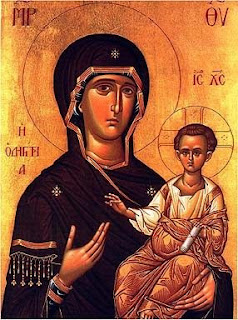
Now her mother was a secret Christian. And her mother brought her to a certain priest. The priest began hearing the case for St. Katherine. She told him what she sought in a suitable husband and the priest explained that he did indeed know a man that would be suited for her. He began to describe this man. The Man was from before all time, born of a Virgin, He presented Himself for the sake of the world. The priest began to describe the life and work of Jesus Christ. He then told her to take with her an icon of the Ever-Virgin with the Christ-Child. She brought the icon home and began to ponder about this Man that the priest had explained to her. In a vision, she beheld the same icon that the priest had given her but the Christ-Child looked away from her. She found herself then in a room with the Ever-Virgin holding the Christ-Child but the Christ-Child refused to look upon the maiden and only looked toward His Mother. Each time she tried to peer into the face of the Christ-Child, the Child would turn His eyes away from her. The Theotokos wondered why and asked Her Child why He would not look into the face of the young maiden. She was quite beautiful in stature. The Christ-Child explained that while the maiden beheld much outer beauty, inwardly, she was filthy. She needed to clean herself from the filth that lay within her. And then He would look upon her.

Katherine, after having this vision, went back to the priest and inquired more about the Christian Faith. Eventually, Katherine rejected all of her Pagan deities, turned to Christ, and was baptized by the priest whom her mother had brought her to. She then beheld in a vision once again, Our Lady with the Christ-Child. This time, the Christ-Child was looking upon her, seeing in her a future bride fit for the Kingdom of Heaven. And she would soon be tested by the material elements of the world which follow after the Father of Lies and give credence to idols and fallen spirits over the one true God of the Universe, Our Lord Jesus Christ. The Emperor Maximinus had declared Christianity illegal and demanded that all must offer sacrifices to his idols. Seeing this new law and understanding the bloodthirsty extremes of the Emperor, Katherine would approach the Imperial Palace and make an argument against the Emperor's gods.

Appealing to Plato, Homer, and Diodorus, before finally confirming the Truth of Christ, Katherine masterfully refuted the Emperor's feeble arguments against the Christian faith in favor of his idols. This frustrated the Emperor so much, but he desired not the death of one so beautiful, so he had many of his wise men come to make an argument against the Christian faith against this woman. Once more, Katherine appealed to the philosophers to shame the gods and then finished off her argument with the Truth of Christ, which is hidden from the wise and revealed to infants (Matt. 11:25). The philosophers stood dumbfounded. They had no argument against the Christian. The Emperor demanded they give an answer but the philosophers explained that since the chief of their philosophers could not refute her arguments, neither could they. And they even accepted Christianity that very moment. These philosophers were put to death immediately, receiving a baptism of blood and entering into the Heavenly Kingdom. Katherine was beat and placed in prison.

In prison, she was visited upon by the Emperor's General Porphyrios and the Augusta whose name in some martyrologies is given as Faustina. As the two visited Katherine, they learned of the Christian faith from her and became attuned to it. Katherine explained to them that they would soon suffer greatly for the Kingdom of Heaven, but it would be for a moment in comparison to their eternal glory. When Katherine was released from prison and brought before the Emperor again, he was irate to find that she was in full health and in good nutrition despite that he had ordered her not to be fed while in prison. He inquired who had fed her to which she replied that no man had fed her but the Lord kept her nourished. The Emperor again began to use bribery and persuasion to convince her that it was the gods who gave her the gifts she held and that she should accept them. But she continued to refuse the Emperor's arguments. The Emperor's prefect Hursasden recommended a punishment so wicked that it had only recently been concocted in that era. He had four wheels which spun. Two in the rightward direction, and two in the leftward direction. The wheels meeting together. This is how the disobedient Katherine ought to receive death. The Emperor gave Katherine another opportunity to repudiate Christ. She refused and repudiated the Emperor's pagan deities once more. The wheels began spinning but as they approached Katherine, they broke apart and flew out in every direction. Those in the room met horrific ends as they cried out, "Great is the God of the Christians!"

Faustina entered into the room in the aftermath and ordered the Emperor to cease and desist his reproach of the Christians. He forgot she was his own wife and became incessant with anger. He had her breasts torn out ad as he was readying to strike her head off with a sword, she called out to Katherine who gave her one last blessing and bid her to eternity. The Emperor struck down his own wife. Then, his General Porphyrios honorably buried the body of the Emperor's holy wife and when the Emperor discovered this, he had Porphyrios and his men slain. Desiring to give Katherine one last chance, the Emperor offered Katherine his hand in marriage. But Katherine wouldn't have it. She repudiated the gods. And as the Emperor led her out to be beheaded, she prayed this one final time:
"My Lord Jesus Christ and God, I  thank Thee that Thou hast secured my feet on the rock of patience and hast directed my steps. Stretch out Thy sacred hand, which was nailed to the Cross for our sake, and receive my soul, which today is separated from the body out of love for Thee. Be Thou mindful, O Lord, that we are flesh and blood; and do Thou forgive my transgressions, which I committed unknowingly, before Thy dread judgment seat; but wash away with the blood that I shed for Thee; and grant that my body, cleaved for Thee, will become invisible to those who seek it, keeping it safe and secure wheresoever Thou dost wish. Look down from on high upon Thy people who surround me, O Lord, and guide them to the light of Thy knowledge. Bestow upon those who invoke Thy name, through me, all they seek for their bereavement, that Thy works may be praised by all and that Thou mayest be glorified with Thine unoriginate Father and Holy Spirit, now and ever unto endless ages. Amen."
She ordered the executioner to cut her head off and as she was beheaded, milk flowed from her body and God had angels carry off her body to a secret place on Mount Sinai to the peak of the highest mountain in Sinai which now also bears her name. She now rests eternally in the glory of the Heavenly Kingdom. St. Katherine of Alexandria, pray for us!

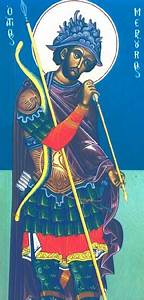
St. Mercurios

One thing that is seen in Christianity is how woman often times overshadow men on Feast Days. I remember my priest talking about this in his homily on the Holy Martyr Katherine from last year. Katherine of Alexandria overshadows the Martyr Mercurios, though certainly no less important. Only in the Christian Faith is the true masculinity of men celebrated and does the true femininity of women prevail. In the modern world, the endgame of feminism is to destroy men and turn women into men. Many people don't even think about women anymore but instead refer to them using their genitals. How disturbed the modern world has become and how much it truly needs a full conversion to Christianity. Only in Christianity do you see the heroic Katherine convert so many sinners to Christ in the span of weeks and only in Christianity do you see the true heroism of the battlefield shine forth in men such as Mercurios.

Mercurios lived much before Katherine. He lived under the Emperors Decius, Gallus, and Valerian. He came from the land of Anatolia. While he was serving Decius, he and his men came across a horde of Scythians who confronted the borders of the Empire. It was here that an angel revealed himself to Mercurios and prophesied that Mercurios would be put to great tests, but that if he accepted the sword the angel gave him and put his trust in the Lord, victory over the barbarians would be granted unto the holy one. Wielding the sword the angel had given unto him, Mercurios went into battle and began to penetrate deeply into the Scythian lines until he reached their general Regas. Reaching him, the two began to fight in single combat and Mercurios bested Regas causing the Scythians to flee.

Following this victory, the Emperor Decius lavished upon Mercurios great praises, exalting him to become commander-in-chief of the Roman armies, making his name known throughout the lands. Mercurios would sit in the palace alongside the Emperor. But it was in this earthly glory, that the angel returned to him reminding him of the eternal glory he was neglecting. This palace was temporary, yet Mercurios found himself basking in it, neglecting even his eternal virtue. Mercurios needed to remember the promise he gave unto the Lord. After this, Mercurios wept bitterly remembering the words of the angel and what he had promised, and the eternal glory he had been forsaking. He then began to come up with different pretexts to avoid meeting with the Emperor and avoid the praises that the Emperor wished to heap upon him. He was soon accused of insubordination by Catallus who hated Mercurios with a vengeance and wanted to take his place as commander-in-chief.

The Emperor summoned Mercurios and questioned why Mercurios would fail to render thanksgiving to the gods for his victory over the barbarians. Mercurios revealed that it was not the gods of the Emperor who gave him victory, but it was Christ who had given him victory over the barbarians. Mercurios stripped himself of all of his military equipment and decorations and presented himself as naked to the Emperor. The Emperor became hostile toward Mercurios and threw him into prison. Mercurios proclaimed, "I shall combat thee and conquer thy great power, that I might receive from my Master Christ the crown of victory." The Emperor subjected Mercurios to being suspended with ropes over a lit brazier with soldiers rending asunder his flesh with knives. After much torture, Mercurios was so wounded he couldn't even walk to the prison cells. The Emperor's soldiers had to carry his body. The next day, Mercurios showed to the Emperor healed and well-nourished, an angel having visited him in the night. When the Emperor queried, Mercurios revealed that he had been healed by Christ. After many tortures endured, the Emperor, desiring to carry out the rest of the issue swiftly, sentenced Mercurios to be decapitated. Mercurios was crowned with heavenly glory on November 25 at the age of twenty-five. When his relics were discovered, there was an ineffable fragrance of myrrh and incense which emanated from them.

Over one hundred years later, St. Basil the Great, living under Julian the Apostate, had received word that the armies of the Emperor would be returning from their campaigns in Persia soon. He and his congregation gathered together on a mountain in Caesarea where the Church of the Most Holy Theotokos was. St. Basil saw in a vision a Woman enthroned with great glory who commanded him to call upon the intercession of St. Mercurios to slay the enemy of her Son. St. Basil obeyed the Theotokos and called upon the intercession of the Great Martyr. He descended to the mountain and arrived at the Church of the Holy Martyr Mercurios where the relics of this martyr lay, but could not find the relics or the weapons that this holy martyr had used in his life. He questioned the sacristan but the sacristan knew nothing. He then discovered on the night he had visited the relics, June 26, 363 A.D., the ungodly Emperor Julian the Apostate, had been slain while fleeing from the Persians. Julian's death remains a mystery to many who are worldly people, but not to Christians. St. Mercurios, pray for us!

Sunday, November 21, 2021

The Greek Fathers


Let heathen sing thy heathen praise
Fall'n Greece! the thought of holier days
    In my sad heart abides;
For sons of thine Truth's first hour
Were tongues and weapons of His power,
Born of the Spirit's fiery shower,
    Our fathers and our guides.

All thine is Clement's varied page?
And Dionysius, ruler sage,
    In days of doubt and pain;
And Origen with eagle eye;
And saintly Basil's purpose high,
To smite imperial heresy
    And cleanse the Altar's stain.

From thee the glorious preacher came,
With soul of zeal and lips of flame,
    A court's stern martyr-guest;
And thine, O inexhaustive race!
Was Nazianzen's heaven-taught grace;
And royal-hearted Athanase,
    With Paul's own mantel blessed.
St. John Henry Newman

St. John Henry Newman shows his theological and historical depth of knowledge in a stream of beauty in his poetry. This one, called "The Greek Fathers", shows the flow of the early Church fathers through the Greek Church. He starts with a lament over the Fall of Constantinople, as the heathen Saracens cheer its downfall, "let the heathen sing thy heathen praise / fall'n Greece..." and then steps back in time to when Greece was Christian. The Greece he refers to is not Ancient Greece of the Platonists nor is it the Macedonian Empire. The Greece he refers to is none other than the Eastern Roman Empire. The Eastern Roman Empire would commonly be called the Greek Empire after the coronation of Charlemagne. After the Fall of Constantinople, Christianity would remain suppressed under Ottoman rule. There was a decline in the intellectual tradition of the Eastern Church. It is this that St. John Henry Newman reflects on. St. Clement of Alexandria, the founder of the Alexandrian school, St. Dionysius whose theological treatises have become influential in the Christian Neo-Platonic thought, Origen who continued the school of Alexandria and influenced an allegorical method of understanding Scriptures. Basil wrote to an imperial officer, the preacher, St. John Chrysostom, was excommunicated by a council formed by an Empress, St. Gregory the Theologian is who is referred to by Nazianzen, he is one of three to be given that epithet, and Athanase, St. Athanasius, who was chased away from his home but declared himself to be against the world.

Yes, let us praise the Greek fathers!

Thursday, November 18, 2021

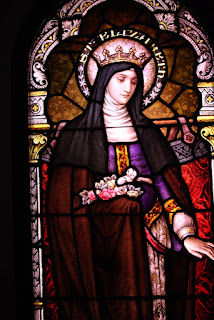
St. Elizabeth, Landgravine of Hungary

St. Elizabeth, the Landgravine of Hungary, is an exceptionally holy and pious example of Christian charity in the Church that the Middle Ages has produced. She also possessed a holy and childlike faith and devotion in all her life to Our Lord Jesus Christ. She was born to the pious King Andrew II who was renowned as King of Hungary for fighting back infidels, and his wife Queen Gertrude, the sister of the High Duchess St. Hedwig of Silesia, another charitable influence on the life of the young Landgravine. Herman, the Landgrave of Thuringia and Hesse at the time, was promised by the king that his son Lewis would be given in marriage to the daughter of the king. This promise was fulfilled, and from a very young age, she would be sent to live with the Landgrave, until she was old enough to marry.

She was always devoted to God and had her heart set on attaining the holiness of Our Lord and nothing else. She was devoted to her guardian angel and to St. John the Evangelist especially. At one point, she took the coronet off her head as she entered into the House of God. The Landgravine Sophia and her daughter Agnes inquired of the Princess why she did such an act, to which the young Elizabeth replied that she could not bear the weight of such jewels on her head while she beheld her Lord with a Crown of Thorns on His own head. Her acts of devotion earned her the ill-treatment of the Landgravine and Agnes who became her primary caretakers not long after she was given over the Landgrave Hermann. For Hermann had reposed when Elizabeth was just nine years of age and the widowed Landgravine became regent for her younger son Lewis, whom Elizabeth would soon marry. The courtiers would also bear hostility toward the young Elizabeth. It was through these trials that the saint would learn the rejection of worldly love and affairs and see that the only thing that mattered was her Lord. She would regularly pray,
O sovereign spouse of my soul, never suffer me to love any thing but in Thee, or for Thee. May every thing which tends not to Thee, be bitter and painful, and Thy will alone sweet. May Thy will be always mine: as in heaven Thy will is punctually performed, so may it be done on earth by all creatures, particularly in me and by me. And as love requires a union, and entire resignation of all things into the hands of the beloved, I give up my whole self to thee without reserve. In my heart I renounce all riches and pomp: if I had many worlds I would leave them all to adhere to Thee alone in poverty and nakedness of spirit, as Thou madest Thyself poor for me. O Spouse of my heart, so great is the love I bear Thee, and holy poverty for thy sake, that with joy I leave all that I am, that I may be transformed into Thee and that abandoned state so amiable to Thee.
Once, when Elizabeth went out in public, richly adorned and crowned, met a crowd of poor people. Having already given to them all her silver, a poor man walked up to her. She gave to him her embroidered glove. A young cavalier who was following the crowd bought the glove from the beggar and attached it to his helmet for Divine protection. He never ceased to go into battle without the glove. He would be triumphant in all battles and tournaments he faced and he fought in the Crusades. He attributed his victories to the saint. And it was not only in gifts of money that the saint would bestow. She would also serve them in holy acts. Once, when serving a group of impoverished people, she went out to gather meat, bread, and eggs. When her husband came out to meet her, he asked what it was she was carrying. She opened her arms to reveal a bundle of flowers and roses. He was about to caress her when he saw a cross appear above her head. He took one of the flowers from her, which he kept throughout his life and went on his way. When she returned to her friends, the flowers had gone back to the form of meat, bread, and eggs. Once, when she found a poor boy who was suffering from leprosy, she washed him and brought him back to her home. The Landgravine Sophia, who had detested Elizabeth for her charitable acts, exclaimed to Lewis, "See what she has done now! ... She has put one in your bed and you will catch the leprosy!" But when Lewis pulled back the curtain, it was revealed that in the bed was the Savior, and he never allowed Elizabeth to be opposed in her acts of charity ever again.

When she turned fourteen, the young Lewis would return from his education and though he would not think of her much, when the question was put in regards to marrying her, the one thing he considered most of value was her virtue. He expressed much displeasure to the way the saint was treated and more than honored, but also promoted her virtuous acts. He also was inspired to much virtue by the saint himself. As a gift, he sent her a glass garnished with precious stones of incredible value, on one side an image of the Crucified Christ, and the other a looking glass. The wedding was performed with utmost pomp and extraordinary public rejoicings by a holy man, Conrad of Marpurg. This Conrad became the saint's confessor and encouraged her in her acts of virtue. Conrad was further approved by Lewis and he submitted to Conrad as his confessor too. Both Lewis and Elizabeth joined themselves together in their charitable acts of giving. If she wasn't praying or reading, she was performing acts of charity, spinning, or cording wool, of which she would distribute to the poor. She strove to make prayer a continual act. And she never ate but what came out of her own kitchen.

In 1221, the Order of St. Francis was founded in Germany and the young Landgravine gave them utmost support. In 1222, Lewis and Elizabeth paid her father a visit and attended his second marriage to Yolande de Courtenay, daughter of the Emperor of Constantinople. In 1223, Elizabeth gave birth to her first child, Hermann. Elizabeth bore Lewis three children. Hermann, Sophia, and Gertrude. In 1225, a severe famine broke out in Germany while Lewis was visiting with the Emperor Frederick II. Elizabeth had exhausted the entire treasury to assist the poor and hungry during this time and the nobles were sharply critical of what she had done. They brought their accusations of her to her husband. But once more, he supported her, acknowledging that God would enrich them with divine blessings for the charity that they had done for the poor. But soon after this event, Lewis would be called out of his piety to fight in the Crusades for the Emperor Frederick II. The separation was a great trial for the two lovers but they bore all things in holiness. On his way to fight in the Crusades however, the Landgrave became ill with a fever and he died in Otranto. Elizabeth had just given birth to her youngest daughter Gertrude when the news of his repose reached her. She put on the dress of a widow and declared, "If my husband be dead, I promise to die henceforth to myself, and to the world with all its vanities."

And God would grant this request to her through the suffering which would soon befall her. For the Landgrave's brother treated his widowed sister-in-law with bitter contempt. It was said she squandered the public revenue to the poor and that her son Hermann was unfit for the government of the state. Elizabeth was forced out of the palace and made to stay in an inn with her maidens. But she nevertheless rejoiced in this newfound poverty that she had acquired. She would attend the Matins of the Franciscan friars the next day, and finding no one to take her in afterwards, stayed at the Church. She eventually was reunited with her children while there. And yet, reduced to poverty, she cried out in worship:
Ah. my Lord and my God, may Thou be all mine, and I all Thine. What is this, my God and my love? Thou all mine and I all Thine. Let me love Thee, my God, above all things, and let me not love myself but for Thee, and all other things in Thee Let me love Thee, with all my soul, with all my memory.
This bitter poverty the princess found herself in at only the age of 20 would not last long. For the nobility and her family were incensed at the outrage that had taken place and demanded justice for the widow and her children. Her aunt Matilda, the Abbess of the Kitzingen Monastery, invited her in. And the Bishop of Bamberg provided her a house near his palace. The Emperor Frederick II, seeing how young she was and having lost his own wife, proposed marriage to her. But the maiden desired to fulfill the rest of her days in chastity. The remains of her husband were brought back to Bamberg for a funeral procession where she thanked God for having received him into His eternal tabernacles. The remains were then brought back to Thuringia and laid to rest. The chief barons demanded that Henry restore her dower and all the rights of her widowhood. Though she chose to renounce the government, allowing Henry to serve as regent for her son while she took the habit of a Third Order Franciscan. Henry gave to her the land Marpurg begrudgingly asserting that if she held all of Germany, it would be given to the poor. She stayed the remainder of her days with her confessor Conrad who forbade her to give up the remaining disposal of her revenues. She converted the remainder of her dower to the use of the poor.

She was now separated from her children. Hermann was the Landgrave of Hungary, his uncle Henry the regent. Her daughter Sophia was pledged in marriage to the Duke of Brabant. Her daughter Gertrude would be the Abbess of the Aldemburg monastery. Her father attempted to encourage her to reclaim her royal titles, but she refused, preferring the state of voluntary poverty to the riches of the world. Conrad began to treat her harshly so that she would not be inclined to think of her past life and always be in remembrance of the new vows she had taken up. He ordered her not to give so much to the poor and not to provide so much for the sick and when she would disobey, he treated her with blows. He further took away her maids Ysentrude and Guda, lest her conversation with them remind them of her past life and replaced them with ill-tempered women. This was to teach Elizabeth the importance of obedience to her new spiritual director and confessor.

One day, a boy, both deaf and dumb, came to the saint. She inquired of him what ailed him. He did not answer. Not knowing why, she presumed an evil spirit had possessed him and said, "In the name of the Lord Jesus, I command you to answer me." At this point, the boy was able to speak. Hearing of this miracle, many brought their sick to the saintly woman for healing. She beheld a vision not long before her death which she would relate to Conrad. A voice had proclaimed to her, "Come, Elizabeth, come with me into the tabernacle I have prepared for thee from all eternity." On the fourth day, she fell ill with a violent fever which last for several days. Though Conrad had also been battling a recent illness, he was able to recover just enough to visit her one last time. The saint gave her last confession and gave up her soul on November 19, 1231. She was brought to the Church of St. Francis where she had often visited. She was laid to rest in Marpurg.

Her confessor Conrad and her brother-in-law Duke Conrad begged Pope Gregory IX to canonize her. The Pope did so on May 26, 1235. On May 1, 1236, people from all over came to do homage to the saint and two altars were erected to her. Frederick II took up the first stone of her grave and placed upon it a rich crown of gold. Her daughters Sophia and Gertrude took part in these ceremonies. Her son Hermann desired to be buried next to his mother. The Landgrave Henry, fearing the miracles that Elizabeth had performed, was afraid that the proximity to her body would raise her son back to life if he was laid next to her. He sought to have Hermann buried next to his father Lewis in Reinhartsbrunn. The Landgravine's widowed daughter Sophia, the Landgravine of Brabant, sought to claim the inheritance of Hermann for her son, and she succeeded in gaining him Hesse. Portions of her relics are kept in the Church of the Carmelites at Brussels; another portion at the Church of La Roche-Guyon upon the Seine; and a significant portion in the electoral treasury of Hanover.

Sources:
Agnes B.C. Dunbar, A Dictionary of Saintly Women

St. Elizabeth of Hungary, pray for me, and may you send your guardian angel to assist my own angel!

Wednesday, November 17, 2021

The beautiful rosary

I learned the rosary from an Anglo-Catholic priest. He knew the history of the rosary quite well and never prayed the luminous mysteries. I don't have any judgment toward those who do, but for me, the rosary will always be prayed with the full 150 Hail Mary's to remember the 150 Psalms. I wrote this on an old blog of mine back in 2016.

I wanted to write this for people unfamiliar with the rosary. It is a very beautiful devotion though often misunderstood. The rosary is quite a scriptural prayer and takes on the prophetic narrative of the 150 Psalms and how they are fulfilled in the Gospel. For instance, Mary’s intercession on behalf of sinners is seen in John 2:1-12. She stands at the side of the King (Psalm 45:1-9) and is always present in his life. One needs to become acquainted with the Psalms though to see how Mary is prophetically seen alongside her son in his mission but this is why the rosary has three sets of mysteries. The joyful, sorrowful, and luminous mysteries. Not only do they recount the prophetic detail of the Psalms but also the prophetic detail of Mary’s participation in Jesus’s life. What initially started as 150 Psalms became 150 Our Father’s and then 150 Hail Mary’s.

So here is the basics on how to pray the rosary.

Start with the crucifix saying the Apostle’s Creed–
I believe in God, the Father almighty, Creator of heaven and earth, and in Jesus Christ, his only Son, our Lord, who was conceived by the Holy Spirit, born of the Virgin Mary, suffered under Pontius Pilate, was crucified, died and was buried; he descended into hell; on the third day he rose again from the dead; he ascended into heaven, and is seated at the right hand of God the Father almighty; from there he will come to judge the living and the dead. I believe in the Holy Spirit, the holy catholic Church, the communion of saints, the forgiveness of sins, the resurrection of the body, and life everlasting. Amen.

Next, pray the Our Father holding the next bead–
Our Father, Who is in heaven, Holy is Your Name; Your kingdom come, Your will be done, on earth as it is in heaven. Give us this day our daily bread, and forgive us our sins, as we forgive those who sin against us; and lead us not into temptation, but deliver us from evil. Amen.

On the next three beads, three Hail Mary’s–
Hail Mary, full of grace. Our Lord is with you. Blessed are you among women, and blessed is the fruit of your womb, Jesus. Holy Mary, Mother of God, pray for us sinners, now and at the hour of our death. Amen.

On the next bead, pray the Glory Be and optional Fatima prayer–
Glory be to the Father, and to the Son, and to the Holy Ghost. As it was in the beginning, is now, and ever shall be, world without end. Amen.
O my Jesus, forgive us of our sins. Save us from the fires of Hell. Especially those in most need of your mercy. Amen.

Then begins the first Our Father introducing the first decade. An Our Father introduces the decade, and then the mystery is announced. Normally, information on the rosary does not specify the mystery, however, for our purposes, we will identify each one as I am most interested in explaining a full rosary which will give the 150 Hail Mary’s reflecting on the prophetic message of the Psalms.

After saying the Our Father, the joyful mysteries are begun. They start with the Annunciation. This is announced followed by 10 Hail Mary’s. Afterward, a Glory Be and optional Fatima prayer and whatever intercessions desired are made.

Then another Our Father and the Visitation of Mary’s to Elizabeth is the next joyful mystery. This is announced followed by 10 Hail Mary’s. Afterward, a Glory Be and optional Fatima prayer and whatever intercessions desired are made.

Then another Our Father and the next mystery is the Nativity. This is announced followed by 10 Hail Mary’s. Afterward, a Glory Be and optional Fatima prayer and whatever intercessions desired are made.

Then another Our Father and the next mystery is the Presentation of Jesus in the Temple. This is announced followed by 10 Hail Mary’s. Afterward, a Glory Be and optional Fatima prayer and whatever intercessions desired are made.

Then another Our Father and the next mystery is the Finding of Jesus in the Temple. This is announced followed by 10 Hail Mary’s. Afterward, a Glory Be and optional Fatima prayer and whatever intercessions desired are made. This concludes the joyful mysteries. The sorrowful mysteries are then transferred to as you pick up normally.

An Our Father is said and the first sorrowful mystery is the Agony in the Garden of Gethsemane. This is announced followed by 10 Hail Mary’s. Afterward, a Glory Be and optional Fatima prayer and whatever intercessions desired are made.

Then another Our Father and the next mystery is the Scourging at the Pillar. This is announced followed by 10 Hail Mary’s. Afterward, a Glory Be and optional Fatima prayer and whatever intercessions desired are made.

Then another Our Father and the next mystery is the Crowning with Thorns. This is announced followed by 10 Hail Mary’s. Afterward, a Glory Be and optional Fatima prayer and whatever intercessions desired are made.

Then another Our Father and the next mystery is the Carrying of the Cross. This is announced followed by 10 Hail Mary’s. Afterward, a Glory Be and optional Fatima prayer and whatever intercessions desired are made.

Then another Our Father and the final sorrowful mystery is the Crucifixion. This is announced followed by 10 Hail Mary’s. Afterward, a Glory Be and optional Fatima prayer and whatever intercessions desired are made.

This concludes the sorrowful mysteries as the glorious mysteries are next transitioned to which complete the prophetic nature of the Psalms. If we go to Hebrews 1:1-12, we see many Psalms are fulfilled in the resurrection. In addition, St Peter cites numerous Psalms, specifically Psalm 110:1 in Acts 2 related to the resurrection. There are three glorious mysteries which refer to our own resurrection–the resurrection of Christ which we are to become incorporated into, the descent of the Holy Spirit at Pentecost in which our baptism is a major part and we are joined to Christ’s resurrection in baptism (Rom. 6:3-4), and the Assumption of Mary which reveals Mary’s own resurrection from the grave to be foreshadowing of our own resurrection.

An Our Father is said as the glorious mysteries are announced. The first of which is the Resurrection of Christ. This is announced followed by 10 Hail Mary’s. Afterward, a Glory Be and optional Fatima prayer and whatever intercessions desired are made.

Another Our Father is said. The next mystery is the Ascension of Christ into Heaven. This is announced followed by 10 Hail Mary’s. Afterward, a Glory Be and optional Fatima prayer and whatever intercessions desired are made.

Then an Our Father is said and the next mystery is the Descent of the Holy Spirit at Pentecost. This is announced followed by 10 Hail Mary’s. Afterward, a Glory Be and optional Fatima prayer and whatever intercessions desired are made.

Then an Our Father is said and the next mystery is the Assumption of Mary. This is announced followed by 10 Hail Mary’s. Afterward, a Glory Be and optional Fatima prayer and whatever intercessions desired are made.

Then an Our Father is said and the last glorious mystery is the Coronation of the Ever-Virgin. This is announced followed by 10 Hail Mary’s. Afterward, a Glory Be and optional Fatima prayer and whatever intercessions desired are made. There is one more prayer–the Hail Holy Queen.
Hail, holy Queen, Mother of mercy, hail, our life, our sweetness and our hope. To thee do we cry, poor banished children of Eve: to thee do we send up our sighs, mourning and weeping in this vale of tears. Turn then, most gracious Advocate, thine eyes of mercy toward us, and after this our exile, show unto us the blessed fruit of thy womb, Jesus, O merciful, O loving, O sweet Virgin Mary! Amen.
This concludes the rosary.

Tuesday, November 16, 2021

The escape from Egypt

During the Fast of St. Phillip, Byzantine Christians pray regularly the service of the Paraklesis. A series of prayers offered to the Theotokos with intentions for our fellow Christian men.* In the course of these prayers, one theme strikes me. Ode 1 reads, "Crossing the waters on dry land, in that way escaping, from the evils of Egypt's land, the Israelites cried out exclaiming: To our Redeemer and God, let us now sing!" We see an historic reference here to the flight of the Israelites from Egypt, but we also tend to forget that there is also a spiritual element to the texts as well. Of course, we see the obvious historical reference. In the sacred history, Israel is subjected to the slavery of Egypt, Moses is chosen by God to deliver the Israelites from Pharaoh's hands, and God unleashes severe plagues on Egypt. It is easy to see the historic meaning and neglect other meanings. But as the Archimandrite told me a year and a half ago, the Scripture are not only shallow enough for an infant to wade in, they are also deep enough for an elephant to drown in!

It is largely in our prayers that we see the spiritual elements at play. In the Psalms, when King David speaks of Babylon, it often refers to a metaphorical place of spiritual captivity. Babylon had not increased in power when King David was alive. Yet King David speaks of a captivity as if it happened or was happening in his days. There is simultaneously prophecy and metaphorical reflection on our own spiritual captivity to the Devil in the Psalms. I will write more on those at another time. In the prophesies of Isaiah and Ezekiel, there are two instances where the Prophets cease speaking of the earthly Kings and refer to the Fall of Lucifer from Heaven. When Isaiah speaks of the King of Babylon and when Ezekiel speaks of the King of Tyre. There may be a typographical imaging in the Kings of Babylon and Tyre respectively that correlate to the Devil's rebellion against God, but the texts are primarily speaking of a spiritual being that has rebelled against God's order.

No truer is this than when we gather to pray the service of the Small Supplicatory Canon to the Theotokos known as the Paraklesis. For when we are confronted with the Israelites being led out of Egypt, we are next confronted with the praise of the Theotokos:
"Most Holy Theotokos save us. With many temptations surrounding me, searching for salvation, I have hastened to you; O Mother of the Word and Ever-Virgin, from all distresses and dangers deliver me."
In the East, the concept of sin is one of our own spiritual captivity. How much more fitting to begin this forty day fast with the realization that the Israel crying out to sing praise to the Theotokos is in fact the very Israel of today! Certain teachers have claimed that Israel still exists as a distinct country in the Scriptures or is of the Jewish inheritance still but those teachers have failed to see in Scriptures that a new Israel has emerged. When Jesus came into the world, He came into a world that was held hostage to sin and the Devil. He came to oust the Devil's rule from this world and release the captives from Hades. This is what St. Peter reflects on. It is why St. Peter compares the waters of regeneration in baptism to the flight of Israel from Egypt. The Israel of the Old Testament was the prefigurement of the Israel of the New Testament. What these teachers miss in their delusion is that the material Israel was under the old agreement. There now reigns a new agreement. The world that is Israel is now seen fulfilled in the Church. So together with the Israelites, we too celebrate our freedom from Egypt, even as we begin a new forty year wandering, which for us is forty days of fasting until the Nativity Feast.
"Assaults of the passions have shaken me, my soul to its limits, has been filled with much despair, bring peace O Maiden, in the calmness, Of your own Son and your God all-blameless One."
Free us from the hand of spiritual Egypt. Free us from the bondage which sin holds to our souls. Free us from the chains of imprisonment, this spiritual slavery we find ourselves in under the Devil. Be with us during these next forty days of wandering. Without the understanding that the Church is Israel, the New Covenant (Testament) becomes almost meaningless. The prayer life of the Church becomes almost void. We are marching forward, away from Egypt, on toward our Hope, on toward the Lord, led by His Holy Light in the Theotokos. She is the bush that did not burn for she held Him Who is Above All in her womb. She is the Ladder that leads Jacob to Heaven. She is the Ark of the Covenant which we now carry with us. "To God and the Savior, you've given birth; I ask you, O Virgin, from the dangers deliver me!"

To the Father and to the Son and to the Holy Spirit be the glory, unto ages and ages, Amen!

*I offered two of my friends names this year, both of whom have difficult job situations and one has been through many of the spiritual challenges I have been through.