Showing posts with label Statues. Show all posts

Thursday, February 10, 2022

The Holy Empress Theodora

The Holy Empress Theodora's life parallels that of the Empress Irene's in the Church's struggle for orthodoxy over the heresy of iconoclasm. Like Irene of Athens, Theodora was brought before the Emperor as part of a bride show. The Emperor Theophilos, like the Emperor Leo IV, was an iconoclast and Theodora was an iconophile. She had been raised an iconophile by her mother Theoktiste and her mother taught her daughters, in secret, the proper veneration of icons. The Emperor Theophilos, who would severely punish, banish, and even branded two monks with iconoclastic texts on their foreheads. Both the Emperor's stepmother who had arranged the bride show, and the Empress's mother, were iconophiles and they recognized the risks, but the orthodoxy had to prevail somehow. The Emperor's stepmother, Euphrosyne, was herself, a descendant of the Holy Empress Irene, a daughter of the Emperor Constantine VI, who was killed for his treacheries against his mother and his heresies of iconoclasm.

The Empress Theodora bore five daughters and two sons to the Emperor Theophilos. One son died in infancy and one daughter died at a young age as well. She would see five children live into adulthood. Michael III would succeed his father on the throne. The marriage was carried out some time around the year 830. Theophilos would discover his wife and their daughters venerating the icons at some point and she fiercely denied that they were icons but insisted instead that they were "dolls". The Emperor is furious about this iconodulist incident occurring in his courts and he orders that the practice cease. Theodora continued the practice of continuing to see her mother and her mother-in-law in private with her children, continuing to raise her children in the orthodoxy of the Second Council of Nicaea. Theophilos would be infected with dysyntery around the age of 29. Much like the Emperor Leo IV was covered in tumors and perished from disease, so God brings disease to call men to repentance. Unlike Leo IV, Theophilos would repent of his sins. Theodora recorded his repentance and presented it to the church seeking a pardon for his iconoclasm. Indeed, as the Patriarch Methodios recorded the names of the iconoclasts and presented them on the altar of Hagia Sophia, the Emperor Theophilos's name would disappear from the list. In Theophilos's case, his dysyntery would bring his mortal body to an end but it called his soul to repentance that it may soon be filled with eternal life.

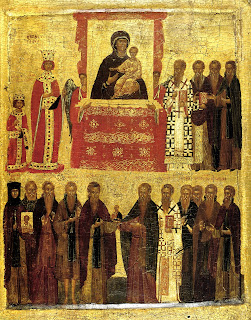
Theodora ordered a council held which re-established the faith of the Second Council of Nicaea. This council was held on the First Sunday of the Great Lent that year. Because of this, Greek Catholics and Eastern Orthodox Christians always celebrate the Feast of the Holy Sunday of Orthodoxy to mark the beginning of Lent. This is not the only imperially established Feast Day on the Church's calendar either. As part of this celebration, the Empress Theodora removed the remains of the iconoclast Emperor Constantine V, the father-in-law of Empress Irene, and had the remains burned. In turn, the remains of the Empress Irene were brought back from Prinkipio and restored to the imperial burial place (Women in Purple, 213). This act further showed the triumph of the iconophiles as the Empress Irene was the one who convened the Second Council of Nicaea, keeping her iconodulist faith hidden from her husband during his briefly lived reign, much as Theodora had to keep her iconodulist faith hidden from her husband as she taught her children to venerate icons.

The Empress was also strong in her leadership.
"She also stood up to the caliphs, according to one historian Bar Hebraeus, who reports that the Arabs thought they could take advantage of a widowed Empress and her young son. 'Seeing that it was a woman who ruled the country, the Arabs regarded Roman homage with contempt and broke the peace. Then Theodora the Queen sent an army against Cicilia in AD 861 and enslaved all the country of the Anazarbos.' There follows the account of an Arab ambassador, a eunuch named Nashif, when the queen offered to make peace but demanded 20,000 Christian prisoners of war in exchange for the 20,000 captured Arabs. When Nashif tried to take them anyway, 'Theodora killed them.'" (235-236)
She also did not hesitate to prosecute the Paulician heresy that was running rampant in the Eastern Empire, persecuting approximately 10,000 of the adherents of this heresy.

Sadly, she did not spend too much time in dedication to her son's education and he was known as "Michael the Drunkard" during his reign. Much like Irene, whose son Constantine VI was a poorly educated and stupid soul, so too was Michael III. Unlike Constantine VI, Michael III would not embrace the iconoclast heresy. But due to his poor ruling, he would ultimately be assassinated by Basil I. Theodora would witness the beginning of the reign of her son's assassination. Having lost the regal authority of being the Dowager Empress, she would not be buried with her husband. Instead, she makes indication to her daughters to be buried beside her mother in Gastria, where her mother lived as a monastic (234). The life of this saint is one of elevation from nothingness to preservation of the faith, to the loftiest of worldly elevations, and then a return back to her own lowly position. But worldly elevations are meaningless for a saint. The glory of an imperial burial might not have been for her but she had in the stead a saintly and holy burial, reaching the end of her life February 11, 867. Though some sources are conflicted and state that her death was in 856 (Thornton, Pious Kings and Right-Believing Queens). This is perhaps why Otto of Freising is also confused as to when to date the assassination of Michael III. It is presumable that the latter date seems most accurate. St. Theodora, Empress Regent and Dowager Empress of the Roman Empire who restored the veneration of icons to Christendom, pray for us!

See also:
Dictionary of Saintly Women, Agnes B.C. Dunbar
Women in Purple: Rulers of Medieval Byzantium, Judith Herrin

Friday, December 3, 2021

St. John of Damascus

St. John of Damascus was born around the year 675 A.D. at a time the Muhammaden heresy was in full power in the Holy Lands. Not only this, but the Emperor Leo the Isaurian began to reign during the lifetime of this holy man and would pursue with a vengeance this man of God. Leo the Isaurian was a notorious God-hating iconoclast who despised the veneration of holy images and the orthodox faith of the Apostolic Catholic Church. Though heresy was rampant throughout his birthplace, St. John's parents preserved the Faith and they reared him to preserving it as well. Sergios was a faithful servant of the Caliph and was in a prominent position but the Caliph whom he served was more lenient toward Christians at the time and allowed the practice of Christianity.

Sergios would adopt an orphan named Kosmas who became a brother to St. John. But he wanted the boys to be well-learned in the faith. Once, he came across a monk named Kosmas who was about to be executed who was weeping bitterly. Sergios asked the monk why he was weeping so in the face of death as martyrdom should bring a Christian great joy and Kosmas disclosed that while he had studied the natural sciences throughout his life, finding them incomplete, he began to study the theology of the Orthodox Church. There, he came to faith, but he had no disciple to pass on his knowledge to. Thus, rejoicing, Sergios had realized he had found a man to tutor his sons in the sciences. He ordered Kosmas to weep no more for he would be released and would tutor his sons. He pleaded to the Caliph to release Kosmas and the Caliph obliged. Kosmas educated the young John and Kosmas until they surpassed him in knowledges. Upon this, Kosmas, who had become a dear friend to Sergios, reposed. Sergios would repose not long afterward and John would be elevated to the role of Advisor to the Caliph following his father's footsteps.

St. John wrote relentlessly against the attacks of the iconoclasts that were wreaking havoc upon the Church. He defended the veneration of icons on the basis that matter was made holy and good by God. "I salute all remaining matter with reverence, because God has filled it with His grace and power." When we venerate the icons, we are not worshiping a mere image nor are we worshiping matter. We are reverencing the grace of God that the icon has been filled with. We are venerating what is behind the image and has filled the image. His writings eventually reached the Emperor Leo the Isaurian as they spread beyond the Saracen world and throughout the Byzantine Empire. The Emperor Leo was incensed at the writings of this holy man and so obtained one of St. John's writings that was in his own hand. Ordering a copyist to forge the handwriting, he began a plot to frame the saint of treason against the Caliph. As the Emperor could not lay a hand on St. John himself, he had to go about this line of dubious business. A letter that called upon the Emperor to combat the Caliph and liberate the Christians was forged in John's name and sent to the Caliph. The Caliph, finding the letter, ordered the right hand of John to be cut off.

St. John, lamenting the loss of his right hand, asked if he could keep it as a memory. The hand was brought to St. John by a servant and John took the hand placed it upon the icon of the Holy Theotokos. He prayed for healing. St. John fell asleep before the icon and when he arose, he found his hand healed once more.
Thy mighty right hand, O Lord, is glorified in strength. Thy right hand has healed my wounded my right; and, by the same, crush those that refuse to honor thy revered icon and that of Thy Mother. Use my right hand to magnify Thy glory and as an organ against those who destroy icons.
A red thread was wrapped into the wrist of St. John providing evidence that his hand had indeed been cut off, so when he was falsely accused yet again of putting someone else in place to have their right hand severed, he was able to present this evidence to the Caliph. The Caliph, repenting, offered to St. John's old position of Chief Advisor back, but St. John refused, preferring to flee to the monastery of St. Savvas with his brother Kosmas.

In rigorous testing from the elder, he was ordered to go to Damascus selling baskets for twice the price they were worth as the monastery needed money. It was a test of his obedience. He was mocked by many people there who didn't recognize him, but one man who recognized him did pay the price for the baskets that were being sold though he did not disclose to the saint that he was recognized. St. John learned obedience and humility this way. He was ordered by the elder not to write any troparia or sing any hymns, but when a brother reposed, the brothers at the monastery pleaded earnestly that he would write a hymn for the brother who had fallen asleep. The elder was away from the monastery at this point, and St. John eventually gave into the pressure from the brothers, and disobeying his elder, wrote a most beautiful troparion that is still chanted today. The elder, finding out what had happened, banished St. John from the monastery.

The brothers, lamenting, begged the elder to allow St. John back into the monastery as St. John reflected on how his disobedience to the elder was similar to the disobedience of Adam and Eve in the Garden of Eden. The elder eventually let him back into the monastery on the condition that he clean the monastery's bathrooms. St. John, eager to go back to the monastery, took this task faithfully upon himself and the elder was pleased to have such an obedient and humble servant among the brothers. It would be revealed to the elder in a vision of the Theotokos that he had been faithlessly suppressing the holy servant of God. That John was to write all sorts of troparia and defend the Faith in his writings against all sorts of heresies, and explain the Faith to many. The elder, repenting of his former suppression of the saint, allowed John to begin writing all sorts of canons, troparia, idiomela, prosomia, homilies, encomia, octoechos, and various other dogmatic instructions defending the Faith.

He and Kosmas began teaching music together and they compiled a Grammar of Music to help teach music to monastics. He would soon be ordained a priest by John V, the Patriarch of Jerusalem, and would be known as "The Mouthpiece of John" for his preaching and apologetic writings on the Faith. This would incur upon him the wrath of Leo the Isaurian and Constantine V. Kosmas would be consecrated as Bishop of Maiouma in 743 and John would rely heavily upon his brother's advice. St. John went on to write various discourses explaining the Orthodox Faith including Elementary Introduction to Dogma, Exposition and Profession of Faith, On the Holy Trinity, The Fount of Knowledge, and even an encomia to St. Barbara of whom he shares a Feast Day with. He reposed in the year 777 at the age of 104. He has influenced many philosophers, both East and West, including the Angelic Doctor, St. Thomas Aquinas. St. John of Damascus, pray for us!

St. Barbara

St. Barbara was born to the toparch Dioscoros, an ungodly man, during the reign of the Emperor Maximian. Her parents, seeing her beauty, desired to keep her hidden from men and would only allow certain sets of suitors to come. She was stored away in a tower and would turn down each and every one, desiring ultimately to preserve her virginity. Dioscoros, thinking this was out of naïve peevishiness on his daughter's part, had a bathing house built alongside the tower. The tower was filled with idols and Dioscoros ordered his men to construct the bathing house with two windows. But the maiden would have an encounter with Christ as the bathing house was being built and realized that it would be much more beautiful with three windows rather than the two her father desired to have constructed. Once, when basking in the waters of the bathing house, the virgin traced her fingers to form the image of the cross. It was at this point that the maiden realized that the idols were worthless.

When her father returned, he saw that there were three windows, as opposed to the two he had ordered, and questioned why. The maiden explained that the three windows were far more beautiful than the two he had intended to construct in the bathing house for, "Three windows shine upon every person who comes into the world." The maiden expressed a very vivid and detailed understanding of the nature of the Triune God by this statement which baffled her father. Realizing that his daughter no longer adhered to his idolatry, the man became furious and forgot his blood-relations with his daughter. He chased her out of the tower and as she fled down the mountainside, she was preserved from his anger as St. Thekla was once preserved from her pursuers.

In pursuit of his daughter, Dioscoros came across two shepherds. One did not have the heart to give up the persecuted virgin to her pursuer so he denied having seen her. The other was malicious in character and pointed the father in her direction. As a Divine punishment upon the shepherd, his sheep were turned to acanthus plants and he was deprived of his herd. Her father found her and took her before the Governor Markianos who encouraged her to embrace the idols of the Roman religion and preserve her life. He desired not to kill such a young and beautiful woman. But St. Barbara refused and gave her worship to Christ. She was subjected to different tortures and thrashed about, being deprived of her beauty but healed by Christ. The Governor claimed it was the gods who had healed her but she knew better and resisted his malicious deceits.

St. Barbara, rebuking the Governor, was sentenced to a second round of beatings. During these beatings, a witness, St. Juliane, wept for the saint and was spotted by the Governor Markianos. Revealing herself to be a Christian, Juliane was suspended on high and her flesh was lacerated and burned with lit torches. Their breasts were torn out, Juliane was imprisoned, and Barbara was led out naked through the streets, in mockery. St. Barbara, not wishing herself to be defiled, called out to God to have her clothed. Angels descended upon the Holy Virgin clothing her in a splendid array of glory, once again foiling the plight of the Pagans who attempted to defile her.

Seeing that Juliane and Barbara would not be swayed toward the demonic cult of heathenism anymore, the Governor ordered his executioner to behead the two Holy Women. But St. Barbara's father, forgetting his own blood relation with his daughter, desired himself to be the one to execute her. He went up with the executioner to the mountain where the two would be beheaded and as the executioner fell upon Juliane with his blade, so too did Dioscoros fall upon his own daughter with his blade. The saints executed, the vengeance of God would not go unsatiated. As Dioscoros descended from the mountain, a lightning bolt from the sky struck him down, reducing his flesh to nothingness and sentencing him to the fiery torment for his gruesome actions. Witnessing the flash of lightning fall upon the Toparch, the Governor Markianos went insane and died in his own madness. A man named Valentinos would preserve the relics of the two Holy Martyrs in a nearby village.

St. Barbara, mostly from the way her father died, is a patron saint of artillery, lightning, fire, gunpowder, gunners, and sudden death. She is called upon during thunderstorms and to preserve against sudden death. She is also revered as a military patroness for her patronage over gunners and artillery units. St. Barbara, pray for us!

Tuesday, September 14, 2021

The Exaltation of the Holy Cross


Under the imperial rule of Constantine, his mother Helena, on a visit to the Holy Land, discovered the Holy Cross on Golgotha after a Jewish man named Judah revealed it to her. It had been hidden under a Temple of Venus built by the Emperor Hadrian and the Empress ordered the Temple to be razed. Below it, were three crosses. As a funeral processed, the Patriarch Macarius told the Empress to have each of the three crosses placed upon the dead man. The first two did nothing. The third resurrected the dead man and by this, it was revealed which one was the true Cross of Christ. The Cross was set in a silver case the Empress made for it. Later, it was captured by the Emperor Chozroes who took the city of Jerusalem. The Persian Emperor held the Cross for 14 years before the Greek Emperor Heraclius defeated Chozroes and returned it to Jerusalem. He carried it back to Jerusalem but was suddenly unable. Patriarch Zacharias saw an angel blocking him. Patriarch Zacharias revealed this vision to the Emperor and told the Emperor that he could not bring the cross back to Jerusalem unless he walked the path barefoot and humiliated. Hearing this, Heraclius took of his raiment and in ragged attire, he carried the Cross the rest of the way to Jerusalem, placing it in the Church of the Resurrection.

The Cross is a fundamental part of every day Christian life. Many of us have had a cross with us since our baptism. These are given as gifts by parents, godparents, or friends. Some of us still wear the cross we are given from our baptism around our necks or around our wrists. Mine is too small for that. I have it held on a rosary holder. I was also given another cross before I was baptized which I carry with me in my pocket. Christians generally always keep crosses with them. Jesus told his followers that unless one take up their cross and follow Him, they cannot be His disciple. The cross was an execution device in the ancient world used by the Roman government to punish those who were not citizens. No citizens could be executed on a cross. It was reserved for slaves and traitors. The cross was an execution device utilized for the lowliest of criminals. Yet the Lord of glory was crucified and accepted death upon the cross.

St. Paul speaks of the Cross as being foolish to the Gentiles and a stumbling block to the Jews. The Gentiles cannot understand how one could devote themselves to a King who had received the death of a slave. To the Gentiles, such a man is no King. Maybe a martyr at best, but no King. To the Jews, they cannot accept the reality of the Messiah as the Son of God who came to accept the lowliest of deaths. They believe any one who is hanged on a tree is accursed. St. Paul talks about this in Galatians. It is through the Cross that Christ redeemed us from the curse of the law. St. Gregory Palamas distinguishes between heretics and Christians based solely on their attitude toward the Holy Cross.
"The heretics say that because Christ died nailed to the Cross, they cannot bear to see the form of the wood on which He was put to death. But where was the handwriting nailed which was drawn up against us because of our disobedience, when our forefathers stretched out his hand to a tree? How was it taken out of the way and obliterated, enabling us to return to God's blessing? ... Surely we should honor and use this divine trophy of the freedom of the whole human race. Its appearance alone puts the serpent, the originator of evil, to flight, triumphs over him and disgraces him, proclaiming him defeated and crushed. It glorifies and magnifies Christ, and displays His victory to the world. If it were really necessary to disregard the Cross because Christ suffered death on it, then His death too would be neither honorable or salutary. So how can we have been baptized into His death, as the apostle tells us (Rom. 6:3)? And how can we share in His resurrection, if we have been planted together in the likeness of His death (Rom. 6:5)?" (Homily On the Precious and Life-Giving Cross)
During the iconodulist controversies of the early medieval Church, one notable position remained consistent between those who championed the orthodox faith and those who opposed the orthodox faith of the veneration of icons. Both parties could unanimously concur that the Cross was to be venerated and was indeed a most acceptable icon to venerate. The orthodox rightfully concluded that the Cross was essential to the incarnation which had redeemed all and made every icon venerable through humanity of Christ, which could properly be represented in iconography.
"[W]e decree with full precision and care that, like the figure of the honoured and life-giving cross, the revered and holy images, whether painted or made of mosaic or of other suitable material, are to be exposed in the holy churches of God, on sacred instruments and vestments, on walls and panels, in houses and by public ways, these are the images of our Lord, God and saviour, Jesus Christ, and of our Lady without blemish, the holy God-bearer, and of the revered angels and of any of the saintly holy men." (Second Council of Nicaea)
Recently, I had a conversation with someone and asked them about why God would lay such a heavy burden upon someone even though He insists that His yoke is easy and His burden is light. They responded to me that it maybe was because He wanted to carry the burden with them. Which turned me toward reflecting upon this Feast Day. Consider Christ's walk to Golgotha. How He fell under the weight of the Cross and Simon the Cyrene was called upon by the Roman soldiers to lift the Cross and carry the Cross that Christ would be crucified under. Jesus did not have to carry His Cross alone. This was at a time when all of His apostles had fled and hidden in embarrassment and as He cried out on the Cross, "My God, my God, why has Thou forsaken me?" The only apostle remaining with Him was John. His Mother remained with Him as well as His other women disciples. And strangers were left with Him. Isolation is certainly a heavy burden, but it was a burden that He shared. He tells us to pick up our Cross and follow Him. But He didn't carry His Cross alone. His yoke is easy and His burden is light not in terms of the actual weight, but in terms of the relative weight. Because when we let Him carry our Cross, we will make it to Golgotha with Him. And when we make it to Golgotha, we will then be with Him in Paradise.

Thursday, August 12, 2021

Blessed Radegund, Foundress of the Holy Cross Monastery


Blessed Radegund was a Thuringian Princess and daughter of the King Bertaire. She was raised a Pagan but Bertaire lost his life when he was assassinated by his own brother Hermenfred. Clotaire, the son of Clovis and Clotilda, would then take vengeance upon Hermenfred together with his brother Theodoric and Clotaire would take Radegund and her brother with him into his palace. There, Clotaire would instruct the saint in the religion of Christianity which she would eagerly embrace. Radegund, having become a Christian, would desire to be a martyr but this was during a time when the Church was not persecuted but rather flourishing in the Gallic region. How could she be a martyr when the Church was flourishing? Radegund always embraced the most severe of penances as a result of her faithful desire to be a martyr and always preferred the role of Martha to Mary. Our Lord says that Mary picked the better, however, it is important to remember that the Marthas always have a great reward in eternity for their works always prepare them for much deeper conversation.

Each Lent, Radegund would take on a penance more severe then the one before. Often wearing a haircloth, sometimes she would even adorn herself with chains underneath her clothes which would cut her body and cause bleeding. She distributed finances to the poor and contributed to monasteries. She spent much of her time in prayer. Clotaire would eventually marry her as his first wife in order to cement his political dominance over Thuringia. As his queen, she would appease the anger of the king and intercede on behalf of those he had desired to have put to death, often times saving the lives of many men who had incurred the king's anger. But her prayers and fasting and contributions to the poor angered the king who complained that he had married a nun rather than a queen, even as she kept her royal duties. Fearing an uprising from her brother, he had him assassinated. When Radegund found this out, she began to fear her own life and ran away from her husband.

According to Venantius, Radegund fled from the king all the way to Noyon where she encountered St. Médard. St. Médard refused to give her the monacha since she was the king's wife and still the queen of the Franks but she reprimanded him for choosing to fear man more than God. Convinced and inspired by that argument, he consecrated her as a deaconess. All of the costly gold, jewels, diamonds, she had attired herself with as a queen, she cast before the altar of the Lord as gifts. She founded a nunnery in Poitiers and entreated several bishops, Eufronius, Praetextatus, Germanus, Felix, Domitianus, Victorius, and Domnolus, who granted her approval for the founding of her monastery in the year 566. But Radegund, despite being the foundress of her monastery, deferred the role of abbess to her friend Agnes. She was a Queen who had relinquished royalty and honor in her own monastery.


She had desired many relics in her monastery and wrote to the Emperor Justin II and his wife Sophia in the East for different relics, especially that of the Holy Cross which she sought a piece of. My own parish has a piece of this Holy Cross, the one on which Jesus himself was crucified on. The Emperor had sent her the relics but the Bishop Maroveus was the one who had received them first. Though they were sent to her monastery, he refused to relinquish them to her. She had no help whatsoever from this bishop even as she was subject to him and wrote him, begging for his help much of the time, he still gave her monastery no assistance. She eventually wrote to King Sigibert and the Bishop Eufronius for aid which they did provide, and the Bishop Eufronius obtained the relics and delivered them to her monastery. (St. Gregory of Tours, History of the Franks IX.40) This is why her monastery is called the Monastery of the Holy Cross in Poitiers (Poitiers St. Croix) for the monastery holds a piece of the Holy Cross.

Often times, Radegund would find herself making the meals as the priests would eat. And she preferred to be the one making the meals instead and did so until the brothers were well fed. She denied herself of the luxuries of much foods consuming of a diet of honey water, vegetables, and legumes. Not even the sweetness of fruits did she allow herself to consume. She took up this abstinence her entire life, denying herself the sumptuous meat that many would indulge in. She would even clean the shoes of the other monachas while they slept through the night ensuring that each of them had cleaned and oiled shoes for the next day. She eagerly assisted the lepers. One wonders how she ever found time to pray as she did so many things for others, living a life of complete servitude to her Lord and doing all of these out of the utmost charity for others.

Some of the miracles attributed to her by Venantius include saving a sailor from shipwreck as the waters of his boat filled during a storm and he cried for her intercession. The storm ceased instantly. She cured a bloody humor from the eye of one of her monachas with wormwood which was pressed to the eye. One of her servants, Andered, lost numerous children in infancy before he even saw them. One she took and wrapped up in her mantle, pressing it to her haircloth, the child revived. Another of her monachas had an infant sister who had reposed. She spent several hours in the room with the child, praying fervently though no one knew exactly what was going in the room. While the rites of burial were being prepared for the child, the girl arose as Christ could not deny the faith of the holy woman.

Many more miracles of this holy woman are recorded by both Venantius and St. Gregory of Tours. St. Gregory of Tours recounts the saint left this world on August 13, 587. St. Gregory was present at her funeral and there was much lamentation in the nunnery (IX.2). She was remembered for her humility and her constant devout service to others. St. Gregory records her miracles in his work, Book of Miracles.

Clothaire, who had abused his wife for her faith, would find himself ill toward the end of his life. In 560, he acquired the sole kingship of France as his three brothers and their sons were now all dead. He brought gifts to the tomb of St. Martin of Tours who his mother had held a deep devotion toward. He besought St. Martin for his intercession to implore the mercy of God on his behalf and built a monastery dedicated to St. Médard at Soissons. He showed great repentance for all the crimes he had done crying, "How powerful is the heavenly king, by whose command all the greatest monarchs of the earth resign their life!" He also recalled how he had treated Radegund and repented of what he had done. His illness would take him in the year 561 A.D. There is no doubt that the faith of the holy Radegund had contributed to his conversion.

See also:
Life of Radegund, Venantius Fortunatus

Saturday, August 7, 2021

The Architecture of Justinian


Justinian the Great was truly one of, if not the greatest, of monarchs in world history. Among the accomplishments of this Emperor which, in my brief readings on him, have now been shown to be too many for just one post to do justice to, are his architectural accomplishments. Especially with the ludicrous infrastructure proposals of our current ruling classes, it is important to reflect on the cultural superiority of the late classical period's architecture. We see buildings crumbling and falling down on a routine day-to-day basis. This seems to be what we are used to. But the classical period envisioned that buildings would be built to last. Buildings were to provide refuges for people in times of harsh environments. Justinian the Great came to power in the Roman Empire when it was falling apart, literally and figuratively. Out of nowhere, he rebuilt the entire system, the entire country, and revived what looked to be an almost dead beast.

According to John Malalas, Justinian rebuilt the city of the district of Sykai with its theatres and walls (Chronicle, Bk 18.12) and he also completed the rebuilding of the public baths which the Emperor Anastasios had started (18.17). He also built the central hall of the Basilican cistern. "He was responsible for the building of ninety churches throughout his realm. Most famous, of course, is the incomparable Cathedral of the Holy Wisdom...The great edifice has been called the most important building in Eastern Europe and, along with the Parthenon and St. Peter's in Rome, one of the three most important buildings in European history." (Thornton, Pious Kings and Right-Believing Queens, 252)

Paul the Deacon has the following to say about the Emperor Justinian:
"The same emperor also built within the city of Constantinople to Christ our Lord, who is the wisdom of God the Father, a church which he called by the Greek name 'Hagia Sophia,' that is, 'Divine Wisdom.' The workmanship of this so far excels that of all other buildings that in all the regions of the earth its like cannot be found." (History of the Langobards, Bk. 1.XXV)
Evagrius Scholasticus goes into further detail about the architectural projects of the Emperor Justinian the Great.
"He also raised at Constantinople many sacred buildings of elaborate beauty, in honour of God and the saints, and erected a vast and incomparable work, such as has never been before recorded, namely the largest edifice of the Church, a noble and surpassing structure, beyond the power of words to describe. Nevertheless I will endeavour to the best of my ability to detail the plan of the sacred precinct. The nave of the sanctuary is a dome, supported by four arches, and raised to so great a height that the sight of persons surveying it from below can scarcely reach the vertex of the hemisphere, and no one from above, however daring, ventures to bend over and look down to the floor. The arches are raised clear from the pavement to the roof : but within those on the right and left are ranged columns of Thessalian stone, which, together with other corresponding pillars, support galleries, so as to allow those who wish, to look |228 down upon the performance of the rites below." (Ecclesiastical History, Bk. 4.XXXI)
Justinian also built the Church of the Holy Apostles. Because of his architectural accomplishments, Justinian is often seen in iconography holding a church building.

Much of the architectural contributions of Justinian the Great still hold up to this day. He was well-regarded for his architectural accomplishments. The fact that these buildings are still stable while much of the modernist art is crumbling apart shows which direction our current infrastructure plans need to traverse in. Though Hagia Sophia has long since been turned into a mosque, the building has remained in tact and has never come close to falling apart. We build buildings nowadays that crumble to dust within minutes. But that doesn't seem to phase the current architects who don't generally live in these buildings but are satisfied only with the fact that they built something "within code". The infrastructure of our nation needs serious upheaval immediately. Justinian the Great came to Constantinople at a time when the Roman Empire was about to crumble to dust. It is time we start to consider his architectural vision for our cities before our empire crumbles to dust.

Friday, August 6, 2021

Empress Irene


Empress Irene was considered to be an exceptionally beautiful orphan from Athens. When Constantine V held a beauty contest to determine who his son, Leo IV's, wife would be, she easily won the competition. There was a problem though. The Roman Empire was going through a massive political and theological conflict, much of this would lead to the West crowning for itself a new Emperor in Charlemagne. Leo IV was a strong opponent of the Church's teaching on the veneration of icons and he adhered to the false Council of Hieria which forbade the veneration of icons and supported the destruction of icons. Empress Irene was an iconodule. The agreement of the marriage was that her iconodulist position would remain suppressed and she would say nothing against the Emperor's iconoclastic views.

But this didn't necessarily work out too well as she was found by the Emperor Leo IV with icons which she had privately stowed away. She attempted to state that she had nothing to do with the icons but the Emperor hadn't wanted anything to do with that. The two never reconciled afterwards. Leo IV, a frequent attendee of Hagia Sophia, the Great Church, saw above its altar a crown. Consumed with his anger toward Irene and his iconoclastic viewpoints, as well as his envy for power, demanded the crown be taken down from the altar and placed on his head. No sooner did he do that then he became covered in boils and tumors all over his body. He died later that day in his heresy, a preparation for the worm which devours eternally.

She and her son returned numerous icons which had been stolen by the Emperor and even translated the relics of St. Euphemia from Lemnos to Constantinople, placing them in the Church she had built to receive them. The Empress Irene would provide a care for the Church hotly contrasted by both her husband, now consumed by the worm for his heresies and thievish actions, and her son who would himself turn out as abusive toward the clergy.

The Empress regent, ruling on behalf of her son Constantine VI, dealt with a crumbling Empire which faced treachery from inside and dealt with Arab foes on the outside. The Frankish Empire was beginning to bloom at this point too. She sought an alliance for her son with the daughter of Charlemagne but that marriage never came about as the daughter would repose before the marriage. The iconoclasts were everywhere within the Eastern Empire and a strong push for iconoclasm had always been a scourge for the Eastern Church. It would be the Empress who would convene the Second Council of Nicaea which would overturn the treachery of the Council of Hieria. She appointed the Nikephoros, also a saint and a fervent supporter of the veneration of icons who would be elevated to the Patriarchal throne of Constantinople, as her imperial commissioner at the Council of Nicaea, formally approved in 787, and the iconoclast heresy was condemned. Although this was by no means the end of the heresy, this Council would eventually lead to the finality of the disputation against iconodulism. The work against the heresy of iconoclasm would be completed by the Empress Theodora only half a century later.

The five brothers of the heresiarch Leo IV plotted treachery against the Empress having abandoned their oaths of loyalty to him upon his death. But the Empress was quick-thinking and knew political cunning quite well. She was able to quash their plots of treachery. Much of her reign required her to be constantly on guard from rebellion within her own interior ranks and the uprisings of the Arabs all around the Empire. Not to mention the heretics threatened the Church with persistent regularity. The Second Council of Nicaea was her first major victory in her regency. But the victories would not last for long though and the Empire would eventually give way to the interior turmoil.

Constantine VI was considered by his mother to be rather stupid. And he experienced difficulties with his first wife. As to whether or not Irene had any play in it is disputable as Constantine also was unable to produce a male heir from her. He took for himself one of his mother's ladies-in-waiting. This marriage was objected to by the Church for his first wife was still alive and the Church has always taken  a strong stance in favor of the indissolubility of marriage. In his brief, seven year reign, he abused the clergy of the Church. Patriarch Tarasios would condemn the second marriage and excommunicated the priest who performed the scandal. Constantine VI, who may have been sympathetic to his father's iconoclast heresy, was suspected of treachery by his mother and in 797, she would lead him into the room where he had been born and blinded him. Some sources suggest that he died from the injuries sustained and others suggest that he was imprisoned by his mother until his death some time around 805 A.D. This event led to the Empress being crowned as Empress Regnant. The shockwave led to the Blessed Charlemagne's crowning as Emperor of the Romans by the Pope of Rome as the Byzantine Empire had proven unstable.

The Empress very quickly began to repeal the disasters done by her husband and son as she cut taxes and would be a contributor to monasteries. But this was to no avail. The rebellion and treachery against her continued. She had even attempted to propose a marriage to Charlemagne, hoping that an alliance with the Western Romans would prove fruitful for the Roman Empire as a whole and unify it under one monarchial head again. But the rebels eventually pushed her out. In 802, Nikephoros I led a group of Eunuchs to the Imperial palace while the Empress was in Eleutheria and he proclaimed himself as Emperor. The guards also accepted him as Emperor and under the threat of swords, the Patriarch Tarasios would crown him as Emperor. There was nothing that could be done for the Empress Irene who was ill at the time. She took this as a judgment from God that she was not worthy to reign over the Romans and she was sent off to Mytilene in Lesbos where she was forced to embrace a scanty livelihood. She went on to her Heavenly glory August 9, 803. She, along with the Empress Pulcheria, is celebrated on August 7. If our leaders took after the humility of the Empress Irene, we would see much more justice in this world. St. Irene, pray for us!

See also:
Dictionary of Saintly Women, Agnes B.C. Dunbar
Pious Kings and Right-Believing Queens, Protopresbyter James Thornton

Monday, August 2, 2021

History of the Franks, Bk. III

"Clovis, who believed in the Trinity, crushed the heretics with divine help and enlarged his kingdom to include all of Gaul; but Alaric, who refused to accept the Trinity, was therefore deprived of his kingship." (III) St. Gregory certainly was not shy of inserting polemic into his work, and here he attributes all of Clovis's successes to his Triune orthodox belief over that of the Arians he conquered. As we learned in the last chapter, Clovis could not tolerate the presence of the Arians any more and used that to justify his war of liberation against the Arian kings that had taken over Spain and Germany and to unite all of Gaul under his domain. The two things most feared then about Clovis should be his God and his axe. A cult developed in Medieval France for Clovis though the cult has never received Papal approval, it still flourishes amongst French Christian nationalists to this day. Based on St. Gregory's account, it certainly doesn't seem as if there would be a reason to oppose such a cultus for Clovis.

After the death of Clovis, his four sons, Theuderic (from a mistress whom he had prior to meeting Clotilda), Chlodomer, Childebert, and Lothar, split the kingdom amongst themselves (II.1). Saint Quintianus succeeded Licinius to the episcopal throne in Clermont-Ferrand (III.2), and the Danes attempted to seize part of northern Gaul under their King Chlochilaich but were driven out by Theuderic and their king was killed (III.3). In Thuringia, there ruled three brothers, Baderic, Hermanfrid, and Berthar. "Hermanfrid beat his brother Berthar in battle and killed him" (III.4). Hermanfrid's wife Amalaberg "sowed the seeds of civil war" between the brothers. Theuderic aligned with Hermanfrid to defeat Baderic and they killed him but Hermanfrid failed to keep his word in allowing Theuderic to share the kingdom equally with him. This earned enmity between the two.

Sigismund was the son of Gundobad and he ruled Burgundy after his father's death. A Catholic, he contributed to many monasteries and built the monastery of Saint-Maurice d'Agaune. His first wife had died but he had a son to her named Sigeric. This step-mother was cruel to her step-son and once, when wearing the clothes of Sigismund's first wife, the daughter of Theodoric, her step-son saw her and rebuked her for this. This drove her to great ire and led her to the greatest treachery. She tricked Sigismund into believing that Sigeric wanted to overthrow him. Sigismund had word with his son immediately, sent him to sleep, and in while Sigeric lay asleep, Sigismund murdered his own son. It wasn't long after that Sigismund realized what a mistake he had made. He wept bitterly over this. "An old man who was present is said to have remarked: 'Weep for yourself, Sigismund, for, on your wife's evil advice, you have murdered your own son in this barbarous fashion. There is no point weeping for your boy, who has been strangled in his innocence." (III.5) Sigismund would remain in the monastery of Agaune for the remainder of his life.

Queen Clotilda called Chlodomer and her other sons together and said to them, "My dear children...do not give me cause to regret the fact that I have brought you up with such care. You must surely resent the wrong which has been done to me. You must do all in your power to avenge the death of my mother and father." (III.6) This account seems dubious in accordance with what we later hear of Clotilda in praying for an end to fratricide. Also, it must be considered the events of her parent's deaths are in question too. Further, what she meant by avenging her parents is ambiguous. It is more likely she never intended Sigismund to be slaughtered. Nevertheless, Chlodomer and his brothers fought against Sigismund and his brother Godomar and the Burgundian army was beaten. Sigismund tried to escape to the monastery but was captured with his wife and sons. Chlodomer decided to have Sigismund killed but Saint Avitus warned him, "If you change your plans and respect God by refusing to have these men killed, the Lord will be with you and you will go forth to victory. On the other hand, if you do kill them, you will fall into the hands of your enemies and you will suffer a fate similar to theirs. Whatever you do to Sigismund and his wife and children, the same will be done to your children and your wife and yourself." But Chlodomer didn't listen and he had Sigismund and his wife and his children thrown down a well in Saint-Péravy-la-Colombe. Chlodomer rushed into battle with the Burgundes and heard him mimicking the Frankish troops. He "rushed headlong into the middle of his enemies" and they hacked off his head. His brother Lothar married his widow Guntheuc and after her mourning period was over, Clotilda would take his three sons, Theudovald, Gunthar, and Chlodovald, into her own household.

Theuderic wanted to punish Hermanfrid and called upon his brother Lothar for help. They pushed back the Thuringians and Lothar would take Radegund as his wife. Theuderic remained in Thuringia for a while and Hermanfrid would fall to his death. The exact cause of the fall was unknown but Theuderic is said to have soething to do with it (III.7-8). Theuderic was presumed dead while in Thuringia and his brother assumed control of Clermont-Ferrand but Theuderic returned (III.9). Childebert had heard his sister Clotilda was suffering for her Catholic faith from her Arian husband Amalaric and when she sent a towel with her own blood on it from the abuse, he took up arms against the Gothic King. Amalaric attempted to flee but was struck by a spear and killed. Clotilda did not survive the journey and was buried beside her father Clovis (III.10). Theuderic was encouraged by his brothers to fight against the Burgundes but he desired to punish the people of Clermont-Ferrand. His soldiers pillaged and looted the city, destroying the entire region. Some desecrated the church of St. Julian ad were possessed by an evil spirit which caused them to eat themselves. St. Quintianus was bishop and St. Gregory argues the reason that this was done was on account of the crimes of the priest Proculus committed against his bishop (III.11-13). During the rebellion of the people of Clermont-Ferrand, many were taken hostages by Childebert and Theuderic and many were reduced to slave labor. St. Gregory describes the escape of Attalus from slavery during this time as Attalus was a kinsman of his (III.14-15).

Bishop Dinifius died in Tours and was succeeded by Ommatius who held this throne for three years. After he died, Leo was bishop for seven months. After he died, Bishops Theodorus and Proculus succeeded him at the wish of Clotilda. Then Francilio, a senator, replaced them. He is said to have been poisoned, dying after a drink on Christmas Day. He was replaced by St. Injuriosus (III.17). When Clotilda was in Paris, Childebert began to fear that the affection she was lavishing on the children of Chlodomer would cause a threat to his kingdom. He and Lothar plotted their removal by either cutting their hair or through their deaths. Hair was a signification of social class for the Franks. They deceived Clotilda by informing her they would place them on the throne once held by their father. "Once I see you succeed him on the throne, I shall forget that I have lost my son" (III.18). But their plan was revealed and Clotilda, realizing this said, "If they are not to ascend the throne, I would rather see them dead than with their hair cut short." Chlodovald could not be caught but his brothers were slain. He cut his hair and devoted himself to monasticism serving as a priest until his repose. He is venerated as St. Cloud.

Theuderic sent his son Theudebert with Lothar to reclaim the territory the Goths had taken from their father's kingdom. Theudebert marched to Cabrières and had intercourse with a married woman named Deuteria while his father killed his relative Sigivald (III.21-23). He was ordered to do away with Sigivald's son but instead warned him of what Theuderic had commanded instead. When his father died, he was able to buy off an alliance with his uncles and married Deuteria (III.23). "Once he was firmly on the throne, Theudebert proved himself to be a great king, distinguished by every virtue. He ruled his kingdom justly, respected his bishops, was liberal to the churches, relieved the wants of the poor and distributed many benefits with piety and friendly goodwill." (III.25) Childebert and Theudebert formed an alliance against Lothar. Lothat was not strong enough to resist and hid himself in the forest, trusting in the mercy of God. "Queen Clotild learned what had happened. She went to the tomb of St. Martin, where she knelt in supplication the whole night praying that civil war might not break out between her sons." (III.28) A storm broke out and the troops of Childebert and Theudebert were pelted with hailstones. They withdrew and Lothar was unharmed. Childebert and Lothar set off for Spain but upon seeing a procession for St. Vincent, they became fearful and avoided the city of Saragossa though they did seize much of the Gothic lands. (III.29)

Theodoric, the King of Italy, had married Audofleda, the sister of Clovis. He died leaving her a widow. Her daughter Amalasuntha, also a widow, became regent for her son. Audofleda wanted her to marry a king's son but Amalasuntha preferred one of her slaves, Traguilla and eloped with him. Both of these queens were Arians and the Arians had a practice of distributing communion in different cups preserved for those of royal blood and for those of lesser mortal blood. Amalasuntha placed poison in her mother's cup and upon drinking it, Audofleda died. "What can these miserable Arian heretics say, when the Devil is present even at the altar? We Catholics, on the contrary, believe the Trinity, co-equal and all-powerful, would come to no harm even if we were to drink poison in the name of the Father, the Son, and the Holy Ghost, one true Godhead." (III.31) The Italians were furious with Amalasuntha and replaced her with Theudat who murdered her. Then Childebert, Lothar, and Theudebert upbraided him for having killed their cousin. He sent them fifty thousand pieces of gold but Childebert horded it to himself. Next, Theudebert marched into Italy going all the way up to Pavia. He sent Buccelin back there. Buccelin conquered upper Italy and subjected it to Thedebert. Buccelin then campaigned into lower Italy and defeated Belisarius in a series of campaigns. Justinian would demote Belisarius for his losses and had him replaced with Narses. Narses also lost a series of campaigns against Buccelin (III.32). Theudebert made reconciliations with his fiancée Wisigard, marrying her, recompensing the Bishop Desideratus whom he had wronged, and was summoned by God after an illness which he died from in A.D. 548 (III.33-36). His son Theudebald reigned in his place (III.37).

Sunday, August 1, 2021

History of the Franks, Book II

It is book II where St. Gregory will begin going into the details of the Merovingian dynasty, the first dynasty to govern the Franks. He continues with background information. His book is very much, up until the time period he lives, a work in hagiography as much as it is in history. He writes of saints along with their persecutors and he isn't shy to praise the victories of saints when God gives this to them. "It will not, I am sure, be held unreasonable of me if I describe the blessed lives of the Saints together with the disasters of the unfortunate: for it is the course of events which demands this and not my own fantasy as a writer." (II) In the context of the Frankish Kingdom, this is important to take note of, especially when it comes to Clovis I's conquests, as St. Gregory uses the horrific deeds of the persecutions of the Arian Vandals and Goths to lavish praise on this King of the Franks and show how Clovis's Trinitarian faith was what led to his victories (III). The Arian controversy broke out in the fourth century of the Church in which the heretic Arius rejected the divinity of Christ and considered him to be a creature instead of Creator, equal to the Father, which is the orthodox opinion. The Goths, when they accepted Christianity, were evangelized by the missionaries sent by the Arian Emperor Valens. Thus, they accepted Arianism and held that as "orthodoxy" not knowing of its deficiencies. For this reason, they persecuted orthodox Christians severely, believing they held to the true faith when it was indeed a counterfeit faith.

St. Gregory begins this book where the previous book left off. The death of St. Martin of Tours led to an episcopal vacancy. There was a deacon who would later be a priest who served the Bishop of Tours during his lifetime. This priest was named Brycius and Brycius was always skeptical of the miracles of St. Martin calling into question both the legitimacy of these miracles and even the intelligence of St. Martin. St. Martin had overheard this Brycius call him a "half-wit" behind his back and Brycius vigorously denied this. But there was no hiding the truth from St. Martin who declared to Brycius that after he died, Brycius would succeed him to the episcopal throne but his episcopacy would be filled with various troubles. Soon after St. Martin reposed, Brycius succeeded him to the episcopal throne, and although arrogant, was known for chastity in body. He would be accused by a woman considering a religious vocation of violating her. When the baby came, he called on the baby to answer whether or not he was the baby's father. The baby declared that Brycius was not the father and the people accused him of witchery. "To justify himself to the people, he placed burning coals in his cassock and pressed them against his body and went in procession with the whole mob to the tomb of Saint Martin. When he reached the tomb of he dropped the coals on the ground, but his cassock had no marks of burning on it." (II.1) The people would eventually expel Brycius and after he spent seven years in Rome, he would return to his episcopal see and lived in Tours for another seven years, expiring in the forty-seventh year of his episcopacy. The troubles he received as a bishop were enough to justify him and he is venerated on November 13.

St. Gregory begins to describe the persecution of the Vandals in the next book. "The Christians were persecuted more cruelly in the tie of the Vandals" (II.3) informs the Bishop. And he resists not to censor the persecutions done by the Vandals either as in the prior chapter, he describes the suffering of one Catholic who was coerced into being re-baptized into the Arian "faith" by these same Vandals. She had her menstruation just at the moment she was forced into the water, contaminating the water so that the Arians could not subject her to this re-baptism. They went on to behead her (II.2). The girl is left unnamed. He vividly describes the encounter between Cyrola and Eugenius, the former attempted a miracle in which he had his servant press his hands to his eyes and call out to Cyrola to open them. However, as the servant continued to press his hand to his eyes, it came to such an extent that he could not move his hand but it would press harder. The orthodox bishops Eugenius, Vindimialis, and Longinus anointed him upon the repentance of his heresy and confession to orthodoxy. King Huneric of the Vandals had Vindimialis and Longinus executed but refused to give the award of martyrdom to Eugenius and had him exiled (II.3). Because of heresies which ravaged the churches in Gaul, the barbarians were sent to bring judgment upon it. Bishop Aravatius, despite much fastings and prayers to the Apostle Peter, was powerless to stop the divine judgment, though St. Stephen's oratory was preserved. Gaul was ravaged by the Athanaric of the Goths and Attila of the Huns. (II.4-6) Attila was stopped by Aetius with the aid of St. Peter the Apostle at the city of Metz. (II.7)

It is after the defeat of Attila that St. Gregory goes into deal about the race of the Franks. He hypothesizes that they were once a group of individual tribes with different warlords. The name of their first king is unknown and the texts given seem to be ambiguous for though regales is used to describe their leaders by the differing authors he cites, specifically Sulpicius Alexander, it is not clear what their function was. (II.9) At some point, the governing authority of the Franks was eventually consolidated into a monarchy. One thing that we can be certain about with respect to the Franks is that they seem "always to have followed idolatrous practices" (II.10). St. Gregory, a Catholic, makes this point the only negative element about the Franks. After Gregory describes the extravagances of their idolatrous practices, he goes on to give a history of the succeeding bishops of various French cities.

The Senator Avitus first succeeded in becoming Emperor but was deposed for his libidinous way of life. Somehow, he then became the Bishop of Piacenza but the Senate was still hostile to him and he fled to the church of St. Julian, reposing on the journey and was buried at the foot of the martyr (II.11). Childeric King of the Franks began to seduce the daughters of many of his subjects and there was an assassination plot that rose against him as a result. He entrusted a friend of his with half of a coin and said that when the coin was to be made whole again, he would know it would be safe to return. This was when the Roman Commander Aegidius made Soissons a rump state of the Roman Empire. (II.12) Childeric fled to the King Bisinus and his wife Basina where he seduced Basina after finding her loyal to him and she bore Clovis and deserted her husband. The succeeding bishops of Clermont-Ferrand are Arthemius, Venerandus, and Rusticus. Eustochius was succeeded by Perpetuus in Tours. Eufronius would be made a bishop in Autun. Namatius succeeded Rusticus (II.13-16). During this time, Childeric made alliance with Odovacer and laid waste to the Saxons, subduing the Alamanni to his rule (II.18-19). Duke Victorius was put in charge of the seven cities by Euric, King of the Goths, and he built many underground chapels, erected columns in the church of St. Julian, built the church of St. Lawrence and the church of St. Germanus in Saint-Germain-Lanbron (II.20).

After Namatius, Eparchius succeeded the episcopal throne in Clermont-Ferrand. Sidonius Apollinaris succeeded Eparchius (II.21). After Victorius was stoned to death for creating scandalous rumors about Senator Eucherius and was given over to irregular affairs with women (II.20), King Euric of the Goths started a violent persecution of the Christians in Gaul (II.25). "He ordered the doorways to churches be blocked with briers so that the very difficulty of finding one's way in might encourage men to forget their Christian faith." After the death of Perpetuus, Voluousianus became Bishop of Tours, Verus succeeded him in turn, and it was at this time that Clovis succeeded Childeric and waged battle against Syagrius, the son of Aegidius in Soissons (II.26-27). Syagrius was not afraid to fight Clovis but "the army of Syagrius was annihilated" and he fled to Alaric II in Toulose who handed the refugee over out of fear of the Franks. "At that time many churches were plundered by the troops of Clovis, for he still held fast to his pagan idolatries" (II.27).

This persecution was soon about to change for Clovis was about to meet Clotilda. According to Gregory, she was the daughter of Chilperic, the son of Athanaric, who was killed by his brother Gundobad along with his wife (II.28). Clotilda was taken in with Gundobad and her sister Chroma became a religious. This account is disputed by the New Advent Catholic Encyclopedia.
"The popular poems substituted for King Godegisil, uncle and protector of Clotilda, his brother Gondebad, who was represented as the persecutor of the young princess. Gondebad is supposed to have slain Chilperic, thrown his wife into a well, with a stone tied around her neck, and exiled her two daughters. Clovis, on hearing of the beauty of Clotilda, sent his friend Aurelian, disguised as a beggar, to visit her secretly, and give her a gold ring from his master; he then asked Gondebad for the hand of the young princess. Gondebad, fearing the powerful King of the Franks, dared not refuse, and Clotilda accompanied Aurelian and his escort on their return journey. They hastened to reach Frankish territory, as Clotilda feared that Aredius, the faithful counsellor of Gondebad, on his return from Constantinople whither he had been sent on a mission, would influence his master to retract his promise. Her fears were justified. Shortly after the departure of the princess, Aredius returned and caused Gondebad to repent to the marriage. Troops were despatched to bring Clotilda back, but it was too late, as she was safe on Frankish soil. The details of this recital are purely legendary. It is historically established that Chilperic's death was lamented by Gondebad, and that Cartena lived until 506: she died "full of days", says her epitaph, having had the joy of seeing her children brought up in catholic religion. Aurelian and Aredius are historical personages, though little is known of them in the legend is highly improbable." (New Advent Catholic Encyclopedia: Clotilda)
Regardless, Clovis would become attracted to this saintly woman and would ask for her hand in marriage which led to a religious disputation between the two shortly after the birth of their son Ingomer. Clotilda called on Clovis to forsake his pagan gods. "The gods whom you worship are no good...They are carved out of stone or wood or some old piece of metal...Jupiter, that obscene perpetrator of all sorts of mucky deeds, who couldn't keep his hands off other men, who had fun with all his female relatives...Mars and Mercury...were certainly not worthy of being called divine" (II.29). "[N]o sooner had [the child] received baptism than he he died in his white robes." Clovis became angry but Clotilda rendered her thanks to God. "I am not at all cast down in my mind because of what has happened, for I know that my child, who was called away from this world in his white baptismal robes, will be nurtured in the sight of God." Chlodomer was born, was baptized, and became sick which caused Clovis more anger. Clotilda prayed for the healing of her son Chlodomer and he recovered from the illness. It was in fighting with the Alamanni that Clovis saw his life threatened, he called out to the God of Clotilda at that point, "Jesus Christ, you who Cotild maintains to be the Son of the living God, you who deign to give help to those in travail and victory to those who trust in you, in faith I beg the glory of your help. If you will give me victory over my enemies, and if I may have evidence of that miraculous power which the people dedicated to your name say that say they have experienced, then I will believe in you and I will be baptized in your name. I have called upon my own gods, but, as I see only too clearly, the have no intention of helping me. I therefore cannot believe that they possess any power, for they do not come to the assistance of those who trust in them. I now call upon you. I want to believe in you, but I must first be saved from my enemies." (II.30) After this, the battle turned in Clovis's favor and the Alamanni were routed. He told Clotilda what had happened and she called for the Bishop Remigius and Clovis was baptized as the first convert to the Christian religion from the Franks (II.31).

Clovis would defeat Gundobad with the assistance of Godigisel. Upon seeing Gundobad flee, Clovis sent an ultimatum that Gundobad would offer an annual tribute or Clovis would do whatever he wanted to Gundobad (II.32). This subjected Gundobad to Clovis. Gundobad would then convert to Catholicism after seeing his brother Godigisel defeated by Clovis and his Arian bishop killed (II.33-34). St. Avitus would be the one to receive Gundobad into the faith and St. Gregory lavishes praise on the works of this bishop. "I find it hard to go on seeing these Arians occupy a part of Gaul" (II.37), Clovis declared and he invaded them and drove them out with the help of God. While marching through Poitiers, he ordered that nothing be taken from the land except food and water. One of his men took hay from a poor man. When Clovis found out about the theft, he took his axe and he split the soldier's head open with it. Clovis defeated Alaric II on the battlefield of Vouillé. The Emperor Anastasius would grant Clovis a consulship (II.38). Clovis came to Tours when Licinius succeeded Eustochius (II.39) When Clovis was in Paris, he reached out to Chloderic, the son of Sigibert in the East Frankish region, saying that if his father died, he would have his alliance. Chloderic had his father assassinated. Clovis came to Cologne to show that Chloderic had misinterpreted his words and punished Chloderic for his treacheries, splitting his head open with an axe. The people subjected themselves to Clovis afterward.  "God submitted the enemies of Clovis to his dominion and increased his power, for he walked before him with an upright heart and did what was pleasing in his sight." (II.40) Clovis also defeated Chararic and subdued the rebellion of his relatives Ragnachar and Ricchar, killing both of them with his axe. (II.41-42) Clovis died on November 27, 511 A.D. and was buried in the church of the Holy Apostles (now St. Genievieve) in Paris. Clotilda had built this church. She served as a religios at the church of St. Martin of Tours the rest of her life, occasionally visiting Paris (II.43). "She was remarkable for her great modesty and loving kindness."

Thursday, May 13, 2021

American Harlot


"Behold, I saw a woman sitting on a scarlet beast" (Rev. 17:4). She had the name, "Mystery, Babylon the Great" (17:5). There are metaphorical symbols that we may not fully understand but we are given to know that the Antichrist will find himself opposed to the Whore of Babylon just before her judgment. He will be God's instrument of vengeance against the Great Harlot. The Harlot has carried out great influence and has even gone to cause these kings who will work together with the Antichrist to overthrow the Harlot. We don't know who the Harlot is. St. John Henry Cardinal Newman has the following to say about what tradition has stated about her:
"Secondly, let it be considered, that as Babylon is a type of Rome, and of the world of sin and vanity, so Rome in turn may be a type also, whether of some other city, or of a proud and deceiving world. The woman is said to be Babylon as well as Rome, and as she is something more than Babylon, namely, Rome, so again she may be something more than Rome, which is yet to come. Various great cities in Scripture are made, in their ungodliness and ruin, types of the world itself." ("Lectures on Antichrist", Part 4)
In reading Richard Bauckham's The Theology of the Book of Revelation, he writes the following about this Mother of Harlots:
"From John's perspective Rome's evil lay primarily in absolutizing her power and prosperity. Consequently she pursued and maintained them at the expense of her victims. According to 18:24, it is not just for the martyrdom of Christians, but for the slaughter of all her innocent victims that Rome will be judged: 'in her was found the blood of prophets and saints, and of all who have been slain on earth'. There is therefore a sense in which Revelation takes a view from the 'underside of history', from the perspective of the victims of Rome's power and glory. It takes this perspective not because John and his Christian readers necessarily belonged to the classes which suffered rather than shared Rome's power and prosperity. It takes this perspective because, if they are faithful in their witness to the true God, their opposition to Rome's oppression and their dissociation of themselves from Rome's evil will make them victims of Rome in solidarity with the other victims of Rome. The special significance of Christian martyrdom is that it makes the issue clear. Those who bear witness to the one true God, the only true absolute, to whom all political power is subject, expose Rome's idolatrous self-deification for what it is." (38-39)
It is interesting that everything that Bauckham writes here can very elaborately be applied to the United States of America today. In the Harlot is found the blood of all the innocent, oppressed, prophets, and saints. It is her judgment that reveals to the world the evils of Babylon the Great and yet, the world, participating in her sins, has also become and taken part in the sins of Babylon the Great to such an extent that they mourn her death. Christians are told to join the courts of Heaven in celebrating the triumph of Heaven over the Whore of Babylon as she is ultimately devoured by even the very barbarous enemies of the Antichrist. Her sins have worn down the saints of the Most High to such an extent that those who provide faithful witness will already be in a state of desiring the ultimate triumph over the Great Harlot. They will not mourn for the rest of the world who partakes in her sins for next, the Antichrist who leveled her will also be slain.

But does this apply so strongly to Rome? Maybe the ancient readers viewed it as such but Babylon is called "Mystery" here. A "mystery", as the ancient Christians understood the term, was something that one was to be initiated into. As Newman gives us Babylon as a type, and Rome as a type, so maybe also the great misunderstanding of this Evil Harlot that extended her sins to the Heavens. On many issues, St. Augustine not only exonerated, but also proved why God allowed Rome to blossom and grow. It was not because of her wickedness, certainly not. But because she was morally superior to the other nations. Yet Rome became infatuated with its false deities and so it refused to acknowledge that it was the true God who delivered the Carthaginians and the Druids into her hands.

According to the Romans, the Carthaginians were slain for their infatuation with the evils and horrors of infanticide. There is some speculation that the Carthaginians might have even come from the same bloodlines as the Philistines and worshiped the same demons as the Philistines. This horrified the far more civilized Romans and they declared war on Carthage and subdued it. Julius Caesar's The Gallic Wars, recounts the horrifying details of the Druid practice of human sacrifice. Horrified by this, Caesar, in his highest and most civil sensibilities, declared all-out war on the Druids until they put an immediate end to the practice. But Rome refused to admit that God had delivered these into her hands.
Rome's chief sin was not its immorality but its haughtiness and its self-deification.

Certainly Christians underwent many persecutions under Rome but these were at different intervals of time, with some persecutions being worse, some Emperors being more tolerable toward the Christian religion, and then settling down the next minute. These were persecution cycles they went through. Candida Moss declares it The Myth of Persecution but that is an instance of extreme nonsense from the anti-Christian world. There was persecution, but it exited at differing intervals until the Holy Emperor Constantine declared Christianity to be legal. Even during and after Constantine, orthodox Christians still experienced different intervals of persecution which depended on the governing authorities of the Roman Empire. The sack in 476 A.D. spared the West and enabled Christianity to rule the Empire as Charlemagne was soon crowned as Emperor Augustus by the Pope of Rome. To the great fury of the Roman Emperor in Constantinople. But the result is clear. The subjection of the Roman Emperor, whether in the West or in the East, to the Church, proved decisive in Rome's survival. This is the argument that St. Augustine makes in The City of God. Though pride is the deadliest of all sins, it is hard to see that as extending to the offense of Heaven as greatly as the Harlot's sins. No, the sin here must be seen as unforgivable. Pride is a deadly sin but it is forgivable through the greatest acts of humility.

There are some who revel in the sins they commit and they look for ways to commit even greater sins. This is the manifestation of the sin of the Whore of Babylon. We have seen with our governors here in America how they revel and glorify in the sin of murder. One governor says, "I can kill them when they're 24 weeks in the womb!" And the next governor says, "I can kill them when they're outside the womb!" It's no longer that they are horrified by the sinfulness of their perversities but instead they go out of their way to increase the number of their sins! They bask in these sins. They raise their hearts to the skies and say, "Nothing shall happen to us! Those who criticize us are morons! Nothing to see here!" Everything of the Whore of Babylon, from persecution of the saints through murderous campaigns of the Ku Klux Klan's assaults and killings of Catholics, to the chaining of slaves, to the leveling of innocent civilians overseas, to even the slaying of infants! Everything of the Whore of Babylon is a sin of which the stench reaches to the heights of the Most High.


The religion of Antichrist is rather interesting. He will honor a god of forces and yet exalt himself above all that which is called God. Much the same, the Whore of Babylon seems to mimic or even foreshadow the religion of Antichrist in a sense. St. Hippolytus tells us that when Rome is subdued by the ten kings, these kings will hold sovereignty over democracies that resemble kingdoms. "As these things, then, are in the future, and as the ten toes of the image are equivalent to (so many) democracies, and the ten horns of the fourth beast are distributed over ten kingdoms" (On Christ and Antichrist, 27). And St. John Henry Cardinal Newman remarks on the lust of the United States of America for its state religion:
"On the other hand, after having broken away from all restraint as regards God and man, they gave a name to that reprobate state itself into which they had thrown themselves, and exalted it, that very negation of religion, or rather that real and living blasphemy, into a kind of god. They called it LIBERTY, and they literally worshipped it as a divinity. It would almost be incredible, that men who had flung off all religion should be at the pains to assume a new and senseless worship of their own devising, whether in superstition or in mockery, were not events so recent and so notorious. After abjuring our Lord and Saviour, and blasphemously declaring Him to be an impostor, they proceeded to decree, in the public assembly of the nation, the adoration of Liberty and Equality as divinities: and they appointed festivals besides in honour of Reason, the Country, the Constitution, and the Virtues. Further, they determined that tutelary gods, even dead men, may be canonized, consecrated, and worshipped; and they enrolled in the number of these some of the most notorious infidels and profligates of the last century. The remains of the two principal of these were brought in solemn procession into one of their churches, and placed upon the holy altar itself; incense was offered to them, and the assembled multitude bowed down in worship before one of them—before what remained on earth of an inveterate enemy of Christ." ("Lectures on Antichrist", Part 2)
He further states of the American religion, "And further, let it be remarked, that there was a tendency in the infatuated people I have spoken of, to introduce the old Roman democratic worship, as if further to show us that Rome, the fourth monster of the prophet's vision, is not dead. They even went so far as to restore the worship of one of the Roman divinities (Ceres) by name, raised a statue to her, and appointed a festival in her honour."


Babylon is a type, Rome is a type, and currently, America is a type. If course for our history is not reversed drastically, the current state of both political affairs and religious affairs could usher in the Reign of Antichrist sooner than we imagine. Of the day and hour no one knows. And the Great Harlot shall not be revealed to us until her destruction. But we can clearly see how the United States of America fulfills so many characteristics. The question is whether it will continue to harden and claim that she is Queen, not a widow. Will she begin an even greater persecution of Christians than did even the Soviet Union? I resist speculating more for while the United States clearly fits the description of this effeminate Harlot, I do not believe any one will know until the coming of Antichrist who she actually is.

Sunday, May 9, 2021

Historicism Debunked, Pt. 3 - The Myth of Persecution


In order to bolster their claims that the Papacy is the Antichrist, Protestants are obliged to come up with a whole persecution legend of how the Papacy somehow rose up to persecute the "true Christians" and was in power performing this action the whole time. This is historically problematic to say the least. Numerous details are left out. Numbers from the Inquisitions, Religious Wars, and individual massacres are grotesquely inflated, context is ignored, and they'll even claim certain sects as their own. Let's just state this, it's a fictitious claim to begin with so naturally, numbers have to be inflated. One source claims that the Inquisitions killed an estimated 50,000,000-150,000,000 people! I tried to contact the author of that website in the past, ages ago, asking him what his credentials were. His health seems to be poor and at the time, his wife was also battling a serious illness. It seems she has since reposed as well. He never got back to me. I contacted him recently but have still not heard a response. I don't know if it's because he is simply so caught up in this fictitious narrative that he thinks any one who disagrees with him is a Satanic Beast or simply that he doesn't want to engage in counter-arguments. Regardless, he needs serious prayer so if you can commend him to your prayers, that would be the Christian thing to do.

But again, these numbers are grotesquely exaggerated and there is a huge context missing. Since all historicists maintain that the Papacy is a persecuting power, let's see if they can actually back those claims up. Albert Barnes, in his Biblical Commentary on the Book of Daniel states the following,
"This would be a persecuting power - "making war with the saints," and "wearing out the saints of the Most High." Can anyone doubt that this is true of the Papacy? The Inquisition; the "persecutions of the Waldenses;" the ravages of the Duke of Alva; the fires of Smithfield; the tortures at Goa - indeed, the whole history of the Papacy may be appealed to in proof that this is applicable to that power. If anything could have "worn out the saints of the Most High" - could have cut them off from the earth so that evangelical religion would have become extinct, it would have been the persecutions of the Papal power. In the year 1208, a crusade was proclaimed by Pope Innocent III against the Waldenses and Albigenses, in which a million of men perished. From the beginning of the order of the Jesuits, in the year 1540 to 1580, nine hundred thousand were destroyed. One hundred and fifty thousand perished by the Inquisition in thirty years. In the Low Countries fifty thousand persons were hanged, beheaded, burned, or buried alive, for the crime of heresy, within the space of thirty-eight years from the edict of Charles V, against the Protestants, to the peace of Chateau Cambresis in 1559. Eighteen thousand suffered by the hands of the executioner, in the space of five years and a half, during the administration of the Duke of Alva. Indeed, the slightest acquaintance with the history of the Papacy, will convince anyone that what is here said of "making war with the saints" Daniel 7:21, and "wearing out the saints of the Most High" Daniel 7:25, is strictly applicable to that power, and will accurately describe its history."


If I count correctly, that is a grand total of 2,280,000 Protestants killed by the Papacy. Definitely no where near the number claimed by the previous source cited. Adam Clarke's Commentary on the Book of Revelation also cites Bp. Thomas Newton saying the exact same thing. But here's the full context.

Heretics are a pestilence upon the Church. When one actually studies the context of these "persecutions", one will see that not only have Protestants committed equal crimes against Catholics throughout the years, but also that in many instances, Protestants were the instigators. Who exactly were the Waldensians, the Lollards, and the Albigensians? It's important to start with the Albigensians. The Albigensians, or the Cathar movement, was a sect that "believed the material world was the creation of an evil deity, and that the pope's church was not only corrupt, but also false and evil...[they] also believed in reincarnation and rejected the sacraments, prayers for the dead, and the veneration of images and relics" (47)

Waldensians initially sought approval for their order from the Pope, but somewhere down the line, distanced themselves even more overtly from him and began "to argue that that the ultimate supreme authority was the Bible, not the pope. In addition, much like the Cathars, the Waldenses also questioned the validity of the church's sacraments, prayers for the dead, and the veneration of saints and icons." (Carlos M.N. Eire, Reformations: The Early Modern World, 48)

The Lollards who followed Wycliffe's sacramentarian movement gained incredible popularity in England but then showed a demonic hostility toward iconography, "On taking an image of St. Catherine [of Alexandria] from a chapel, one Lollard said to another: Aha...my dear chap, now God has sent us fuel to cook our cabbage and appease hunger. This holy image will make a bonfire for us. By axe and fire she will undergo a new martyrdom, and perhaps through cruelty of those new torments she will come at last to the kingdom of heaven." (52)

Anabaptists weren't all peaceful either. One sect, "a group of fanatics under Jan van Batenburg (1495-1538" were known as "swordsmen" and "indulged in sporadic terrorism in the Netherlands for nearly a decade after 1535" (Euan Cameron, The European Reformation, 333).

St. Robert Cardinal Bellarmine highlights the fact of religious wars ongoing between Protestants and Catholics and notes that,
"St. Augustine, disputing on this citation, says in the time of Antichrist the Devil will be loosed, and hence that persecution will be much more severe than all the ones that preceded it; the Devil can do so much more cruelly loosed than bound....Hippolytus the Martyr and St. Cyril say that the martyrs whom Antichrist will kill are going to be more illustrious than all the previous ones, because the old martyrs fought against the human ministers of the devil, but these will fight against the Devil himself...we have experienced nothing like that from the year 600 or even 1000." (On the Roman Pontiff, Bk. III, ch. VII)

He then challenges the heretics, "what comparison is there of that sort of persecution with that carried out by Nero, Domitian, Decius, Diocletian, and others? Accordingly, for one heretic who is burned, a thousand Christians formerly were burned—and that was exercised in the whole Roman world, not only in one place. Furthermore, at present when the supreme penalty is given a man is merely burned, but in ancient times they exercised the most unbelievable torments." (ibid)

And this is evident when one examines the martyrdom of St. Catherine of Alexandria, the Forty Martyrs who had rocks thrown at them, the martyr Barbara who was locked in the tower by her father, the martyr Irene who escaped numerous tortures before finally laying down in a coffin having converted thousands to Christianity, St. George who was brutally tortured multiple times before finally being being beheaded, etc. And further, "the fact is that heretics killed many more Catholics in the last ten or fifteen years in France and Flanders than inquisitors burned heretics in perhaps the last hundred." (ibid)

One could even add that if one takes the date of 538 as the start of supposed "Antichrist" reign, you have to take into account the Holy Emperor Justinian's torments of a demon that caused him to turn on numerous orthodox Christians, the iconoclastic Roman Emperors who persecuted men such as St. John of Damascus, framing him for a crime that had the Muhammadans cut his hand off, the imprisonment of St. Maximus the Confessor whose tongue was cut out, and numerous Patriarchs of Constantinople who were deposed by these Emperors for upholding the orthodox Catholic doctrine. And yet it's the Papacy who is the persecuting power? Clerics don't even have the authority to kill or maim a heretic. Only the legitimate authorities of a State have that right! (St. Alphonsus de Liguori, Moral Theology, Bk. IV, 378)

Now, let's not sanitize history. Catholics have done some wretched things, especially to the Waldensians.
"Those in the Piedmont valleys enjoyed religious peace from 1536-1559, owing to the political dependence of the districts upon France. A contrary policy was pursued by the Dukes of Savoy; but the Waldenses at the very outset successfully resisted, and in 1561 were granted in certain districts the free exercise of their religion. In 1655 violence was again fruitlessly resorted to. Later in the same century (1686, 1699) some of them, under stress of renewed persecution, emigrated to Switzerland and Germany." (New Advent Catholic Encyclopedia, "Waldenses")
Catholics are not perfect but indeed are sinners too. That said, the Protestants have done some nasty things to Catholics. And sites that claim this exaggerated number do a grotesque disservice to Christianity in toto by claiming such egregious absurdities as it clearly leads men away from God. 2,300,000 still seems like an exaggeration but when you give about 1,260 years for "beast power" to reign, that is remarkably light. Especially when you consider how much Adolf Hitler massacred in regards to innocent non-combatants in the years of 1939-1945. Or even how much Stalin was able to kill during his great persecutions of political opponents. And one final note, we may not ever know the exact total of numbers but...
"These data and others of the same nature bear out the assertion that the Inquisition marks a substantial advance in the contemporary administration of justice, and therefore in the general civilization of mankind. A more terrible fate awaited the heretic when judged by a secular court. In 1249 Count Raymund VII of Toulouse caused eighty confessed heretics to be burned in his presence without permitting them to recant. It is impossible to imagine any such trials before the Inquisition courts. The large numbers of burnings detailed in various histories are completely unauthenticated, and are either the deliberate invention of pamphleteers, or are based on materials that pertain to the Spanish Inquisition of later times or the German witchcraft trials (Vacandard, op. cit., 237 sqq.)." (New Advent Catholic Encyclopedia, "Inquisition")

Overall, the numbers of 50,000,000-150,000,000 given by our first source are a drastically unverified claim and to insist that the Catholic Church is just covering up the true numbers to "hide itself" from being identified as "the Antichrist" is just absurd. It's a blanket statement. Protestants underwent no where near the persecution that was let loose by the Roman Empire on the faithful Christians. That's just an historic fact. Much of their claim is based on a moronic persecution complex built on inflated pride. The Waldensians clearly disturbed public peace in preaching and spreading their errors into the Church much like the Jehovah's Witnesses and the Mormons go door-knocking on everyone's house nowadays disturbing them. The State's response toward them was brutal at times, and possibly over-the-top, but no where near the level of persecution. The Albigensians weren't even Christians but were Gnostics who held to "Good-god, bad-god" ideology and other Gnostic theology. The Lollards themselves persecuted and smashed churches much like the Black Lives Matter idiot, Shaun King, commands that his demented followers destroy all images of "White Jesus". At certain points, the Protestant killings of Catholics rivaled, if not even flat-out exceeded the numbers killed by Catholics. So the "beast" is not the Papacy. The Papacy never persecuted Christians. This is just simple nonsense.

Nevertheless, keep the man who wrote the article linked in your prayers. He needs healing. Both from his heresy and from the ailments he faces. God bless his soul!